Blog

  • Another Disjointed Post In Which The True Owners Of America’s Senior Citizens are Revealed

    I have about 30-40 very exciting posts planned, but don’t have the time or willpower to actually sit down and write them. Besides, I should really be working on two very interesting projects.. Three very interesting pro.. No, actually five. The Spanish Inquisition should really give me some Ritalin. Anyways, meanwhile I need to dash off a small observational post. I mean without these and cat pictures a blog is not a blog, right?

    I am using SharpMT, a very nice little Movable Type client, to write this. I hope having a client that is similar to awesome Semajic will improve my blogging frequency. But I am very much annoyed at the fact that in this day and age almost all of what The Joel calls “real-time spell checker(s) with wavy red underlines” do not understand html markup and wavy-underline all a href= ? I mean, the spellchercker in this MT client is bad enough to not understand the word “blog”, but Outlook and Outlook Express are not any better.

    Hmm.. Where was I? Oh, right, observational post. Last Monday was a miserable rainy day. I was already a little late for work when I boarded my train. The train was slow as usual – people who are already late are not in a hurry, right? And then the conductor uttered the two words that make every NYC Subway rider groan. “Sick passenger”.

    You see, if somebody faints on a train the train usually stays in the station until an EMT arrives. The EMT arrival times are amazingly fast in NYC and MTA even has a few of its own paramedics stationedat major stations, but the delay in getting the “sick passengers” of the train makes the trains stack up and forces the dispatchers to rerout them sometimes causing major delays. There is a passage about the “sick passengers” in Randy Kennedy’s awesome Subwayland : Adventures in the World Beneath New York. One of the interesting observations there is that the highest percentage of “sick passenger” incidents happens on Modays. Amen to that.

    The train that I was on was rerouted to Penn Station. I got out right next to the theater that plays “Monty Python’s Spamalot”. The street was full of actors dressed up as knights and there was a SPAM truck involved in distribution of free Spamwitches. As I was already pretty late I did not even have time to indulge in taking a picture with the knights or in free luncheon meat.

    Later in the week I finally had a big ol’ titanium screw screwed in where I used to have a tooth before. Now I have a titanium wedding ring, titanium watch, titanium glasses, titanium coffee tamper and a titanium implant.

    Next day I was standing in front of a drugstore counter waiting for my antibiotic and painkiller prescription to be filled out. The drugstore had a really cool ScriptPro Robotic Prescription Dispensing System. It works kind of like one of those mainframe tape retrieval systems – a robotic arm moves around in a glassed in cabinet, scans compartment barcodes and dispenses pills into bottles. To think of it, I think I’ve seen modern backup handling systems like that too. I always wanted one of those for my bookshelves.

    Two oldtimers seated in the corner were obsessively discussing their prescription plans. What drew my attention was an interesting choice of words they used to describe their relaionship to the plans – it was always “belong to”. Not once did they say “what plan did you have” – it was always “what plan did you belong to”.
  • Dirty Money

    Livejournal’s outstanding found_objects community has this gem that is a mix of CSI and Capital 1’s “What’s In Yer Wallet?” commercial.

    Don’t know about you, but I just had to check all the bills in my wallet.

  • FUD You

    A common IT worker in computer related conversation spews more acronyms than a Soviet Commissar, but chances are he or she won’t be able to decipher half of them. Managers often don’t even know the meaning of the concepts that the acronyms represent.

    Some acronyms are meaningless by design and recursive to boot. GNU? GNU’s Not Unix!

    Others seem like acronyms, but aren’t. I always thought that TWAIN stood for “Technology Without An Interesting Name”, but it turns out it originates from “The Ballad of East and West” – “and never the twain shall meet”. Sometimes when I try to reinstall my scanner for the hundred’s time it seems to be very appropriate.

    Some apparently stood for something at some point in time, but then lost their meaning. People understood COM to stand for “Common Object Model”, then “Component Object Model” and now it stands for that old difficult technology that only Don Box used to completely understand. You need to use .NET instead, which is an acronym looking non-acronym which stands for whatever Microsoft wants it to stand for. Now Expect Trouble. Never Edit Text. Next Exciting Technology. What is the dot for? Come on, every developer knows that dots make your code more powerful.

    An acronym that is often used in conversations about Microsoft is “FUD”. It always made me think of Elmer Fudd (because people using it often sounded like him), but it’s actually a term coined by a computing pioneer, Dr. Gene Amdahl.

    It stands for “Fear, Uncertainty and Doubt” – tactics that IBM salesmen used against Dr. Amdahl’s company. Amdahl made mainframes that were fully compatible with IBM’s, but cheaper and faster. It’s easy to use FUD on managers that were in charge of purchasing those multimillion dollar big irons. “Nobody was ever fired for going with IBM”, right?

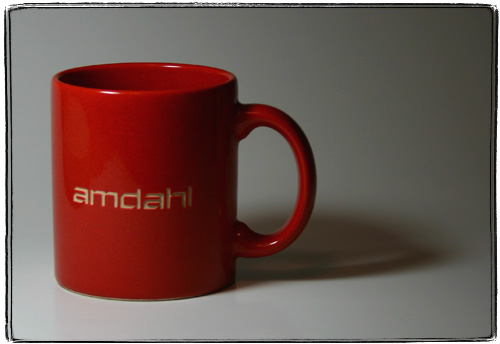
    The sheer existence of Amdahl was a huge boon to mainframe purchasing customers. The rumor was that if you placed an Amdahl mug on your table, IBM salespeople were gonna give you million dollar discounts.

    Let me present an artifact from my collection: the famous “Million Dollar Mug”:

  • White Paper, The Non-boring Kind

    As a deeply materialistic person I have a lot of various collectible kipple in my cubicle and at home. I like to brag about artifacts that I own, but often don’t because I am often ashamed of photos of them that I take.

    Well, no more. I thought about it for a while and realized that the best way to photograph my knick-knacks would be in sort of white background product catalog way. B&H has many fine lighting kits with domes, lights, boxes and backgrounds. I guess I’ll go there some day to pick one up after conferring with surly yarmulke wearing salespeople.

    Meanwhile I headed over to my nearest drugstore and purchased a large sheet of white construction paper. I propped it up against some books on my table, placed the first object to be photographed on it and pointed my daylight reading lamp on it. The trick to avoid reflections is to shoot from some distance with a zoom lens.

    Behold: an 1989 vintage (you can kind of see the date on the label) bottle of imported Soviet Pepsi in all its glory! Still full, and even seems to have some carbonation remaining. I bet for many of you this will bring back some memories as it does for me.

    Also see my posts about Soviet soda and soda machines if you missed them.

  • Absolut Subway

    There’s an ugly blotch on the ugly tile floor of the auxiliary vestibule of the Kings Highway Brighton line subway station. It’s been there for a while and I am not sure what it is – some sort of sticky dirt, duct tape or pigeon poop. All I know is that it could make an Absolut Vodka ad.

  • Of Sugar and Stamps

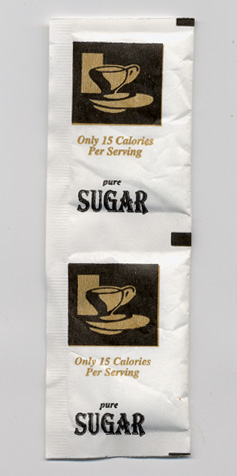
    Sugar producers must be reeling from the effects of low carbohydrate diets: how else you’d explained this shining example of sugar marketing that I found recently in my hotel room?

    That’s right – only 15 calories per serving! It’s a diet food!

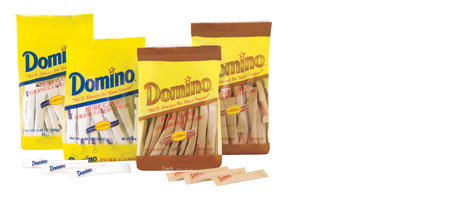
    I found another example of sugar marketing innovation in a grocery store where I shop – Dominos Sugar seems to have a wide variety of exotic sugar products, like Organic Sugar, Brownulated® Sugar (a perfectly cromulent word for high-tech brown sugar) and these ultracool sugar stick packets that upon closer examination turned out to be even more exotic:

    “Available in two varieties: pure cane granulated and Demerara – a golden brown crunchy sugar grown and harvested on the island of Mauritius, off the African Coast.”

    Ahhh, that set off a whole bunch of childhood memories for me. First of all, growing up in the Soviet Union where most sugar was made out of beets, upon reading about cane sugar in Mayne Reid’s books I thought it to be something super exotic, like the books themselves. Because of that I always associated it with America and adventure, and found the common explanation that cane sugar tasted exactly like beet sugar, except a bit less sweet, (which is indeed the cast) inadequate.

    Mayne Reid, by the way is one of that breed of writers that are extremely obscure in America, but famous in the former USSR. There Reid was considered to be on par with Jack London, just like Robert Sheckley enjoys popularity equal to that of Ray Bradbury. I mean, come on, Sheckly basically invented the concept of reality television, but this seems like a topic for a whole different post.

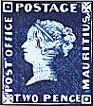
    Back to our exotic sugar. “Grown and harvested on the island of Mauritius”, huh? Generally horribly ignorant of geography I immediately recognized the isle of Mauritius as the location that produced two of the most famous rare stamps known as “Post Office Mauritius” stamps.

    The highly romantisized story goes something like this: the governor of the tiny British colony wanted to issue some of those newly invented “postal stamp” thingies and ordered a batch from local engraver Joseph Osmond Barnard. The engraver allegedly forgot what copy needed to go on the left side of the stamp and went looking for the postmaster. When he was approaching the post office, he suddenly remembered – “Post Office”, went back and put that on the stamp. The postmaster was massively pissed off – it should have said “Postage Paid”. Most of the stamps from the “error” batch went onto the governor’s wife’s fancy dinner invitations.

    There is a lot of controversy (read further down) weather “Post Office” was actually a mistake, but mistake or not, the story captured collectors’ imaginations and the invitation envelopes sell in multimillion dollar range today.

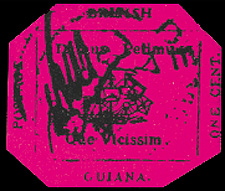
    The postmaster of nearby Mauritius used handstamps to “cancel” postage, but back in those days stamps were sometimes “cancelled” by hand, with a strike of a pen or sometimes with a signature. For instance, the postmaster of nearby colony of British Guiana placed his autograph on every single stamp along with a stamped “cancel”.

    His autograph on the famous “Penny Magenta” was sold for just under 1 million dollars in the nineties. What makes the story more interesting is that the original owner, Vernon Vaughan, 12, of Demerara (aha!), British Guiana sold the ugly, dirty stamp that had its corners clipped by somebody probably out of boredom, for an equivalent of a couple of bucks to a stamp dealer.

    I remember reading about the last sale in the philatelist magazine and wondering who the anonymous buyer was. Only now I learned that it was the crazy du Pont heir that was convicted of killing an Olympic wrestler.

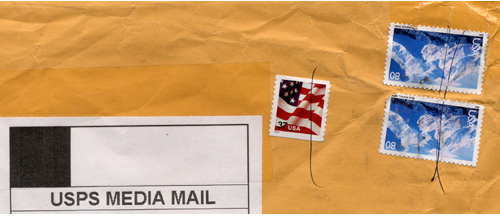
    In this age of book superstores and computer processed mail, recently I was pleasantly surprised to see a real pen “cancel” on an USPS parcel containing shipment of books from a small bookshop. Maybe there is no automatic sorting machine at that remote little town and the postmaster could not locate a handstamp :)

  • There’s No Cleopatra And There’s No Needle

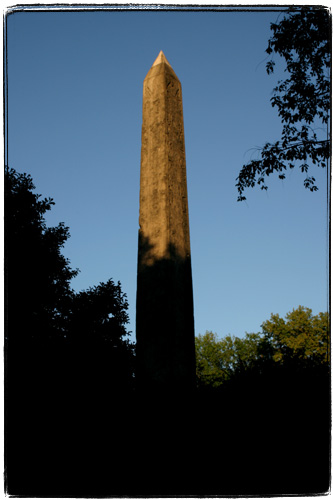
    Central Park contains an amazing artifact commonly referred to as “Cleopatra’s Needle”. It’s one of the many Egyptian obelisks scattered all around the world, and one of the two that used to stand in front of the Sun temple in Heliopolis. A second obelisk is located in London these days.

    In general, Egyptian obelisks were moved around the globe by different governments kind of like a college statues by drunken frat boys. The Romans moved the two Cleopatra’s Needles to Alexandria, and then as gifts from the Egyptians to the Great Britain and the US, the were moved by British and American engineers to their current locations. Overall the moves turned out to be amazing feats of engineering, especially with the British overcomplicated scheme of building a pontoon around the obelisk and towing it with another ship.

    You can find it right across from the Met, on the 5th Ave. side approximately between 81st and 82nd.

    The pillar does not give an impression of being an element of the Sun god’s temple. The 3500 year old monolith is gloomy, foreboding and downright Lovecraftian. The shadow play at sunset is especially spooky (that’s what I tried to capture in the above picture).

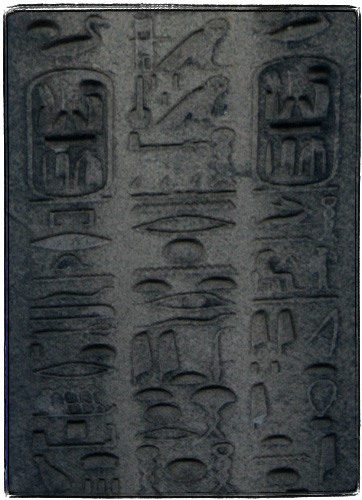
    Cleopatra has very little to do with either obelisks. They were built by king Tuthmosis III (well, the king probably had some help from his slaves). Later everybody’s favorite pharaoh, Ramses II, seeing how there was a lot of space left on the obelisks added some of his own “press releases” to it:

    The writing looks like a story of an alien abduction (with the flying saucers and wavy tractor beams), but as it turns out these are normal hieroglyphics. “Bird , Bird , Giant Eye … Cat Head , guy doing this” and so forth. I thought that there were thousands of glyphs, but it turns out that they are just an alphabet. So the flying saucers on the picture are “R” sounds, and the “tractor beam” is an “H”.

    I was surprised to see the pharaoh being referred to as “Lord of the Two Lands, User-maat-ra”. What was he a user of? Well, as it turns out all pharaohs have ridiculous system of 5 different names. I mean, come on, a Horus name and the Golden Horus Name!? (Horus happens to be the Sun god, the one with the falcon head ) User-maat-ra happens to be the throne name, the one that one that the Greeks transcribed as Ozymandias.

    So he’s the king from Percy Shelly’s “Ozymandias” sonnet. Yup, good ol’ Ramses was kind of like Donald Trump – liked to build things and put his names on things. Also, like a rockstar or an NBA superstar he had sex with hundreds of women, siring hundreds of children as Durex Ramses condoms were apparently not available back then. Last but not least he was apparently the “7 cows dream” and “let my people go” pharaoh of the Bible.

  • Victorian Prank 96 Years In The Making

    Here’s my latest eBay acquisition – a wonderful 96 year old postcard featuring currently 340 year old Van Pelt Manor (aka Van Pelt Mansion and Van Pelt Homestead) located at 18th Ave & 82nd St. in Brooklyn.

    Ethics of publishing other people photographs and letters are rather questionable to me. This seems to be a gray area. For instance I feel that many posts in found_objects, foundphotos and vintagephoto communities of photos that were ripped up and thrown out, or of embarrassing nature, or personal letters overstep some ethical guidelines. But on the other hand I enjoy them nevertheless.

    I don’t think that the writing on this postcard could likely hurt or embarrass anyone, so I decided that I’ll publish it.

    It came from someone at 182 Garfield place. A little note on the right says “look under the stamp”.

    On the back it says:
    New York is a great place, we are “Forty five minutes from Broadway”. Do you see “Kitty” very often. She ran away and never did say good-bye to me. Pump up your Airship and sail over to see me some evening soon.
    Youre “Soda Water Tessie”.

    The stamp was still attached. The mystery of what was under the stamp was solved rather quickly : being a stamp collector I know how to properly take stamps off. My wonderful espresso machine provided some steam and I carefully peeled back the 1 cent green Ben Franklin (Scott Catalogue # 300). “Was it hard to get off?” – the little prank that “Soda Water Tessie” pulled on Mr. Ray Feathers of Toledo, OH finally saw light of day 96 years later.

    I wonder, did Mr. Feathers actually own an airship?

    P.S. Taking stamps off is generally a capitally bad idea. Dang early collectors liked to steam off stamps so much that we have very few surviving stamps on envelopes (which are often referred to as “postal history”). “Postal history” items usually sell with a high multiplier to the value of every stamp on the envelope.

  • Still Round The Corner There May Wait A Restaurant or a Hidden Starbucks

    Advertising might be the engine of commerce, but there is a surprising number of NYC businesses are hidden inside skyscrapers with almost no indication of them on the outside.

    For instance, me and my co-workers often go to a Starbucks that is located in a lobby of a skyscraper. There is no sign outside, and inside you need to pass a security guy (who surprisingly lets you through) and turn a corner. I could not believe my eyes – you absolutely had to know where that Starbucks was.

    There is nothing special about our hidden Starbucks, except it is the closest one to us and the lines are usually shorter. They do have an old style La Marzocco machine not yet replaced by the new superautomatics, but the barrista has no idea about how to grind the coffee and tamp it properly. I guess they don’t teach that anymore at Starbucks U.

    There is a more interesting hidden place that we frequent. It’s a restaurant called Taam-Tov (46 West 47th Street, 4th floor 212-768-8001) which happens to be located on the fourth floor of a dumpy and decrepit art deco building in the middle of the Jewelry district on 47th street. To be fair I have to mention that there is a little sign on the step of a staircase that can be seen from outside. But you have to climb 8 flights of stairs, past dirty walls, an exposed phone comm. box and frequent full trash bags. There you will see an unmarked closed door and a small open order window.

    Alternatively you can enter a jewelry store on the first floor and take a tiny little elevator, which will deposit you inside the restaurant. I strongly discourage you from using it.

    Once me and three of my co-workers, one of whom is “portlier” than I am (and I am pretty “portly” myself), two have asthma and only one inhaler, despite my reluctance chose to take that tiny elevator. We let a bunch of people go up before us, waited for the elevator to come back and boarded it. Immediately what seemed to me like three shady looking Russian jewelers squeezed in after us. To my horror I noticed that in fact there was a fourth guy with them, just as sweaty and unshaven, but really short and skinny. Of course we got stuck between the floors and it took me and one of the jewelers few very uncomfortable minutes to figure out how to open the doors. Oh, and I forgot to mention – the co-worker who insisted the most on the elevator was not only slightly asthmatic, but a bit claustrophobic as well.

    Anyway, the place is rather unique. The patrons are mostly jewelers – you might see them exchanging large sums of money and gold or diamonds, but there are a lot of programmers from surrounding offices who also found that place somewhere. Since the place was featured in the last issue of Time Out New York dedicated to cheapest restaurants, there the mix will be a bit more eclectic in the future.

    The cuisine can be described as Middle Eastern/Russian, typical of the Baku region. Everything is cooked on site (in fact I’ve witnessed a small kitchen fire once that was quickly taken under control while everyone continued eating), kosher and very tasty. Shish kabobs are excellent (my favorite is rib kabob), so are soups. Just don’t ask for sour cream for your Borscht – and you can be sure that they don’t use Ukrainian pork fat. Other than that it’s very good. There are good salads, golubtsi, pelmeni, shawarma, etc. They even have kompot – Russian fruit punch and green tea served in small “piala” cups with sugar cubes (for drinking “vprikusku”).

    Over the years I had lunch at Taam Tov with my boss, my boss’ bosses there, my co-workers, three different livejournal users and many other people. And until I’ve read Time Out New York article I did not know that one floor below Taam Tov there’s a second hole in the wall restaurant called Sabor Latino.

  • Crouching Tourist, Hidden Bathroom

    One of the most annoying things about New York and many other American cities is the lack of pubic bathrooms. There are no paid privately ran WCs like in Europe, so tourists mostly rely on McDonalds and Starbucks stores for bathroomage (if it’s not a word, we have the technology to make it one).

    There are a few other esoteric choices like subway bathrooms – despite the popular wisdom that there are none, most terminal stations and big hubs have open bathrooms, which are scary and extremely dirty, but are sometimes functioning. In all of my years in NYC I wasn’t brave enough to actually use one. I have seen a few experimental high tech bathrooms, sort of 24th century port-o-johns around the city. The one that I used once had a five minute time limit after which the doors opened and the floor was automatically cleaned.

    But if you are to experience the NYC’s ultimate hidden, but public bathroom, you need to visit the Trump Tower (725 Fifth Avenue at 56th Street ). There is a doorman next to a set of doors that you can see swung open when an unlucky Apprentice is being expelled, but it’s not going to open for you. You need to enter through revolving doors reserved for regular shmoes. But inside you’ll find a huge pink marble lobby housing a public mall, complete with a multistoried lighted waterfall, Starbucks, Tower Records, a small booth hawking “You are fired” t-shirs and mugs, a bunch of luxury stores, a deli counter and – you guessed it – one of New York’s best public restrooms.

    Almost everything in the building is adorned with a “T” or with Turmp’s “family crest”. I was expected to see it on trashcans and urinals, but I guess The Donald did not want to go that far with branding. Men’s bathroom has grey marble surfaces and is well maintained. I expected it to be more lavish, but it is still better than the rest.