A photo of Gotham Police Department cars and a movie of the awful new batmobile courtesy of
The people responsible for Darren Aronovsky’s “Batman Year One” not happening deserve the ultimate punishment.
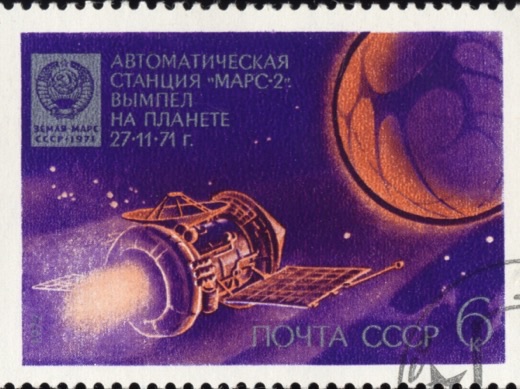
A photo of Gotham Police Department cars and a movie of the awful new batmobile courtesy of
The people responsible for Darren Aronovsky’s “Batman Year One” not happening deserve the ultimate punishment.
Oh, eBay, thy name is … (can’t think of anything). But I don’t have to. Think of an epithet for yourself. For just GBP 0.99 you can bid on the amazing Blog in a Box:
“ANYONE Can Create Their Own Blog Quickly AND Successfully Make A Profit, Even If They Have NO IDEA What A Blog Actually Is”

But wait, there’s more! If you order now, you’ll get “Resale Rights”!
At the office we have a pool on predicting tomorrow’s New York Post headline. My entry is “Gay Gov Greevy : I Quit”. Hmm, also could be “Geyvernator” or “Geyvernor”. Yep, I think I’ll stick with “Geyvernator”.
Update: Nope, not even close.

I had some of the best times of my life fishing in Odessa. There were two piers (jetties) that I frequented, the I and the L shaped one.
I probably fished the most on the I shaped pier. I must have known every little nook and cranny there.
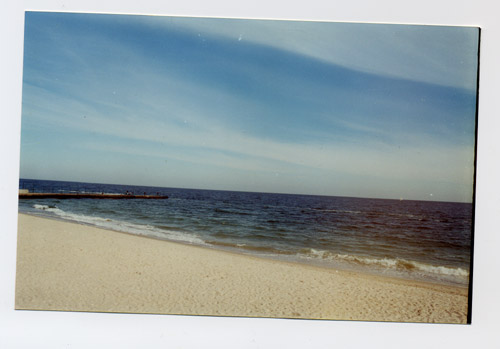
The L (Russian Г ) shaped pier for some reason had less fish around it, but allowed for fishing even in windy conditions – the water behind it was calm even when the wind was high.
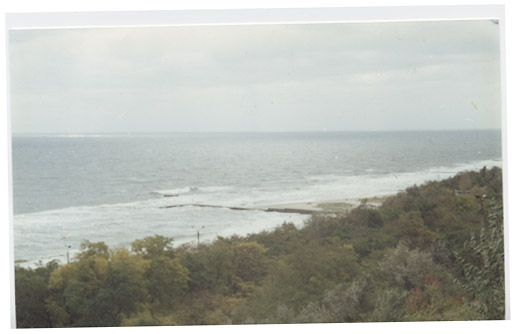
All the piers were connected by a wave breaker structure, an underwater wall that ran parallel to the shore and about half a meter below the surface. You could walk on it and fish from it. My father would not allow me to wear his waders because I could have drowned in them, so I had to spend many hours fishing from the wave breaker cold, wet, miserable and with feet cut up by mussels.
In theory you could walk on the wave breaker from the I pier, passing a few more piers and reaching a small cement platform a little bit higher than the L pier (it can barely be seen in the photograph). I never got there because there was a break in the wave breaker somewhere in the middle. I could easily swim over it, but for some reason that break always freaked me out, and I never reached that cement platform, although a lot of people did.
A few days ago I had a dream where I was looking at the little platform from the L pier.
These days I own some very serious espresso equipment. I am pretty much set with espresso. But one thing is still missing from my kitchen, and that’s a commercial soda fountain.
I do not own a car, which is one of the reasons why I have time and money to purchase the abovementioned espresso equipment. Not having a car, I hate lugging soda bottles from the store , hate running out of soda, hate having to drink warm soda because I forgot to put a few bottles into the fridge. The solution is rather simple – build my own soda fountain.
Indeed there are people crazy enough to put together soda fountains from parts bought on eBay. I might have a better espresso machine, but this guy, for example, has a bar style soda gun right in his kitchen:

This setup is pretty sweet as well :

If you read the explanation from the link above, building your own from eBay parts is a long and messy process, although the price will stay under $1000. There’s a company that sells prereconfigured units, but that costs about 3K. Also all of the soda machines take up a lot of cabinet space, and some require a separate ice cube maker.
I don’t have the time, space or money to attempt a project like this now. But there’s a low rent / low tech alternative called Soda Club. You have to chill bottles with water and then carbonate them in a small tabletop unit. I don’t know looks kind of similar to the iSi syphon and thus lame. Maybe I’ll try it.
Why, glass, of course. I hate soda sold in plastic bottles. Hate it, hate it, hate it.
Here in New York in many restaurants you can find Coke and rarely Pepsi in glass bottles. Yes, Coke in the original bottle shaped like the cacao tree seed pod instead of the coca seed. They are made in Mexico, I think
“She told me that they were bottled in Mexico and I nodded since I already knew that and said, “I think it is because they use real sugar.”
She shook her head, “No, no, not the sugar. It’s the water.”
She leaned in like she was telling me a secret, “Mexican water is the BEST water in the entire world.”
Just then a smaller woman leaned in beside her grinning with a single eyebrow raised and whispered.
“It’s MAGIC water!”
Apparently it is not Montezuma’s revenge that assails unsuspecting tourists, but the magic waters that sour in the bellies of the unimaginative, somewhere South of the border.”
Remember I mentioned Pepsy Crystal? People called it second New Coke, but I actually liked it. Well, these days it’s a bit more expensive – single can sells for $20-25 on eBay. Overall “coca cola unopened” and “pepsi unopened” bring back very interesting results.
Apparently they still make Moxie and Diet Moxie. Yep, the drink that gave us a word for “ability to face difficulty with spirit and courage“.
One of the chores that I had to do weekly when I was little was refilling two large soda syphons in a little kiosk a few blocks away from where we lived in Odessa. You can still buy a soda syphon today, but these are crummy tiny cartridge operated ones. Mine were big metal units that were refilled by what was probably a hundred year old machine operated by a cantankerous old dude or his equally cantankerous wife.
In the kiosk they also sold soda by the glass, adding syrup from a very interesting dispenser that operated on the same principle as a titration buret. The choice of syrups was the same as in soda vending machines.
Once, on a trip to Kiev, my father took me to an amazing giant shop that sold soda. They had a whole forest of those syrup dispensers, all different. The place was operated since before the revolution of 1917 (a huge rarity in the Soviet Union). I remember trying the most delicious tarragon flavored soda.
Actually a very delicious bottled tarragon soda was also sold in the Soviet Union under the brand name “Tarhun”.
Soviet soda was sold in glass bottles with crescent shaped labels. For some weird reason Pepsi was sometimes made available in different bottles with square labels. I’ve never seen a Soviet Coke bottle, but apparently they existed :

I had my first taste of Coke in Moscow in the late eighties in a theater’s concession stand.
The label above and the ones below are from the site of some dude who has an amazing collection of Soviet soda labels. he sells them at $2.50 a pop. I think I’ll buy some. Oooh, these bring back a lot of memories.


One of the neighborhood grocery stores here in Brooklyn once stocked very interesting plastic seltzer bottles from Brazil (I think) that operated as siphons. Iv’e never seen ones like that since.
While we are on the topic of vending machines, I gotta mention hacking.
I remember that a trick with a coin with a little hole attached to a string worked on Soviet payphones, but I don’t remember seeing it used on soda machines. I never tried it. Mr Krabs in a Spongebob cartoon about the origin of Krusty Krab did that, sot it’s probably an international “hack”.
At UGO one bright person tried to cheat the Coke machine out of a dollar by applying a long piece of scotch tape to the bill and trying to pull it back out once the machine swallowed it. This broke our subsidized 25 cent machine resulting in an office full of pissed off people. That cost the company a few hundred dollars.
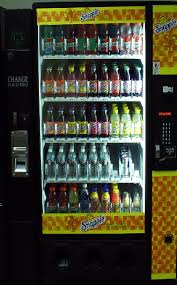
Then there was an interesting machine at iXL – one that dispenses glass bottles of Snapple. There are 5 shelves, and glass bottles fall down and somehow surviving. Somebody figured out that that particular machine checked if the bottle fell to the bottom before taking the money. If one stopped the bottle by holding a flap that swings to protect the dispensing box at the bottom, the machine was tricked into thinking that the bottle did not dispense and let the user make another selection. Everything was fine, but one not very bright individual caught one bottle with the flap and proceeded to drop a second bottle from the top shelf directly overhead. The dispensing bin was immediately filled by glass shards and Snapple.
 .
.
Some American soda machines have a hidden menu that can be activated by pressing drink buttons in the following order : 4 2 3 1. I activated it once by accident (the dang machine was out of everything) and only now found a reference to this online. Some snack food machine can be induced to show its internal temperature, but I don’t know the key combination.
The company where I work now used to have two presidents at the same time. One liked Coca Cola and another liked Pepsi. Because of that we used to have two vending machines. Now they are both gone and we have only one machine.
And last is but not least : a weird “hack” that some of my classmates used to trick a proprietor of a soda kiosk in Odessa. They cracked a broken fluorescent lamp open and rubbed the white residue found inside on a copper 2 kopek coin. The coin became silvery and could be easily passed off as a 15 kopek coin. What’s that white residue? Deadly mercury.
Here’s another memory of my childhood illustrated by a photograph by the author of Window Shopping in the (Evil?) Empire:

This is a Polish version of the Soviet soda vending machine, an amazing piece of technology.
During Perestroika we got a glimpse of foreign television during the Japanese TV week. If I remember correctly they showed an hour or two of selected Japanese TV shows on one of the three state-run stations. As a curiosity they showed a snippet in which Japanese reporters try to use one of these machines. Equipped with some change, giggling they approached the machine. They put one of the coins into the slot and were surprised by the jet of water from the dispensing nozzle. In Japan one of them explained, the glass drops down from the machine and fills with ice. Then they noticed the communal glass (a paneled one from the previous post) and for a few minutes tried to figure out how to wash it. Then they notices the indentation to the right of the machine. They stuck the glass in there and after a few tries washed it with in the mechanism that shoots little jest of water from underneath. Another coin – soda went into the glass correctly prompting shouts of triumph. I don’t remember if they were brave enough to drink it.

The prices were 1 kopek for plain seltzer and 3 kopeks for seltzer with a shot of syrup. Those with a sweet tooth liked to collect a few shots of syrup which was dispensed prior to the water (technically making it a post-mix machine) and then filling the glass completely. Unscrupulous machine maintainers liked to underdose the syrup helping them to steal some money.
Another one of bright memories was when my father, a civil engineer, took me to his construction site which had one of these soda machines that did not require a kopek to operate – you could drink as much as you wanted. There was no syrup water, but the refrigiration unit was hacked to make it much colder than the machines out in the street. Even visiting Microsoft which has commercial style refrigirators filled with free soda, juices and water did not impress me that much. Oh, and I also got to go up into the cabin of a huge crane (not at Microsoft of course).
Believe it or not, but the company that made these soda machines is still in business. They look like this now:

I’ve been thinking about soda (aka pop) a bit lately, so there’ll be a few soda related posts. Here’s the first one.
My childhood memories about soda come down to three things: Soviet drinking glasses, Soviet soda machines, soda siphons and the little booth in Odessa run by a cantankerous married pair.
The mass produced Soviet glass is a legendary piece of glassware. I took me a while to figure out how to translate the Russian word for this type of glassware – “граненый”. “Edged” immediately came to mind, but the proper term is “paneled”.
The Soviet paneled glass was designed in 1943 by the sculptor Vera Mukhina (best known for her sculpture “The Worker and Collective-Farm Girl” and it’s shape was possibly suggested by Kasimir Malevich (famous for his painting “Black Square“).
The author of the article linked above suggests that the popularity of the glass came from the fact that worker’s hands became accustomed to things with edges such as hexagonal nuts. The cheapness and robustness of the glass indeed made it very popular. So popular that is became a symbol of alcoholism in Russia after being featured in countless anti-alcoholism posters and cartoons.
There’s a similar glass that is popular in American restaurants, but it is a little different: the panels do not reach the top of the glass and they come in a number of sizes:

I bought 8 very similar glasses today since I gave up on looking for the real deal on eBay. Also this seems to be a similar glass used in Rocco’s restaurant, the subject of the show on which I am currently hooked.
