

Blog
-
RNC In NYC
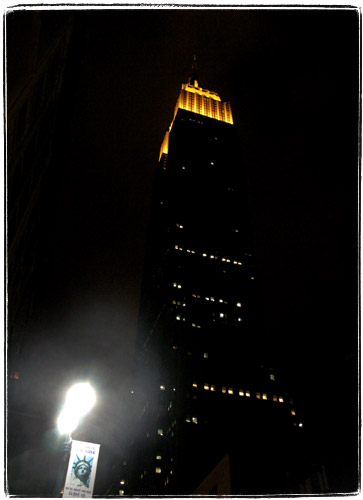
Conventioneering Fingerlicans and protesting Tastycrats are out in full force, but so many New Yorkers got out of the city that the streets are almost empty (by New York standards of course). In honor of those who left the city the Empire State Building was yellow yesterday (despite the fact that the official website says that it’s in honor of US Open).
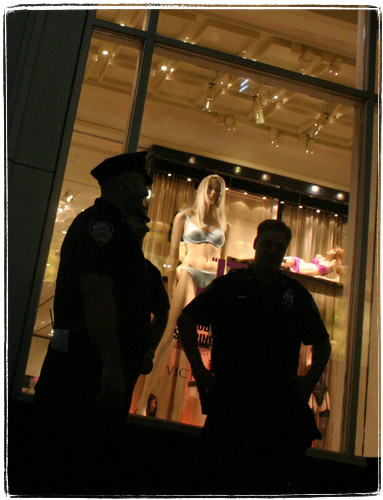
I’ve seen a lot of regular police officers and semi-military ones out before, but I haven’t seen such a concentration of police brass performing regular cop duties. There was a police lieutenant guarding the subway turnstiles, another lieutenant directing traffic and a captain guarding what looked like a normal transit bus with police “Christmas tree” on the roof filled with cages and lockers of assault rifles (and probably other stuff). They even posted a sergeant and a couple of cops to guard Victoria’s Secret (probably from Republicans who might want to find out what it is).
I took this picture because my wife was egging me on. Now she wants credit.
There was this cool bigbrothermobile driving around. Hey, it doesn’t matter if you are in a velo-rickshaw. You gotta get your 2 minutes of hate on.

-
And Then They Feed Them Plastic Doughnuts…
Not only snowmen are affected. Lane Bryant has some manequins that even
doesn’t have in his collection. And he has many of them, including one that looks like Pris.

-
/dev/sign
Ok, I am going to wallow in my geekiness. I went ahead and bought a Pro-Lite led marquee Model PL-M2014RV6 (aka Tru-ColorII ) on eBay for 150 hard earned American dollars.

I mounted it in my cube, connected it to the serial port of my computer and proceeded to hack together a perl script that talks to it. Easy enough. Then I innovated (in a Microsoft meaning of the word) – wrote a script that parses our weblogs and outputs what people search for on the marquee with fancy dissolve effects. Add a couple of lava lamps and it’ll be just like Googleplex.
I read up on Pro-Lite programming on this website, but ended up not using any of the code from there. Also some of the information there is outdated – the ROM on my sign is version 6.5
P.S. For those of you who are wondering, “tru” colors are: red, orange, yellow, lime (!) and green. They come in dim, normal and bright varieties, also rainbow, red/green, red on green and other combinations. All other colors are not “tru”.
-
Dream A Little Dream Of S-40
If you’ve been readin my journal for a while, you might know how important dreams are to me.
There are a lot of important and famous dreams recorded in history – Mendeleev seeing the periodic table; Kekule seeing the worm Oroborous and understanding the benzine ring; Chief Sitting Bull seeing soldiers falling upside down and predicting victory of the Little Big Horn, Hitler seeing the trench engulfed in molten lava in his dream and leaving it thus saving himself, Julius Caesar having a dream in which one website that will be left unnamed says “his mother appeared” and then “taking” Rome, etc.
Over the weekend I was reading Igor Sikorsky, His Three Careers in Aviation by Frank DeLear, and in it was an example of a forshadowing dream that I haven’t encountered before.
The book says that when he was 11 years old, Sikorsky had a dream in which he was standing in a narrow passageway. There was a bluish light overhead and the floor with a fine carpet under his feet. The floor was vibrating, but for some reason he immediately realized that it wasn’t a train or a boat, but a flying machine. He walked through to a door that led to a richly decorated lounge and then woke up. Since he was born in 1889, this would make it the year of 1900 when he had the dream. The Wright Brothers flight was three years away.
Years later, in America Sikorsky was walking through his latest design, the S-40 plane and was struck by a sense of deja vu. There it was, bluish light of fluorescent lamps overhead, the vibration and the fine carpet and even the smoking lounge at the end.
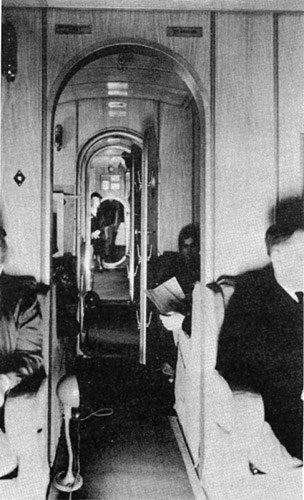
(the photo is from Igor Sikorsky, His Three Careers in Aviation) by Frank DeLear
Next in my reading queue: John C. Wright’s The Last Guardian of Everness – a fantasy that deals with dream worlds and such. Figures.
-
The Ugliest Building In Brooklyn
Inspired by Howard Kunstler’s Eyesore of the Month, which currently features Frank Gehry’s Museum of Tolerance that looks like robot’s puke , I decided to start my own section on architectural monstrosities.
Behold – The Six of Diamonds Building.

Just the first look at it puzzled me immediatly. Is this a residential or a commercial building? How many floors are there in the structure? What is the function of the small square windows on the facade? Is there a windowless torture chamber on the top floor beautified with the green diamonds? It seems like pepto-bismol would have been a better choice of color, but then that’s probably what it was before fading out.
-
WML : Screw You, Computer Hardware Manufacturers!
Continuing with the screw theme, let me share with you another piece of fastener lore that I’ve learned over the year. As any person who ever cut her hands on ragged edges of cheaply made computer cases knows, when you buy a filthy overpriced little baggy of computer screws there’s a weird and confusing variety inside.
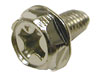
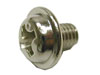
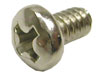
Here are the most common, left to right: chassi screw, cd-rom screw, floppy screw and hard disk screw. Now here’s the confusing part – The hex headed chassi screw is a bit bigger than the very similar cd rom screw. But the soft metal of computer components makes it possible to use it to fasten everything – floppy drives, cd roms, hard disks. It is the most useful screw of the four. I get the feeling that the hard drive screw is just a tad bigger, which makes it almost as useful, but it will get stuck if you try to attach a floppy drive with it. The cd rom screw and the floppy screws are next to useless – without knowing the proper type of screw to use, most people already embiggened the holes with chassis screws, and the little cd rom screws end up pretending to go in, but then falling out. They end up filling up all the useful space in the little box where I store my accumulation of computer screws.
Since I mostly buy cases with motherboards already mounted in them, I am not going to delve into the whole plastic vs. metal motherboard standoffs. I’ll just mention that the metal ones sometimes cause shorts by themselves, and plastic ones are sometimes not strong enough to prevent shorts from flexing. There, I said it. Now I’ll merrily continue my screw rant.
But at least the computer screw weirdness makes peoples life harder not on purpose. But some fancy pants computer (cough Hpaq cough) and consumer device (cough TIVO cough) manufacturers use torx screws and tamper proof torx screws. For that exact reason I own a whole bunch of torx screwdrivers. That is a bit sneaky.

But not as sneaky as the hardcore tamper proof screws made by Tamperproof Screw Company of New York:


Snake Eyes®, which I see a lot in elevator button panels, Tri-Wing® that I hear is used in GameboyTM devices, OpsitTM, which is which is built to make mockery of the holy mantra of “Righty Tighty, Lefty Loosey” – it tightens conterclockwise (just like MTA lightbulbs). Тhere are other weird things like philips or torx screws with a pin in the middle and one way screws.
Also there seem to be a whole bunch of Pozidriv screws around. I think that the last cam out fiasco that I had was caused by me trying to use a Pozidriv bit on a Philips screw or the other way around. It’s very hard to tell them apart. Luckily I had screw drill out set similar to this one. It works ok on easy cases, but for every screw that I remove with it there seem to be a couple where I end up just completely breaking down the head of the screw leaving the rest under surface.
Wow, it looks like Philips screw company has special aerospace screws, like this wicked looking ACR Torq-Set. I would be way cool to get a box of those.
This is just like one of my favorite Russian sayings – “Ð?а каждую хитрую жопу еÑ?Ñ‚ÑŒ хуй Ñ? винтом. Ð?а каждый хуй Ñ? винтом найдётÑ?Ñ? жопа Ñ? лабиринтом”.
-
WML : Fasteners Are Engineer’s Best Friend
While we are on the subject of screws, here’s another thing that I learned about fasteners. As any know-it-all who pays attention to things like that I looked up why screws with what we called cross-shaped screws in the USSR are called Philips screws in the US (I wonder what they call them in other countries) are called so. Of course the answer was one web search away in the Straight Dope Classic Why did this guy Phillips think we needed a new type of screw?
I also purchased One Good Turn: A Natural History of the Screwdriver and the Screw used at Amazon. I learned that the screw and the screwdriver is a rather recent invention, interestigly enough one of the very few tools not known to the ancient Chinese.
Useless trivia aside, I hate both slotted and Phillips screws. Of course I would not even think of using slotted screws for anything other than period-correct Craftsman style or Art Deco hardware such as cabinet pulls or outlet covers. But the common Phillips screws, with their falling off from the bit (even the magnetic one) and stripping (not the good bachelor party kind) drive me absolutely nuts.
The solution? I bought a couple of boxes of hybrid Phillips/square screws from Rockler. You can use the regular Philips driver, or you can use a special square one. The benefit of a square bit is that the screw does not fall of the bit and does not strip easily. The kit also includes a bottle of suggestively named Rockler Screw-Lube. The paper box is rather sucky and unusable – the partitions lift up and the screws mix.


-
WML : Mr. Squeek No More
Here’s yet another edition of WML – What Michael Learned. And the subject of today’s post is one of the things that I hate as much as I love hardwood parquet floors – squeaks. In SAT-speak I am somewhat corpulent and nocturnal. And a sonorous squeak of a parquet floor in the dead of the night is not one of my favorite sounds. I am certainly not one of those people who think that squeakiness adds character to an old floor.
A few years ago I searched for a way to repair squeaky floors and kept finding advice for those who could access the floor from below – in cases of houses with basements that expose the underside of the upper floors. Then recently I found a solution in an episode of Ask This Old House that works for me. It is marketed as “Squeeeeek No More“. That’s right – 5 e’s. Luckily Google suggests the “correct” spelling even if you use less e’s.
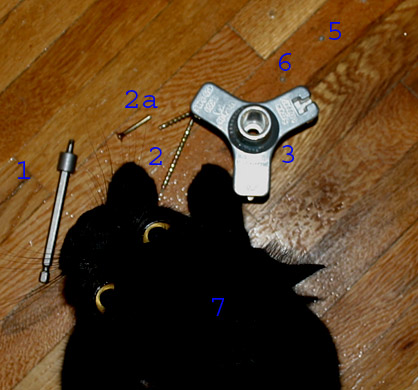
I bought my kit over here. It came with 50 snap-off screws, a square driver bit, a special stud finder screw (he heh) and a depth control/snap-off tool that looks like a Klingon weapon or instrument of torture.
Here’s how it works :
First of all you shoo away the cat (7). Then you need to find a parquet plank that squeaks. You do that by first finding the general location of the squeek and then with your foot sideways pressing on individual planks. Usually it’s only one or two loose planks that generate the noise when they move. Each one of the planks is nailed individually and it’s the nails that make the sound . You don’t need to worry about finding a stud – just drill a few pilot holes (so that the wood won’t split). Then using the square driver bit (1) you drive the screw (2) a few turns into the pilot hole. Then you drop a depth tool (3) over the top of the screw and continue driving the screw into the floor with the driver bit. The driver bit has a fat section at the bottom which will prevent it from driving the screw further than necessary when used with the depth tool.Then you use a T-shaped hole in the depth tool to gently break off the head of the screw (2a) by rocking it side to side. The screw will break off under the surface of the wood leaving a small hole (5) and (6) in the floor that can be filled in with wood repair sticks.
I found that it takes about three to five screws per squeaky plank. The Klingon device is not really necessary for parquet floors without carpets. The screw breaks easily with the tool, and doesn’t when you screw it in. It would be a good idea to practice on some scrap wood (which I didn’t do of course), but I’ve had no accidental snapoffs so far. It would become a problem if the screw would break off above the surface. I guess the best way to fix that would be to pound the crew in with a nail set (which is not an easy matter for sure). If you do not predrill the hole a split in the plank would not be an easy fix as well. On the plus side, the holes are not very visible even unfilled. I guess the best time to do this fix would be right before floor refinishing.
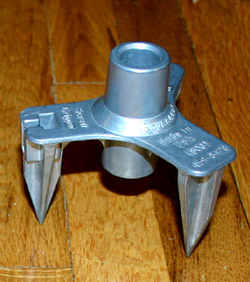
There is a cheaper version of the kit marketed as “Countersnap“, which seems to be exactly the same thing, except the depth/snap-off tool that comes with it can’t be used on carpets. Actually I think that’s the one I’ve seen Tommy use on Ask TOH.

Of course this system will not work for people with radiant floor heating, pipes and electric wires that run under the floor, super expensive museum quality floors with highly polished astronomical mirror grade finishes and landlords who do not allow driving screws into the wooden floors no matter how squeaky you or the floor gets.
Oh, right. 50 deadprogrammerTM points to the reader who can tell me the sci-fi author who inspired the title.

