Author: deadprogrammer

  • Soviet Realism In The Subway

    During its renovation Times Square seems to have been steadily acquiring the biggest and ugliest modern mosaics. The architects seem to have forseen the ugliness of the mosaics and strategically used lighting with a lot of glare to mercifully obscure the them from view. Still, even ugly Soviet Realism style “The Return of Spring” by Jack Beal is a little better than water stained cracked tile.

    Looking more closely though, some weird details become apparent. First of all, what is the guy with the hammer going to hit? Looks like one of the three guys in front of him. Also it looks like they are prying open a manhole, but it takes only one guy usually and they use a tool like this. The guy with a jackhammer seems intent on injuring the guy next to him too.

    But what is going on with this guy’s hand?

  • Kora Music In The Land Of The Stainless Steel Worm

    Jaili Kandjia Cissoko, African Criot (Bard), Kora Player, Soloist Composer in NYC Subway’s Times Square station.

    This is an illustration to my earlier article about Cora music. As Mr. Cissoko unfortunately doen’st have any cds of his own, your best bet of experiencing Cora music is either to seek him out in the subway or listening to one of these cds:

    Djelika is my favorite, I absolutely love the title song that is based on the melody from The Good, The Bad and the Ugly.

  • Raiding the Foodmotron

    I am endlessly fascinated with vending machines, and being my old semi-autistic self like to study their contents. These days, trying to fight my way out of being overweight, the only thing I ever consume out of them is peanuts or trail mix. Still, I am amazed at how hard it is to get anything remotely healthy out of them.

    I’ve seen an article once that described how to get a balanced meal out of a vending machine. All I have to say to that is – “Ha!”. So in the spirit of exploration I decided to figure out what is the single most unhealthy item you can get from them.

    The placement of items in most of machines that I’ve seen at different workplaces follows the same pattern. Chips at the top, various snacks in the middle and ultrascary stuff at the bottom. The very last minirow is usually reserved for dried out rolls of lifesavers and gum.

    The ultrascary items are the ones that I am interested in here. I have to admit that in the dot com years a consumed a couple of items from there. In fact I had a manager who publicly admitted his addiction to “Black Forrest Brownies” located there. I looked at the wrapper of the brownies and was absolutely scared of the fact that somebody managed to stick that much high calory crud into such a small package.

    I checked the machine at work and promptly started the collection of scary vending machine food wrappers. I present to you the current champion:

    The little “Eddie” character looks a little creepy, doesn’t he?

    Wow, 40 grams of fat and 61 grams of carbs. Food of the gods!

    I dare you to find something less healthy in your vending machine. If you do and send me a scan of the package I will send you a nice set of 3d photos of New York that I took and 3d glasses to view them.

  • Deadprogrammer.com is Moving

    Once again instead of writing something good for you to read I am changing my blogging software. Movable Type was a little better than Livejournal, but looks like WordPress is the right tool for me.

    It will take some time for me to fix the feeds, lins, etc, so bear with me for a while.

  • Side Effects Of Programming

    “Nelson: Ah, he’s the greatest showman since that kid who eats worms!
    Kid Who Eats Worms: My 15 minutes of fame are over!”
    The Simpsons, Episode 3G02

    The post about Durian seems to have been the most popular one in the recent history of deadprogrammer.com . This once again proves that eating gross things is entertaining to the masses. To prevent the surging popularity of my blog I absolutely must write a little bit about something that I almost never write about. Programming.

    My co-worker who could not understand why he could not increment a variable in XSLT found an amazing piece of technical writing in an O’Reilly book about XSLT. Here it is:

    “Although these XSLT variables are called variables, they’re not variables in the traditional sense of procedural programming languages like C++ or Java. Remember that earlier we said one goal behind the design of the stylesheet language is to avoid side effects in execution? Well, one of the most common side effects used in most procedural languages is changing the value of a variable. If we write our stylesheet so that the results depend on the varying values of different variables, the stylesheet engine would be forced to evaluate the templates in a certain order.

    XSLT variables are more like variables in the traditional mathematical sense. In mathematics, we can define a function called square(x) that returns the value of a number (represented by x) multiplied by itself. In other words, square(2.5) returns 6.25. In this context, we understand that x can be any number; we also understand that the square function can’t change the value of x.

    It takes a while to get used to this concept, but you’ll get there. Trust me on this.”

    (full text here)

    The quote that I highlighted in bold absolutely gets me. Yeah, that’s one good side effect. I get the feeling that XSLT was committee designed with the specific purpose to make life miserable for programmers. Also that committee must have had some really good stuff to smoke.

    Update
    Uh, see, now this is what happens when you try to write programs without actually understanding computer science fundamentals. I did not realize that XSLT was functional, not procedural. Like most mediocre programmers out there I was not exposed to much functional programming (I did try to teach myself Lisp, but quickly gave up). Having to do a lot of SQL(which is near-procedural) over the years improved my understanding of functional programming, but not enough to realize what the XSLT book was talking about (reading it from beginning would have been helpful too). Now hardware XSLT accelerators, which made me laugh when I first heard about them, make sense too.

  • Ach, Mate, Say “Australian for Beer”. Please?

    I have a friend who married a Scot and moved away to Scotland. In fact marrying men from exotic locales seems to be a trend amongst my female Russian friends – another one married an Australian.

    It’s almost ironic that my favorite bar in New York is a Scottish bar called St. Andrews (which is also a place in Scotland where my friend used to live). St. Andrews the bar is characterized by an amazing selection of whisky, good atmosphere, good food (there’s a restaurant in the back), moderate prices and friendly kilt-wearing waiters with Scottish accents.

    Recently I braced myself and ordered haggis. It’s a widely known “scary” dish which is a sausage made out of various organ meats. It is served with obscene sounding “neeps and tatties” (mashed turnips and potatoes).

    At St. Andrews it was served the following way : a layer of the abovementioned “neeps and tatties”, then a layer of contents of haggis sausage (which is somewhat similar in texture to ground hamburger), then another layer of “neeps and tatties”.

    It certainly did not smell as some cartoons would make you believe. In fact it was very tasty. The puree/meat combination was very nice. The haggis itself tasted like very tasty hamburger. Low grade meats rule!

    St. Andrews bar is located at 120 W 44th St, Between 6th & Broadway.

    The most exotic Australian thing that I had was kangaroo jerky that my friend brought me from her trip to Australia. It tasted a lot like chicken jerky :)

  • Looking at Design.ru and Remembering Dot Com Ads

    I was browsing http://www.design.ru and a few associations formed in my mind.

    Latest set of images with quotes from Tema remind me of Kenneth Cole ads with obligatory quote from Mr. Cole himself. By the way, I am glad to see that kennethcole.com is back to an almost original state similar to what it was when I worked on it, from a horrible flash monster that it became later. I’ve met Kenneth Cole at the time, maybe I’ll meet Lebedev some day too.

    Illustrations by Yana Moskalyuk look to me as if Lavalife.com ads mated with Bluefly.com ads. It’s interesting to see that bluefly.com is still around. I only bought something from there once, when they were giving away $50 gift certificates.

  • Can You Smell What Deadprogrammer’s Cooking?

    And now welcome to yet another edition of “Gastronomic Adventures with Deadprogrammer”. Since I wrote previous installments I’ve noticed that I am not the only blogger who takes the time to purchase and eat weird stuff. The Sneeze is home to outstanding section called “Steve, Don’t Eat It!”

    I’ve read an article (though I can’t remember who wrote it) about the fact that many gourmet foods are initially repulsive to most people. The first signal your brain sends you when your are having oysters, stinky cheese, scotch or caviar is “Dude! This stuff is spoiled, spit it out right now!”. But then, you consciously think, “Come on, brain, this is 25 year old Talisker we are having here. I just paid $225 for the bottle, you better relax and try to enjoy it. Yes, I know that it tastes like peat a little bit. It’s supposed to. It’s a good thing”.

    The ultimate gourmet food for which you need to fight with your brain is Durian. Available in most oriental stores in New York, this pointy skinned exotic fruit is widely known for smelling awful but tasting heavenly.

    Recently I purchased one on my trip to Avenue U, which is more and more becoming Brooklyn’s Chinatown. Here it is, sitting innocently on my Naked Chef-style cutting board.
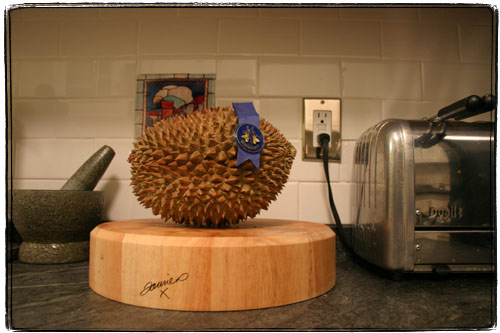
    When you cut it with a knife, you find several sections filled with custard-like flesh and big seeds.
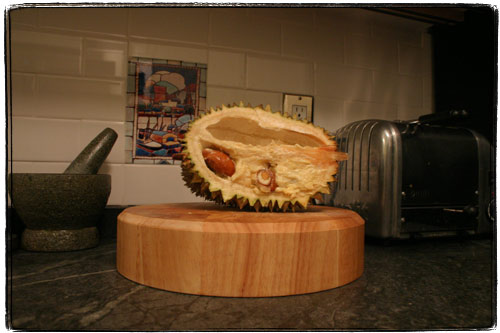
    I have to say that the smell was not as horrible as most places describe it. It was definitely odd, somewhat unpleasant, but not completely overpowering. I found it similar in strength and quality to the smell of expensive sulfur spring mineral water that you might find in many resorts. Nothing even close to the horrors that you might find in any article describing Durian on the web.

    The taste and texture of the fruit flesh was absolutely great. It had the texture and sweetness of a creamy custard, very smooth and buttery, tasting somewhat like pineapple, lemon and banana at the same time. It was very sweet, but not in a nauseating way. An absolutely unique taste, very, very exotic.

    I can also happy to report not having any gas or any other digestive problems widely reported as associated with the fruit in question. On the other hand I did not eat the entire thing as I am still trying to watch my carbohydrate intake.

    Apparently picking Durian is sort of a hit and miss experience. I had the most expensive kind my store had, an 89 cent/lb Mornthong variety. There are other varieties that are maybe stronger smelling and of lesser quality.

  • Objectivist Living With Style

    A Curbed article about the new “tower of penthouses” tower reminded me of the Enright House in Rand’s “The Fountainhead”:

    He stopped. He saw the reproduction of a drawing: the Enright House by Howard Roark.

    He did not need to see the caption or the brusque signature in the corner of the sketch; he knew that no one else had conceived that house and he knew the manner of drawing, serene and violent at once, the pencil lines like high-tension wires on the paper, slender and innocent to see, but not to be touched. It was a structure on a broad pace by the East River. He did not grasp it as a building, at first glance, but as a rising mass of rock crystal. There was the same severe, mathematical order holding together a free, fantastic growth; straight lines and clean angles, space slashed with a knife, yet in a harmony of formation as delicate as the work of a jeweler; an incredible variety of shapes, each separate unit unrepeated, but leading inevitably to the next one and to the whole; so that the future inhabitants were to have, not a square cage out of a square pile of cages, but each a single house held to the other houses like a single crystal to the side of a rock.

    Yeah, I guess Mr. Calatrava is no Mr. Roark. But still, kudos to him for trying.

  • iPhoto Retro or John Sculley’s Gift To The World of Photography

    I collect 20th century technology antiques. They are not expensive and don’t take up much space – perfect for my cubicle museum.

    My shelf at work houses a small, but growing collection of monstrous early cellphones. There are a couple of gigantic vacuum tubes (some from an early Univac), a core memory plane, a multiprocessor unit from an Amdahl mainframe, a weird hardwired logic unit from a forgotten computing machine. My latest purchase is rather interesting – the first consumer digital camera.

    A $700 piece of equipment in 1994 Apple Quicktake 100 cameras sell for just a few bucks on eBay. I first saw one mentioned in this outstanding livejournal post. This guy’s camera still had some images in it which provided a weird time tunnel into some office party in 1994. I guess the people in the photos were celebrating extravagant Mac purchases.

    I bought two cameras on eBay for just a few bucks each, and one came with a cable and a floppy with PC software. Not even hoping that it’d work I plugged in the serial cable, installed the software on my Win 2000 machine, turned on the camera and ran the program. It worked the first time.

    Here are the two Apple QuickTake 100’s that I purchased. I bought two so I could take stereo images and view them on my 100 year old stereoscope. In a couple of years I think I’ll be able to buy a couple of iPod photo thingies for a few bucks and do what this guy did.

    Times Square at night in full .3 megapixel power (compressed to 500 width).

    Times Square at night with lower resolution option turned on

    Snow storm in Brooklyn

    Considering how difficult lighting conditions were the results are respectable. Usability wise these cameras are lacking. Even though they look like those binoculars from Star Wars movies, they have a very nasty lens cover that is very hard to open without leaving a nice fingerprint on the lens. Taking portrait orientated pictures is rather hard.

    So here I am, paying tribute to one of the last Apple products of John Sculley’s era at Apple (note how Apple CEOs are arranged in a timeline at Wikipedia – just like kings). I wonder if Steve Jobs will ever consider making an Apple digital camera. So far the fate of Apple Newton shows that to Jobs anything ever touched by Sculley is taboo.