Author: deadprogrammer

  • Thinking About the Future

    My father-in-law once told me about a group of young guys, all from orphanages, that he met when he served in the Soviet Army. Those kids would talk for hours and hours about retiring on the government pension. I am a little bit like that too – I like to plan my retirement.

    One thing that I’ll do then is write a series of science fiction stories, probably in graphic novel format. Since it might very well be that all the things that I squirrel away in my notes might come true by the time I retire, let me share with you some of my world building.

    The protagonist’s name is John van Nostrand (after a Brooklyn street name). He’s a space pilot from future Brooklyn (or alternative past). His antagonists are pilot Naru Nan, underhero Jackson, supervisor Coder Jones and inspector Rublev. I haven’t worked out the characters much yet.

    Some notes about the future/alternative past. A series of technological breakthroughs accomplished the following:

    Sleep is not necessary anymore. Thanks to a wonder drug or a surgical implant of some sort people no longer have to spend 8 hours sleeping. Sleep becomes optional, and a sort of entertainment, as an REM inducing machine can produce vivid and even lucid dreams on demand.

    Total domination of bacteria and viruses through biotechnological means (no nanotech though). This in turn leads to a revolution in cooking (among other things). It becomes perfectly safe to eat all foods raw. Cooking a steak, for instance becomes mechanized. Lasers sear the outside, while inside can stay pretty raw. Overall, a specialized food computers are used. They can laser-sear, microwave, dry out, mince, liquefy and wrap in special membranes and capsules and produce all sorts of futuristic foods. Many techniques involve “jet printing” ingredients.

    Bathing is now optional, a sort of relaxation as well. A special membranous symbiont is genetically engineered to live inside people’s skins and consumes sweat and toxins.

    Buildings are built by the jet printing method with titanium-containing alloy for strength, as well as slew of ceramic and other materials for insulation and decoration. Ridiculously tall and strong skyscrapers result.

    Huge space cities are built out of towed metallic asteroids, again through jet printing. Real estate on Earth and in space is spectacular.

    I still have many things to decide upon, such as the mode of space travel, politics, and a million other things. There will be no aliens or interstellar travel though. I’m pretty sure about that.

  • Some Soundbites

    Chatting with Joe Grossberg today I mentioned that I really don’t understand why so many people read Scripting News. I tried reading it many times, and it always bored me to death. Joe gave me a perfectly good analogy:

    it’s like trying to figure out why German people listen to David Hasselhoff

    Also, I came upon a nice quote in Mike Meginnis’ interview with Jeffrey Rowland:

    You mentioned viral marketing, and that’s something interesting about the ‘net. It really promotes artists who are skilled at making things that people will basically shout at each other over AIM.

    Now I think I understand why my own blog is not particularly popular :) Also, I could not help, but remember a Futurama episode:

    Farnsworth: Look, it started out as a calculated plot to rummage through your underwear. But once I got in there, I found more — much more. And now I want to shout our love from the rooftops. Perhaps I’ll breed some sort of albino shouting gorilla.”

  • Trump Brand – Down The Toilet

    Donald Trump really takes care of the details. The man and the brand – they are inseparable. Here’s what he’s writing in his blog:

    “If I were to put “Trump” on everything that came my way – from potato chips to paper clips – the power of my name would be diluted. I’m very demanding and selective about where that name goes. And I always try to make sure the letters are in gold.

    I was at the Trump Tower recently – I came in to use the bathroom, as he keeps one of the cleanest public bathrooms in the city (I wrote about it in Crouching Tourist, Hidden Bathroom). I felt kind of guilty about mooching of the Donald, so I decided to buy one of the mugs (sold in a little stand near the bathrooms).

    Upon examining it at home, I realized that my dreams of drinking latte out of a snazzy mug with Trump’s “family crest” were shattered. Here’s what I found at the bottom:

    By the way, if I were Trump, I would kick out Starbucks out of the Tower and invite Joe The Art of Coffee.

  • Japanese Brooklyn

    Victorian Brooklyn is amazingly beautiful. In Victorian times skilled labour and land was cheaper than it is today and wealthy people were able to build really elaborate and architecturally significant residences rather than Mc Masions of today.

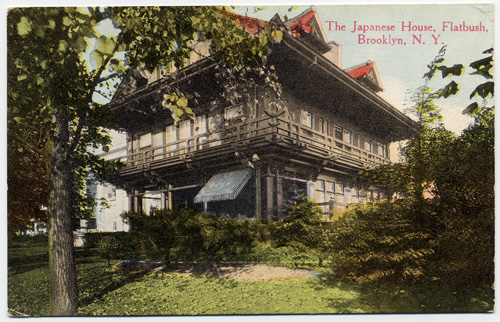
    In a big lot of old postcards that I picked up on eBay I found this – a postcard featuring “The Japanese House, Flatbush, N. Y.” It looks like this wasn’t the only time this house was featured on a postcard: here’s another one.

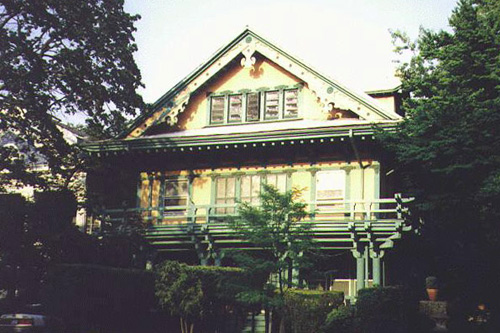
    Don Wiss of the Brooklyn photo store photo fame graciously allowed me to use his picture of the Japanese House, which turned out to be
    Frederick S. Kolle House at 131 Buckingham Road.


    Here are Don’s notes, mostly gleaned from the AIA Guide to New York City.

    I did a little bit more digging and found a New York Times article, which somehow is fully available.

    The house was built by a developer in order to promote Prospect Park area.

    Alvord advertised the house in Country Life in America in the summer of 1903, calling it ”a faithful reflection of the dainty Japanese art from which America is learning so much.” But the house was ”thoroughly practical,” the ad continued, with a ”porcelain Roman bathtub, also needle and shower baths,” and a 22-minute commute to Park Row. It was offered at $26,500.

    According to this calculator that translates to somewhere between 600K if you use Consumer Price index to 12 million if you use the relative share of GDP. Stupid Zillow is showing values in $1 million range, which is of course very wrong. I suspect that the current value of the house is much closer to the GDP share range :)

    The NYT article goes on to say that Dr. Kolle, the first owner of the house was a pioneering radiologist. It seems like he purchased the house on the cheap after the unusualness of it did not attract many bidders. Also, in 97 the house used to belong (and probably still does) to the director of Flatbush Development Corporation who bought the house in the 70s.

    The following quote made me drool:

    “Except for the kitchen, the ground floor interior of the Fischers’ house is completely intact, with dragon figures in the stained-glass windows, Japanese decorative detail around the fireplace and a definite feeling of thinness to the partitions — there are leaded glass windows between the sitting and dining rooms. The Fischers have furnished the house with an eclectic mix of furniture and artwork, from Belter to Bauhaus, as well as memorabilia from the Kolle family.”

    Apparently the Flatbush Development corporation is holding a Victorian House Tour, that at least in 97 featured the Japanese House as one of the stops. I wonder if they still do – I’d love to see it.

    Looking at the butt-ugly condos and renovation in McMansion syle that I see all over, I can’t help but think – will they build houses that are postcard-worthy again in Brooklyn?

  • Deadprogrammer Visits Japan Part III : Monk Money

    Money-making schemes are a on my mind a lot lately, so here’s a little bit about ingenious schemes by which Japanese monks are raising money.

    As I don’t have much understanding of Buddhism and Shinto, Japanese temples did not leave much impression upon me. After a while, they all started to look alike. One common element was the fundraising gimmicks used by the monks which I found rather ingenious.

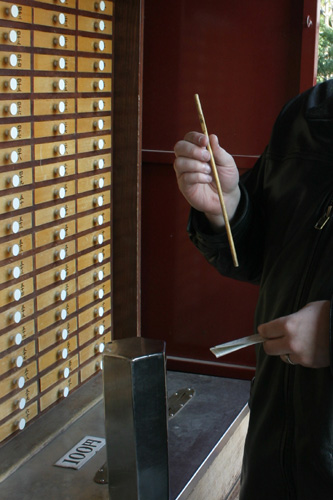
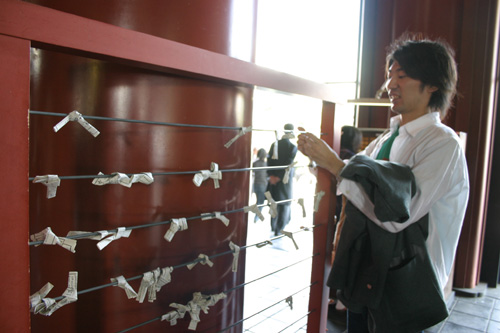
    First up, there’s omikuji, literally “sacred lottery.” You deposit a 100 yen (about $1) coin in a slot (on an honor system), shake a metal container with wooden stick marked with a hieroglyph (probably a number), match it up to a drawer and take out a sheet of paper. The fortunes contain a variety of outcomes, from blessing – dai-kichi (now I know what Daikichi Sushi restaurants are named after:), through lesser forchunes such as near-small-blessing, sue-shō-kichi, and to great curse – dai-kyō.

    The genius of the system is that if you don’t like your fortune, you can tie it on special pine planks (according to Wikipedia it’s a pun – “pine tree” is “matsu” and “to wait” is “matsu”). Then you can try again.

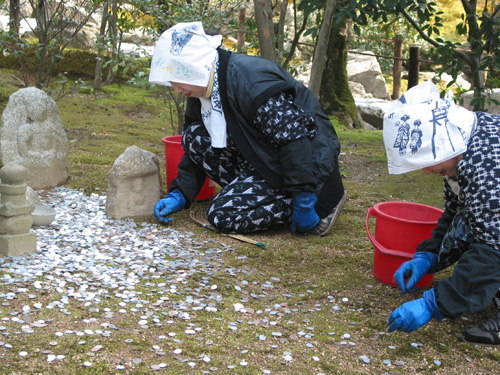
    Somewhere, I think it was near Ryoan-ji Temple I encountered this attraction. A little statue of a deity with a little bowl next to it. From what I understand, you need to throw a coin into the bowl for good luck. As you can see, it’s not too easy. My wife managed to get a 5 yen coin in though.

    Here are temple workers collecting the bounty. They even have little bamboo rakes!

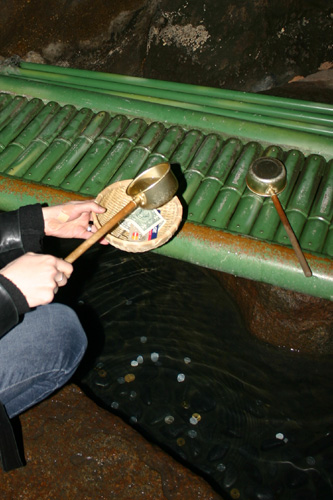
    Then there’s Zeniarai Benten Shrine, where you can rent a special basket to wash your money is an underground spring, that is supposed to double your money. I hope washing a banking card works too :)

    I’d like to finish this with a little news item that I pulled from Mainichi news: Man who stole 2 yen from shrine sentenced to 22 months behind bars. A yen is about 1 cent. Pretty rough, eh? Well, the article goes on to say that he also stole some batteries…

  • Public Service Announcement: Metro’s Best Concert Series

    A kind reader alerted me to Metro’s Best series of concerts at Jamaica Center for Arts & Learning:

    METRO’S BEST
    Saturday afternoons at 3pm
    The “Metro’s Best” series features some of the finest musical performers discovered under the city of New York. All performers in our series are professional musicians who were sanctioned by the Metropolitan Transportation Authority to give New Yorkers a bit of respite during their travels and perform in the subways. Ranging from classical and jazz to world music, these musicians breathe life into New York and radiate its diversity. After fighting our way through the enthralled crowds, we invited them to perform in the Jamaica Center for Art & Learning theatre. “Metro’s Best” is an enchanting series of discovery as musicians of the Underground come to the surface in Jamaica, Queens. Admission: $5. For more information call 718-658-7400.

    Featured Artists include:
    Don Witter, Jr., classical guitarist
    Luellen Abdoo, violinist
    Jaili Kandjia Cissoko, Kora player
    Manze Dayila, Empress of Haitian Roots Music

    Of particular interest is Jaili Kandjia Cissoko. I wrote about him here and here.

  • Japanese Convinience

    In one of the stories of the late genius science fiction writer Robert Sheckley, the main character needs crazy and exotic items to cast a spell. Bat wings, eyes of newt, etc, etc. Seemingly hard to find items, yet the character did not have any problems finding them. Why? Because he lived in Manhattan. You can find the most obscure, impossible to locate items in New York. Dried parasitic fungus that feeds on caterpillars? I had no trouble finding it.

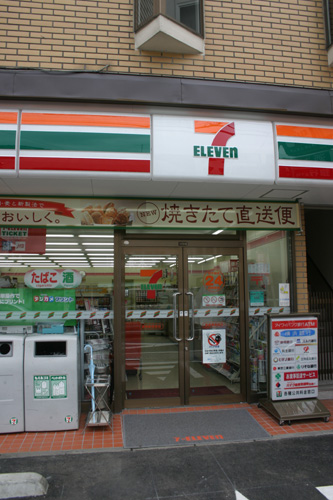
    A couple of days ago I made a happy discovery. It looks like Manhattan has it’s own chain of authentic Japanese “konbini” – convenience stores. When I visited Japan, I really liked konbinis. They have 7-Eleven, just like we do, but also Ministop, Lawson, Sunkus and FamilyMart.

    So, what’s different in a Japanese konbini? The variety and quality of junk food that they sell is a lot better. They are stocked with a humongous variety of snacks. Dozens of types of dried squid and fish for beer, Japanese sweets, nuts, edamame, sashimi quality fish, japanese pickles like umeboshi. The variety of soft drinks and genki drinks. They also have Japanese shampoos and skincare products. In short, they are stuffed with Japanese goodness of overpowering variety.

    I’ve been to SAM BOK store at 127 West 43rd Street before. It was nice but not the same as the real Japanese kombini. Also there’s a big Chinese supermarket in my are which has a lot of Japanese stuff. Not the same either. But then I found JAS MART. It even has 3 locations!

    35 St. Marks Place, (Bet 2nd & 3rd Ave), NYC
    212-420-6370
    Sun – Thur: 11:00 AM – 11:00 PM
    Fri & Sat: 11:00 AM – 12:00 AM

    34 East 23rd Street, (Bet Park & Madison Ave), NYC
    212-387-8882
    Mon – Fri: 9:00 AM – 9:00 PM
    Sat & Sun: 10:00 AM – 9:00 PM

    2847 Broadway, (Bet 110th & 111th St), NYC
    212-866-4780
    Mon – Sun: 10:00 AM – 10:00 PM

    They even have genki drinks and Coffee Boss coffe! I’ve been to the one on 23rd street and promptly loaded myself up with goodies. Unagi eel, unagi sauce, roasted rice tea, sencha tea, several types of dried ika and fish, umeboshi, edamame. It’s a little expensive, but hey – beats buying tickets to Japan.

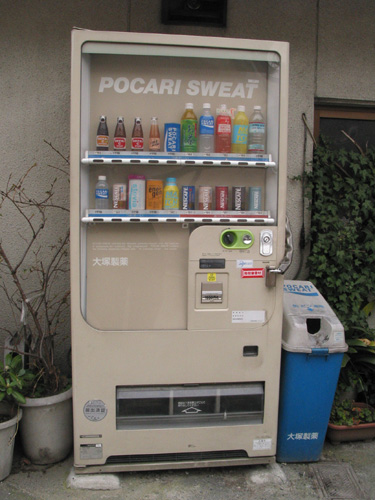
    Coffee Boss is a brand of Japanese canned coffee drinks with a J. R. “Bob” Dobbs-look alike mascot. They are sold in Japanese style soda machines which look rather different from the US Coke/Pepsi machines. They can serve the cans hot or cold. I wonder why somebody doesn’t bring some of these to Manhattan – it looks like the design of soda machines hasn’t changed much in the last 20 years!

    Pocari Sweat is a brand of Japanese sports drink, and despite the name rather tasty I might add. Notice the recycling can next to the machine – apparently the Japanese etiquette requires you to finish drinking your soft drinks next to the machine and not walking around with them. Almost every machine sold unsweetened green tea, in many cases Coke or Pepsi-branded.

  • It’s Tough Being Boss

    Several days ago I was startled by something in a post titled “moving up in “teh company”” in Livejournal’s Starbucks barrista community. The poster said:

    “< insert typical “yay me, I’m being promoted to SS” comment here >

    So I went to my learning coach class last night. It was very informative and good. I’ll begin official SS training about a week and a half from now.”

    It took me a little while to realize that SS in Starbucksian jargon stands for Shift Supervisor, not Schutzstaffel. Over the years I got used to being asked for my SS (Social Security) number, but apparently when I hear “SS” in other contexts my first thought is still “Nazis!”.

    This reminded me of a rumor that I’ve heard before. See, I’ve been told that that SS uniforms were so stylish because they were designed by Hugo Boss. It did not sound right – I thought that Hugo Boss is an American company, that was created after the war and that Hugo Boss is not a real person, but a created brand, like Mavis Beacon (see my post about that).

    The first place I went to was hugoboss.com. Well, I was wrong, it’s a German company all right. But the website is missing “Company history” section. Suspicious. I mean, usually established companies are rather proud of their beginnings. Kennethcole.com, for instance, has a whole segment about how Kenneth Cole (he’s a real person, I’ve even met him once) hacked New York City rules by pretending to shoot a movie in order to gain valuable parking permit necessary to sell shoes out of a trailer. You can read all about it here.

    So, I did a little digging of my own and guess what – according to Wikipedia, which in turn quotes Washington Post, Hugo Boss, the founder of the company did indeed design and manufacture Nazi uniforms, and on top of that likely used forced labour.

    Here’s a picture from hugoboss.com:

    And here’s one from Wikipedia that I doctored up a little (I changed the position of the guy on the right – the original is here)

    Maybe Hugo Boss of today is very, very different from the WWII era one, but they do make some snappy clothes.

  • A Pineapple Grows In Brooklyn

    There’s one piece of Americana that I do not like. Lawns. Suburban grass lawns. Keeping a good looking lawn is difficult and expensive. The amount of watering and cutting and fertilizing is mind boggling, considering that you are simply growing grass. Lawns do have a nice, neat appearance, but in my opinion they are way too sterile.

    Of course, I am not alone in lawn-hating. Various hippies are also unhappy with vast water-hogging expenses of grass they can’t smoke. They propose various solutions, such as replacing grass with clover, wild flowers, etc. I actually very like one solution I’ve seen somewhere (can’t find the link) – they’ve replaced the lawn with a vegetable garden. It’s not as neat and sterile, but still green most of the year. And you get your own organic berries and vegetables.

    Oh, and I got to mention this, my wife always liked this black grass (Ophiopogon planiscapus, I think) that grown across from the waterlily pond in Brooklyn Botanical. Now, that would make one nice gothy lawn.

    In any case, my McMansion-owning friends can have their humongous lawns and tractor lawnmowers. Living in an apartment, all I can operate with is a windowsill.

    Speaking about windowsills. I grew up in a very old apartment in Odessa, Ukraine. The windowsills there were huge – you could sleep on those things. Some of the newer houses in America don’t even have windowsills – they have picture frame moulding around them. The older, Art Deco era apartment where I live now has decently sized windowsills. They are big enough for a couple of cats to sleep on.

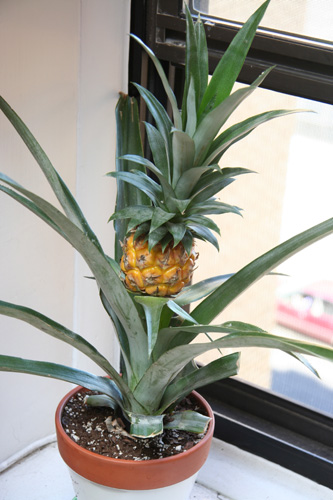
    In any case, there’s a lot of super cool stuff you can grow on your windowsill. I, for one have a couple of real pineapple plants.

    For the longest time I thought that pineapples grew on palm trees, like bananas and coconuts. Well, I just found out that bananas also don’t grow on palm trees and are technically herbs. Live and learn.

    Anyway, pineapples grow low on the ground, kind of like corn. The first pineapple plant that I grew on my windowsill I got from Brooklyn Botanical Garden gift shop. It already had the small fruit and cost me about $30 bucks. That was years ago. It has proven to be amazingly resilient – I generally have a brown thumb, and frequently forgot to water it. It survived a cold New York winter, and finally I ended up eating the slightly bigger pineapple. It was small, but very pineapply.

    The plant that you see in the picture is one of the two that I picked up from Ikea in Elizabeth, NJ. They set me back only 20 bucks, together. Thank you, Ingvar.

    I bet there are other cool plants that I could grow. Various dwarf citrus plants – lemons, oranges, kumquats, etc. Coffee tree. Maybe even a dwarf banana. The trick, of course if finding plants that already have fruit on them (if you know a good supplier, please let me know) – growing something from a seed is a huge pain in the ass.

  • Looking Up, Part 2

    My former co-worker, he of the Planet of the Geeks, asked me a few questions about selecting a telescope recently, and inderectly inspired me to write this post.

    Backyard astronomy is one of the most popular geek pastimes. Like espresso making and photography, it’s one of those hobbies where there’s basically no limit on how badly it makes you want to break your budget. There are such gadgets, oh such gadgets

    The rule of thumb in purchasing a telescope is the same as in purchasing an espresso machine – “poor people can’t afford to buy cheap things.” I am not going to write a telescope purchasing advice post though – enough is written on the subject already.

    What am I going to write about is the motivation for purchasing telescopes, eyepieces and other stuff. Really, why should you want to buy these expensive toys, drag your butt out into the cold of the night and crouch in uncomfortable position when there’s Hubble Space Telescope and Astronomy Picture of the Day?

    Well, first off, seeing a high resolution picture of Saturn taken by a billion dollar space probe somehow pales in comparison with seeing a blurry tiny speck of an image produced by the cheapest telescope. There’s something magical about having the actual photons reflecting of or generated by the celestial body hitting your retina. These almost physical things travelled over ridiculous distances end up hitting your eye forming an image. The feeling is completely different.

    Most scope advice sites tell beginners to not even think about astrophotography. My advise to you is to disregard this. Astrophotography is one of the most rewarding things you can do. That picture won’t be of Hubble quality, but it will be yours. A detailed mosaic of the lunar surface makes a great wall hanging or wallpaper. Again, there’s something different in the pictures that you took. People don’t stop snapping pictures of New York just because they can buy professionally made postcards, do they? If you do buy a telescope, buy one that can be made suitable for astrophotography.

    Note

    I don’t own a serious telescope right now, and never did. All I have is an old Celestron C90 spotting scope (actually mine is an older model that looks rather differently. The idea was to use it later as a telephoto lens (which I did) and a spotting scope for a big telescope that I ended up not buying. Even with that, I managed to take this photo of the Moon.

    Besides subjective experiences, there’s a very good reason to own your own gear and doing your own observations. The space is so huge that there’s still room for a complete amateur to make a discovery or just gather some useful scientific data.

    The humblest in amateur research is doing Cepheid variable observations. You basically record how certain stars change their brightness from night to night. It’s painstaking and boring work, but it helps to chart galactic distances or something to that effect.

    On the plus side, while looking for Cepheids, you can spot a nova or even a supernova. Nova discoveries by amateurs are not super frequent, but are not too rare either. Here’s one, for instance.

    Another mainstream field of armature research is occultation recording and timing. Occultation is a transit of one celestial body behind another. For instance, you can watch Saturn disappear behind Moon’s disk and reappear again. By watching a bright star or planet pass behind the Moon, for instance, you can get some interesting information. First of all, by recording the time you can help calculate Moon’s orbit more precisely. Secondly, yo can see lunar terrain backlit, seeing outlines of mountains. In theory, something can be learned about atmosphere of planets and maybe even moons by watching occultations, but that requires some serious gear. In any case, space probes do a much better job.

    Blah blah, meticulous observations by amateurs, blah, tiny little pieces of data, blah. Let’s kick it up a notch, crank up the hubris. Remember that Simpsons episode where Bart discovered a comet? Although the chances are low and the competition is fierce, it is possible for an amateur to discover a comet. And comets are the only things that are named after their discoverers these days.

    They don’t let you name asteroids, but discovering one is rather cool. If you find an Earth orbit crossing one, you can _potentially_ join the Planet Savior club. They’ll name stuff after you then.

    If that’s not enough, start looking for a planet. They won’t let you name it too, but putting “found a planet” on your resume is very cool. Of course, there is a lot of debate if those huge Trans-Neptunian objects such as Pluto and 2003 UB313 aka Xena are really planets. I say the more the merrier. Xena is magnitude 19 by the way, which is bright enough to be seen in high end amateur telescopes in dark sky conditions.

    There’s also the category of looking for major stuff that most probably isn’t there. Searching for planet Vulcan is likely to be futile, as Einstein explained away Mercury’s orbit.

    Major planets probably have way more satellites than are catalogued. It’s probably impossible, but maybe the Moon might have one too? In any case, hunting for satellites might be fun.

    Also, you have the Nemeses theory. It might just be that good ol’ Sol is really a binary star (binary stars are much more common than single ones) – Nemeses, it’s partner is a brown dwarf beyond the Oort Cloud. It’s possibly bright enough to be detected with an amateur scope. Now, that would be a discovery.

    How do you look for all of that stuff? Well, you mostly line up and “blink” photographic images of the same piece of sky taken at different times. Most stars are so far away that they don’t change their positions. Planets, asteroids and satellites have larger proper motion and appear to move in blinked photos. A lot of them will be artificial satellites and already discovered stuff, but hey – you never know. Public astrophotographs are available for this sort of thing, and there are ways to cheaply rent time on professional telescopes over the web, but it’s not as fun and generating your own.

    Even if your scope sucks and you live in a very light polluted place, you can still look for transient Lunar phenomena. Maybe you’ll see some aliens while you are at it.