Deadprogrammer.com is going on hiatus. I want to concentrate on a couple of projects that I’m about to launch.
Author: deadprogrammer
-
Keep It Under Your Hat
Thanks to John Kennedy the only people who wear hats these days are hipsters and cops. Hipsters do it ironically and cops have to. Cops don’t particularly like wearing hats, and the hats even have a special loop for attaching them to a belt carabiner.
NYPD duty hats have a special little pocket in the lining. Over the years I noticed many interesting items in there: icons, shopping lists, wanted posters, family photos. By far the most common is this little card featuring Archangel Michael, the patron saint of law enforcement.
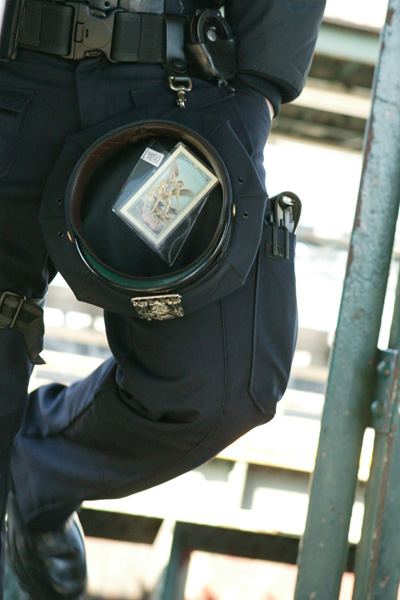
It seems to be this particular holy card with a prayer on the back. Interesting to note that in Guido Reni’s painting from which this card was made, Michael holds a chain instead of a scale, his cape is pink, hair is longer, there are pink ribbons in his outfit, and there’s a very prominent nipple showing.

-
A review of personal genomics profile from 23andme
What do I buy: a cleaning robot, an e-ink powered ebook, or a personal genetic test from 23andme.com? This is one of those terrible trilemmas facing geeks who are not willing to sacrifice financial stability for having all the coolest gadgets. I chose a 23andme test, and haven’t regretted it.
The factoid that always is mentioned in the press about 23andme is that its co-founder Anne Wojcicki is married to Google co-founder Sergey Brin. This of course means that the data that 23andme is collecting is going to be used to help Google’s Skynet to gain the upper hand in the forthcoming war.
23andme’s service works like this: you give them some money (at the time when I write this the price is $399, but it used to be over $800), they send you a test tube into which you spit, some special preservative solution, and a return envelope. You follow some simple instructions and send your spit to a processing facility. Then you wait (this is the hard part). In a month or so (it depends how long the backlog of orders is) you recieve an email telling you that you can log into 23andme.com and take a look at the results.
The processing that they do in the lab creates a data file that represents an impressive number of genetic data points called SNPs or single-nucleotide polymorphisms. The way I understand it, SNPs are known variations that happen in DNA sequences. Much of the DNA stays the same for all people, but there are some variations in a single location. Let’s say there’s a string of DNA in humans that goes
G-A-T-T-A-C-A
C-T-A-A-T-G-Tand 6 positions there are the same for everyone, except the seventh, which is sometimes AT and sometimes GC. So basically it’s a single position on the one of the 23 chromosomes or mitochondrial DNA (I guess 23andmitochondriaandme was shot down as a possible name for the company) that statistically is different from person to person as opposed to long stretches of DNA that stay the same.
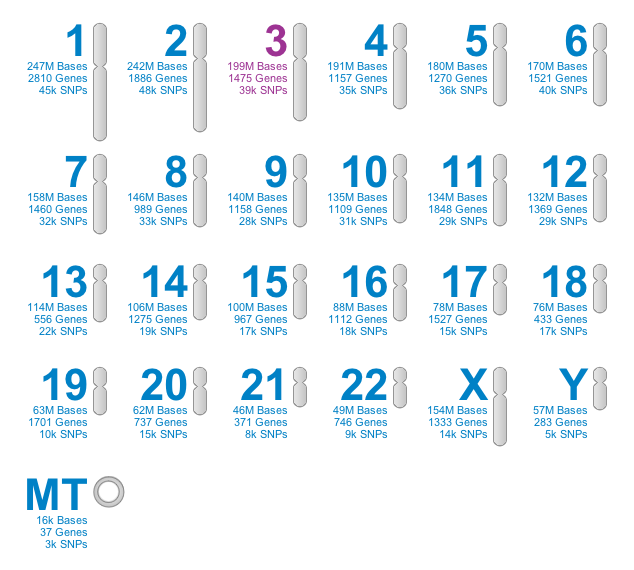
Scientists all over the world are studying the correlations that SNPs have with disease risks and traits. I guess these studies go something like this: you grab 500 programmers that use emacs editor and 500 that use vi. You have a hunch that editor preference is related to gene C4711. You sequence the dna of all your coders looking for SNPs in the gene C4711 that are one way in your vi-using alphas and another way in emacs-using sub-omegaloids. Then you find that in most of vi users SNP rs1729 is AA. Then you come out and say – AA in s1729 increases the odds of a programmer preferring vi by 47%.

The more people that a study has – the better the results. 23andme has genetics experts on staff that sift through mountains of these studies, rank them, and then tell the website people to add results to the interface. This way you can go to 23andme.com and see (as of right now) that tell you right away what your lifetime chances of getting 10 diseases. Some, like Parkinson’s, they don’t let you see without you agreeing to see it yourself. Sergey Brin was reported in the media to get some bad news from that particular one (mine came back “Typical Risk” which means that my chance of getting Parkinson’s is about 1.6%, same as everybody else).
A lot of people that I talked to about genetic testing told me that they’d “rather not know”. It’s true that some of the things that you might learn will make you worry without being able to do anything about it. On the other hand, there are some that you might be able to do something about.
“24.1 out of 100 people of European ethnicity who share this genotype will get Prostate Cancer between the ages of 35 and 79” vs “17.8 out of 100” on average. Here I learned that I have about 1 in 4 chance of getting prostate cancer. Prostate cancer is one of the relatively treatable ones if caught early, but with unpleasant diagnostic procedures. All of a sound “digital exam” does not sound so bad, and I guess I’ll have to bend over and cough a lot more often than I otherwise would. I’m not sure what coughing does, but the “digital” part has nothing to do with electronics or numbers.
There are also 10 traits that are available right now. The most interesting one for me was “Resistant to infection by the most common strain of HIV people usually encounter, though protection is not complete”. I apparently have two copies of something called “Delta32 version of CCR5”. “Although people with two copies of Delta32 are highly resistant to the most common type of HIV, they can be vulnerable to strains of the virus that do not use CCR5 to enter immune cells”.
This makes me a little bit more at ease when I donate blood, even though I know that the chances of getting infected with AIDS at a blood donation are already less than winning that Mega jackpot. On the other hand Dr. Asimov died of AIDS that he received through a transfusion. What’s more interesting, is that this is the same mutation that prominently figured in the media with the AIDS patient who was cured through a bone marrow transplant.
Then there’s a section that has 79 research reports. These get a rating fоr “research confidence”. I, for instance, have an elevated risk of obesity from research that has a three star rating.
Doctor House would have loved getting access to this kind of data for every one of his patients. There are risks for rare diseases mentioned on the show Ankylosing spondylitis, Hemochromatosis, Bloom’s syndrome, and everybody’s favorite – Lupus (which it’s never).
One of the tests included in 23andme is for muscle performance, the one that was in newspapers lately because it was offered by a few companies. The news angle was that sports obsessed parents paid hundred of dollars to find out if their kids have sprinting or marathon ability. Mine says: “One working copy of alpha-actinin-3 in fast-twitch muscle fiber. Many world-class sprinters and some endurance athletes have this genotype.” This sounds plausible – for a fat dude I have an uncanny ability to sprint, yet suck at long distances.
But wait, this is not all. For the same low price you also get some ancestral info. This comes in a form of maternal and paternal haplogroup. I am not sure I understand the what haplogroup is very well, and found 23andme’s infographics somewhat confusing. From what I understand a haplogroup is a number that is attached to a certain mutation (a few SNPs maybe?) that arose thousands of years ago and that has been statistically crosslinked to people living in certain geographical locations.
My paternal haplogroup is E3b1c1* – “populations: Ethiopians, Jordanians, Ashkenazi and Sephardic Jews”. My maternal haplogroup is H5a* – “populations: Lebanese, Polish, Irish”. Both of my ancestral branches are supposedly Ashkenazi, and I guess haplogroups are not a high enough resolution to prove or disprove Jewish ancestry. All they do is tell you that the progeny of your very remote ancestor was likely found in certain wide geographic locales “before the era of intercontinental travel.” What’s interesting is that there’s a small chunk of my maternal haplogroup’s population in Siberia.
23andme is a true Web 2.0 service (in the good sense of that expression). There’s a blog called The Spittoon. In between educational (sometimes interesting, sometimes boring) posts about genetics they have a section called “SNPwatch“. There they write about new research and usually provide a link to raw data in your 23andme profile. So for instance there was an article titled “Variants in Genes for Carcinogen Transporters Linked to Lung Cancer” about a mutation that prevents lungs from clearing out cancer-causing chemicals. Then you can click on two links and see if you have that mutation (to my relief I don’t).
There are some social network features: you can compare your DNA profile to your relatives. I’m not sure if hilarity might ensue because I think you can figure out possibility/impossibility of paternity and maternity, like Dr. House did in that episode. You can even compare your DNA to other users of 23andme – you have to accept a “friend” request for that. I’m not really sure what’s the fun in that. You can participate in surveys that might be used for research (there isn’t one yet about vi vs. emacs yet, but there are some other ones).
It does not look like the $400 fee even covers the cost of gathering the data (there no further fees as of now) or paying for staff/website maintenance, and ongoing research. I’m not really sure what the business model here is (and that makes me a little nervous. Businesses like this remind me of an old Yiddish joke:
Moyshe is selling boiled chicken eggs. He buys them for a kopek each and sells them for a kopek each. Chaim asks – “Moishe – where’s the profit in this?” “What, are you stupid?” – answers Moyshe. “I get to keep the broth”.
My guess is that the “broth” here is an opportunity to conduct groundbreaking research and maybe sell the anonymized data. That, and helping Google’s Skynet find and assassinate John Connor.
I don’t really worry too much about being denied insurance in the grim meathook future that surely is coming just because I used 23andme. There’s legislation against that on the books right now, and if insurance companies will be able to deny coverage based on genetics they’ll be much more likely to get this info by requiring a blood test.
I really wish I could get the data from my grandparents (none of whom are sadly alive). I will buy kits for my entire family though as soon as I’ll be willing to part with another chunk of disposable income (I do want that dang Kindle first though).
-
National Air And Space Visit
While in Washington, I visited the National Air and Space Museum. It is like some kind of Lovecraftian Costco warehouse filled with a mix of priceless artifacts encased in layers of plexiglas and cheezy recreations, carnival-like educational attractions, and disguasting food courts and kiosks.
Overhead, like beached whales or a giant boy’s toy models, hang famous air and space ships. They have just about everything you could think of – Spirit of St. Louis, Space Ship One, a Brietling Orbiter, even the original Wright Flyer. They all look lifeless and sad, especially the spacecraft.

I was a bit overwhelmed by the craft collection, but it’s the little things that I enjoyed seeing the most. They have, side by side, Nestler sliderules that used to belong to former z/k Korolev and former Sturmbannfuhrer Von Braun. Missing is the Nestler that used to belong to Albert Einstein. I also wonder who now owns the two two-copek coins that were Korolev’s lucky charm. I also wonder if Von Braun used to have a lucky charm.


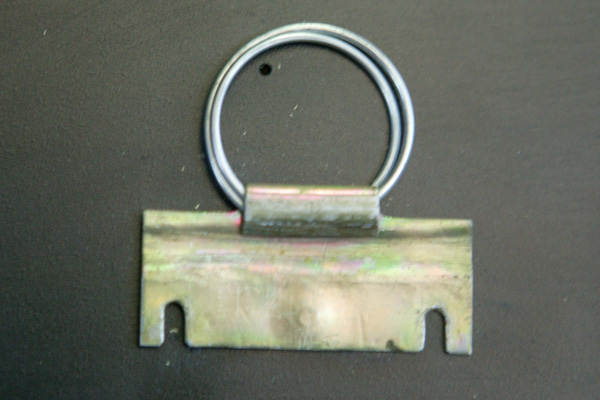
The only remaining piece of the original Sputnik – an arming device that was removed prior to launch, an equivalent of little strips of paper you sometimes find in remote controls and other battery-powered gadgets.
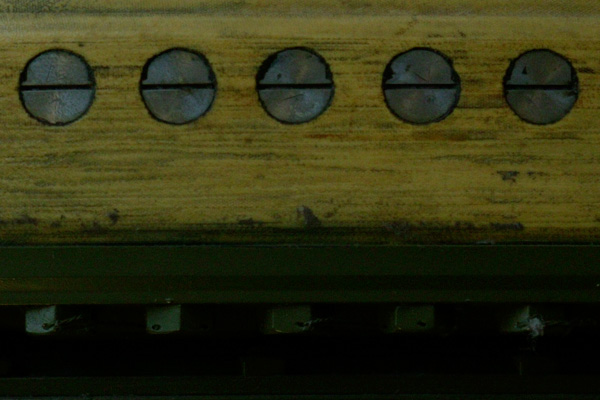
It was interesting to notice how many aircraft were put together using slotted instead of philips screws, like these huge ones on the Soviet ICBM.
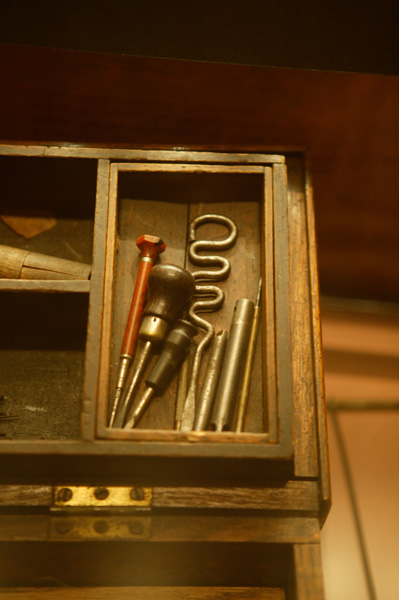
I don’t know why, but I stood for a good while admiring the hypnotic twists of a handmade screwdriver that used to belong to Charlie Taylor, Wright’s mechanic.
Soviet space kitch collection is vast: from magnetic Mir-flown chess (something of a 70s vintage space look to them)
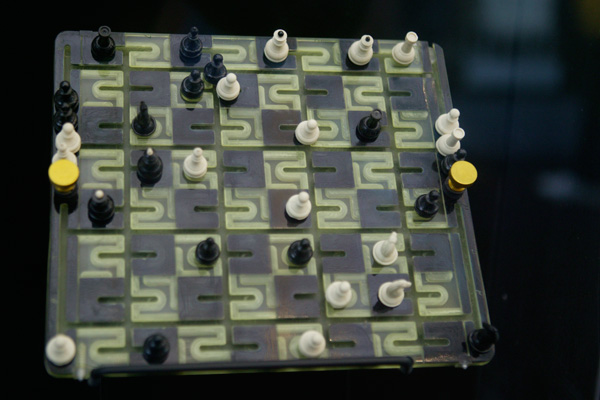
to all kinds of space crappers (a low-tec suction bulb is probably safer where your privates and vaccuum are involved).
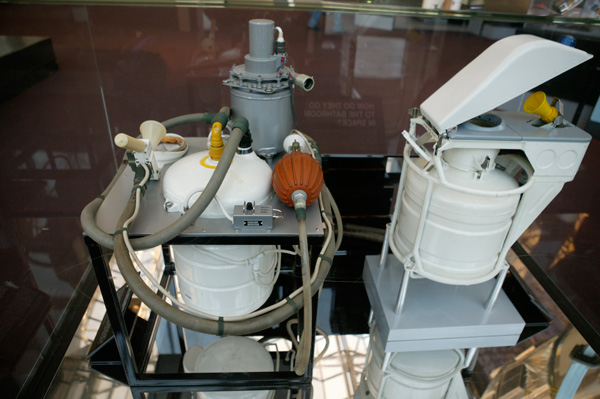
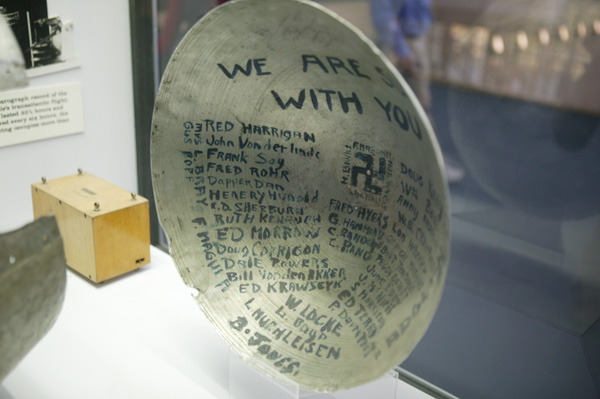
The nose cone from the Spirit of St. Louis is signed on the inside, but you have to cram yourself into an uncomfortable niche to see the swastika and signatures of well-wishers, including Wrong Way Corrigan. Apparently early aviators frequently used not yet befouled by Nazis swastikas as good luck charms.
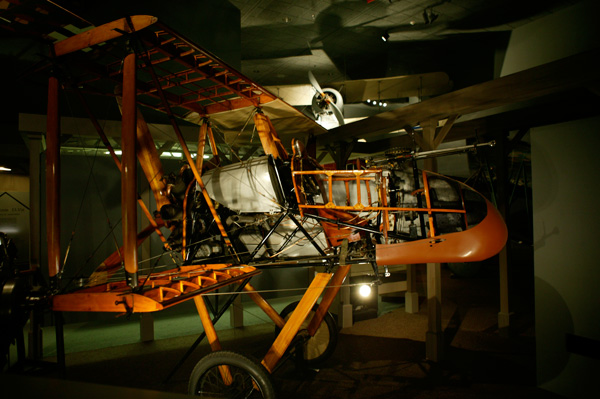
One of the last things I saw, a crazy looking British pusher airplane had such an amazing Star Wars look that I maybe even gasped a little.
-
My Advice to Russian Bride Hunters
I recently received an email from a reader who wanted advice about seeking a Russian bride. I decided to post my snarky, although relatively detailed reply here. After I sent the email, I realized that there’s a book on the subject

that according to one review is “simply ‘excellent’. It is factual without being offensive. It’s helpful without being overbearing. It is instructive without being condescending.” I don’t think I managed any of these feats, but here’s what I wrote:
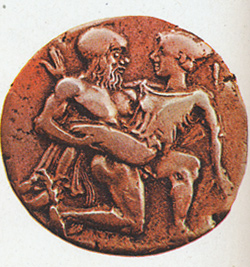
Ancient Odessa, coin, erotic scene. II-III century BC.
Hey, ….. .
Your potential mailorder bride is most likely a scammer. I am about to give you and those like you some advice, which might turn out useful to some and entertaining to others (I plan on posting my reply on my blog).
Seeking a foreign bride is not a simple, risk free, or casual process. It is not impossible though: one of my female friends married an Australian, another a Briton. These two pairs are extremely happy together.
You claim that you are having problems finding a “normal chick to settle down with.” I think I know what you mean by that, but I am not sure that you do. In my interpretation you blame your inability to find a mate on the quality of the pool of potential dates available to you.
By definition, “normal” means standard, usual, average. Since the majority is never “not normal” (unless you are in a psychiatric institution), there must be another explanation. It’s probably a combination of your high standards in selecting a mate (model looks, high paying job, domestic excellence) and your lack of same qualities. In short you are looking for a girl out of your league.
So here you think: there are these places where the girls are super hot, live in poverty (and thus aren’t spoiled) and will jump at a chance of snagging a knight in shining armor who will whisk them away to America. Your thinking is correct. Being American with some money will let you fish in the deep end of the gene pool in many a foreign land.
Russian and Ukrainian cities are teeming with ultrahotness: Slavic female beauty is world famous. There is no obesity epidemic there due to superior quality of food, so sometimes it looks like city centers are overrun by hordes of supermodels. The ubiquitous blond hair and rare eye colors are a part of the local genetic markup.
Meanwhile, widespread alcoholism in men is far from being an untrue stereotype, and there are many men wearing purses in the street and speedos at the beach. Simply not being an alcoholic and having a modicum of fashion sense are great assets there. Basic hygiene is also not really a default in men there. Boldness and fatness is not as repulsive to women in those parts of the world, and an American citizenship is an outright aphrodisiac.
So, those are all the advantages that you have there. What about disadvantages? A shared background is a cornerstone of a healthy relationship. You and your potential bride grew up speaking different languages, reading different books, eating different food, watching different tv shows. There might be some overlap in music, but the overall experiences that the two you of had were vastly different. That gap has to be bridged somehow, and it seems very likely to me that you will leave this burden to the girl. She will have to suffer the tremendous cultural shock upon arriving in the US (I know I have), she will have to speak English. Based on your spelling and grammar you do not strike me as good with learning languages, and Russian is a difficult one to learn. You also show a good level of ignorance of Russian culture, geography and history. That is a big handicap.
So, yes, there are millions of “normal chicks” there, but you are limited only to English-speaking ones, of which there aren’t too many. Most “normal chicks” find it as hard to learn a second language as you are. So in practice the pool of girls that you are looking mostly consist of girls that have unrealistic expectations of life in the US, scammers (some of which are not actually girls), and those girls who can’t find “normal dudes” because of one issue or another.
Even if you get through all the logistical and bureaucratic nightmares, there are some tough odds to overcome. Imagine yourself in a freshly minted mailorder bride’s place: being a stranger in a strange land, feeling exploited and locked into a marriage, no old friends to lean on, having to speak English 100% of the time, homesickness etc, etc. That is some tough situation. If you are not god’s gift to women where you live, your foreign bride stressed by all the changes will probably not like you much better, but will be locked into staying married to you for a good while. It’d be exploitative of you, wouldn’t it?
The scammers are sometimes crude, sometimes very sophisticated. A friend of mine mentioned a girl that communicates in the way that you described with dozens of men, with the intent of scamming them. “She doesn’t ask me to send money, to go visit, or anything else like that.” That is a good sign, but this usually does not last: a good scammer does not want to set the hook too early. The fact that she does not own a tv or a computer and uses a friend’s computer at work seems suspicious to me. Her story – too smooth. You can’t be too careful in these situations.
Remember I mentioned my two friends who made their relationships work? The guys they married are very good looking, hard working, and have outstanding personalities. One pair met in an online game (true story), another at a university. Both girls spoke near-flawless English (the men did not learn more than a few phrases in Russian, very typically).
So here’s my final bit of advice: if you do want yourself a beauty from the former USSR — learn Russian, at the very least read everything you’ll find in Wikipedia about the places where you’ll be looking, but better thoroughly educate yourself about Russian and Ukrainian history, politics, current affairs. Then do some traveling. Then you might be ready for something like what you are attempting. If you will learn enough Russian and will travel there, you can get laid with impunity without having to go through with the whole marriage thing, unless the “sex tourist” label bothers you.
-
Happy New Year!
I am continuing this blog’s tradition of a New Year’s cards, even while thinking of closing down deadprogrammer.com. I might do it the Dr. Fun way – get it to 10 years and call it quits.

This was a tough fricking year. I spent it on call for application breakdowns, learning system administration, stressing out of my mind, hitting hard deadlines, missing soft ones, gaining 15 pounds, etc, etc.
I was stupid enough not to listen to my very smart friend and keeping my 401K in S&P 500 instead of in cash equivalent funds. I did have enough sense to sell it after Lehman Brothers shat the bed.
This was my first year of being 99% free of Microsoft Windows. Indeed, once you go Mac you don’t go back.
An interesting new web application that I worked on in my spare time should launch around February. I did waste a lot of my free time watching “my stories” (“The Wire”, “Mad Men”, “How It’s Made”, and other yuppie deligths), but I did not waste all of it. You’ll see.
In any case, I wish you all a very happy, healthy and prosperous New Year!
-
Back to Livejournal
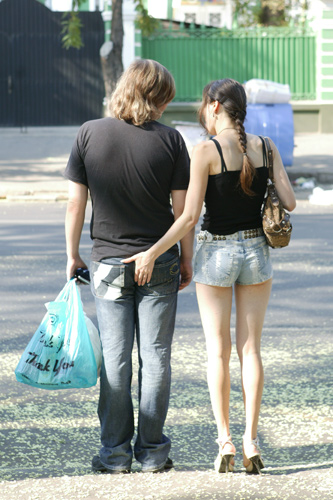
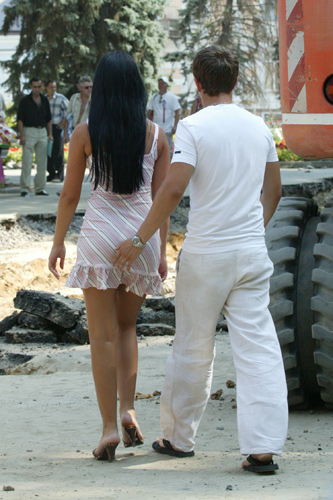
I did a bit of posting in Livejournal’s community related to my hometown and received more comments that I accumulated at deadprogrammer.com in a couple of years. The posts are in Russian, but I believe they will be interesting to a significant portion of my readers, especially the comment part where I debate merits (or lack thereof) of speedos, man purses, and other things.
The rest of you please enjoy these two pictures from one of the posts: