AOL’s logo, “The Running Man” (not to be confused with the book of the same name, which in turn is not to be confused with the movie of the same name) is gone from the window in Rockefeller Center.
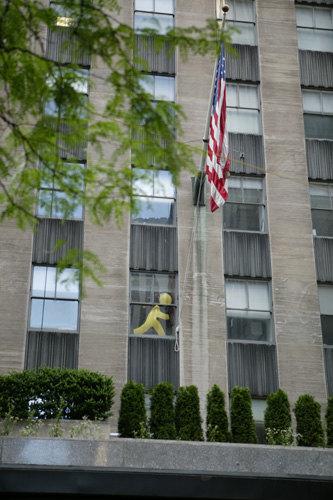
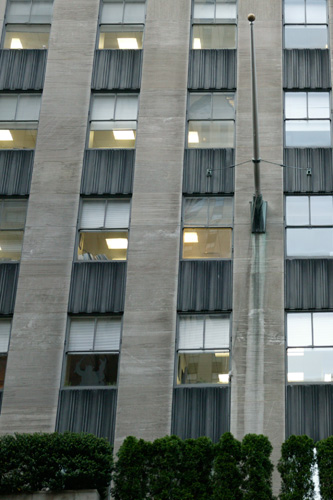

AOL’s logo, “The Running Man” (not to be confused with the book of the same name, which in turn is not to be confused with the movie of the same name) is gone from the window in Rockefeller Center.
I woke up from a nap to a loud pop and a smell of burning plastic. The source turned out to be one of the most precious and important to me digital devices: a ReadyNAS NV+, a small silver box with over a terabyte of hard drives that store my backups, music, and photos.
Network attached storage (NAS) is an engineering compromise. It’s a storage solution that lets you keep a bunch of drives in a self-contained device. It’s redundant: you can lose a drive (which is a statistical certainty) and not lose your data. There are also handy usb ports that let you connect usb drives and a button to run backup jobs onto these drives. It also serves as a print server, and in theory it can be used as a streaming media server. On the other hand it’s slow (gigabit networks are not fast enough when you need gigs of data fast), a complete nightmare to use with photo managers like Picasa, and an even worse nightmare if you want to use it as a Time Capsule.
I’ve spent a lot of time babysitting my ReadyNAS NV+: changing the defective RAM that it shipped with, updating the buggy firmware, finding the right drives for it (some don’t have the right temperature sensors). Don’t get me started on what it took to make it work with Mac’s Time Machine.
And after all that, the one box that was supposed to keep my precious digital archives safe was smoking. This was preceeded by a few days of weird performance issues and a couple of hangs. The power supply finally died a horrible death, and I realized that once again I was falling victim (or “mugu” as Nigerians say) to faulty capacitors.
According to Wikipedia, the name of this phenomenon is “Capacitor Plague“. There is an epidemic of failure in electrolytic capacitors from certain shady manufacturers. Electrolytic capacitors are usually found in power supplies. They are little aluminum cylinders filled with special film and electrolytic liquid or gel. Power supplies get very hot, and the liquid part of the capacitors, the electrolyte, always wants to either dry up or explode. The formula for the electrolyte is very hard to get right.
The rumor is that one or a few companies resorted to industrial espionage to steal electrolyte formulations. They weren’t entirely successful – they either got an incomplete formula or just plain Brawndo.
Spectrum Online did some digging:
“According to the source, a scientist stole the formula for an electrolyte from his employer in Japan and began using it himself at the Chinese branch of a Taiwanese electrolyte manufacturer. He or his colleagues then sold the formula to an electrolyte maker in Taiwan, which began producing it for Taiwanese and possibly other capacitor firms. Unfortunately, the formula as sold was incomplete.
“It didn’t have the right additives,” says Dennis Zogbi, publisher of Passive Component Industry magazine (Cary, N.C.), which broke the story last fall. According to Zogbi’s sources, the capacitors made from the formula become unstable when charged, generating hydrogen gas, bursting, and letting the electrolyte leak onto the circuit board. Zogbi cites tests by Japanese manufacturers that indicate the capacitor’s lifetimes are half or less of the 4000 hours of continuous ripple current they are rated for.”
Wastefulness of today’s society masks the problem: most people don’t perform autopsies on their dead $70 DVD players or $500 computers, they just use that as an excuse to buy the new hottness. The techies with (or without) spare time and soldering skills do the following: fill bulleten boards with tales of saving their devices by soldering in new capacitors; search for instructions on how to solder and purchase capacitors; and curse creatively after doing it for the 5th time.
The unique thing about the capacitor plague is how easy it is to identify: the capacitors literally blow their tops, venting electrolyte through the special stress relief indentations. It’s also unique in that anybody with a soldering iron has a very good chance of fixing it: the caps are easy to locate and solder. In the age when most electronic components are of the “surface mount” type (the size of a sesame seed) or chips with dozens legs as fine as silk, soldering in a two legged capacitor is very refreshing.
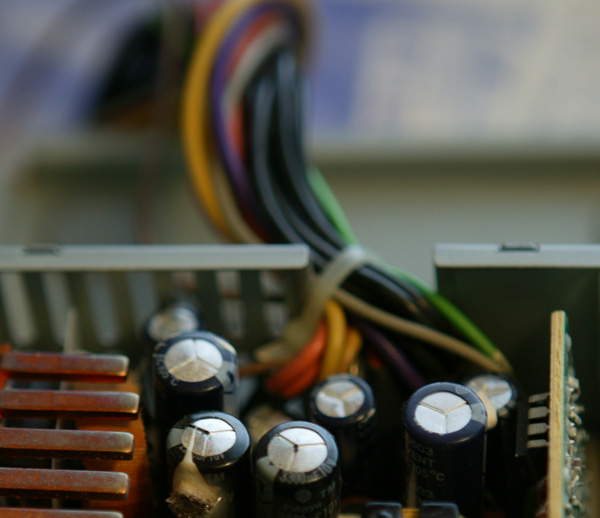
Here’s a nest of capacitors from my busted power supply: two in the left corner are clearly popped, the one on the right is probably ok:
In the last couple of years the following devices that I own fell prey to faulty caps: a cheap off-brand dvd player, a speed control on my Dodge Caravan’s air conditioner, a Netgear network hub, a huge and expensive Air King window fan, and now, my ReadyNAS. The interesting thing is that the problem exists in both high end and low end products, as well as in high tech and low tech ones (I did not know there were electronic components in the window fan).
I am out of warranty on my ReadyNAS because I bought it in May of 07. The following passage leads me to believe that the shitty capacitors are a problem that they are aware of and (maybe) fixed in newer releases of the hardware (they could not offer a 5 year warranty if they used the same capacitors – they’d just go broke).
“Please be aware that ReadyNAS purchased prior to August 21, 2007 carries a one-year limited warranty. Extended warranty purchased for these ReadyNAS will be honored by NETGEAR. ReadyNAS NV+ and 1100 purchased August 21, 2007 and later have a 5-year limited warranty, and the ReadyNAS Duo has a 3-year warranty.”
The brand name of the popped capacitors reads “Fuhjyyu”. It lead me to the an urban dictionary entry that says that Fuhjyyu is either
“1) Chinese word for feces.
or
(2) Brand name of abysmal quality capacitors that are installed on logic boards, switching power supplies and various other electronic components.”
There’s also a post from a guy who implores ReadyNas to stop using those capacitors.
Then there’s badcaps.net – a global capacitor gripefest that is too depressing to read.
You can see a nice gallery of busted caps over here
There are broader implications of this: coupled with the fragile lead free solder, leaky capacitors don’t only cause kajillions of dollars of damage, but will also make electronics of our era impossible to use in the near future. The aluminum in burnable cds and dvds are rotting too, destroying the record of our time.
At my current job there are four employees who speak Russian. Three are younger programmers, one is an older janitor.
Related: my old post, The Unrussian Profession.
When you live and work in New York, you spend a huge amount of time on tv and movie sets. Most of the time the sets are abandoned by the shooting crews, but very frequently tv or movie magic is happening as you are walking by.
Why is New York so overrepresented on screen? Part of it is because it’s New York. But it’s also because the city government is also very friendly to the moving picture industry.
When I worked on a website for Kenneth Cole, I learned an interesting factoid: the real name of this fashion powerhouse is Kenneth Cole Productions. It turns out that in the early days they abused a perk that the city gives to movie people: ability to park their huge trailers in places where normally only city services vehicles can linger. Cole applied for a permit to shoot a movie called “The Birth of a Shoe Company”, parked a huge truck in front of a hotel where a major shoe show was taking place, and proceeded to sell enough shoes while cameras were rolling (sometimes even with film) to start a company.
While watching a movie or a show set in New York I get a lot of “oh, hey it’s” and a lot of “hmm, where’s that?” moments. Sometimes a movie or a show becomes more memorable just because its locations are so familiar to me.
Let me give you some examples about how cinematically impregnated my environs are. Take, for instance 30 Rock. I spent 7 years working in two buildings that are behind 30 Rock, and every little thing in, under and over Rockefeller plaza is seared in my brain. Also, I have the same last name of one of the actors (is Jane Krakowski a relative? Probably not).
The 47-50th Street/Rockefeller Center subway station that I got out at almost every day for those 7 years (unless I missed a few stops while reading or sleeping) is the one featured in a key scene in Darren Aranofsky’s “Pi”. The Brighton Beach bus stop in “Requiem for a Dream” – one of my first American jobs was right there, handing out fliers for a gypsy psychic. One of the buildings where I worked, 1211 Avenue of the Americas was very subtly featured as Sideshow Bob’s prisoner number in a Simpson’s episode.
Sterling Cooper corporate headquarters are famously located at a non-existing 405 Madison Avenue. On the other hand 415 Madison Avenue is a very real building where my wife used to work.
When I go to and from work now, I pass a grating which John McClane ripped off in one of the Die Hard movies to jump on the top of a moving train. The building where I work? Well, it doubles as the Massive Dynamic headquarters on “Fringe”. They do a lot of shooting at the floor where I work. You can see our big conference room called “Jail” in a number of commercials. You know, Doctor House, he’s supposed to stay in New Jersey, but one time he slept on “my” couch at the office after shooting a commercial there. The butterflies of doom from Fringe also live in “Jail”.
Ironically, the only famous person who went to my hight school is Larry David, the co-creator of a certain show about nothing set in New York, but shot in LA.
I find Jewish humor to be one of the best ways to explain certain situations in programming. Here are two that I find particularly funny and useful.
The first is a true story told me by a friend. I use it when I’m told that good web developers don’t use tables. It goes like this: My friend’s aunt met her religious relatives for the first time after coming to America from the Soviet Union. Horrified at being served pork sausage, they told her: “But auntie, Jews don’t eat pork!”. She replied — “Nonsense, I eat it all the time.”
The second is an old and racist Soviet-era joke. A Chukcha serves in the Soviet Army, and is an exemplary soldier in border patrol. There’s only one problem — he tends to eat patrol dogs, considering them a delicacy (this untrue ethnic detail must have been created to make the joke setup work). An army psychologist offers to correct this. He sits the soldier down, takes out his watch, and hypnotizes him with the words “you are not a Chukcha, you are a Jew. You don’t like to eat dogs, you like to eat gefilte fish.” The patrol dogs continue to vanish even after the hypnosis seems to have worked. Authorities send another soldier to follow the hypnotized Chukcha around. This soldier reports that the Chukcha sits the dogs down, takes out his watch and hypnotizes them with the words “You are not a dog, you are gefilte fish.” I tend to tell it when I’m told that the act of turning a hack into a Drupal module somehow makes it “gefilte fish.”
I recently visited my alma mater, Brooklyn College. Some things changed for the better, like the gorgeous new library addition, some for the worse, like the Campus Sugar Bowl restaurant replaced by Starbucks.
On the other hand, the science classrooms and offices in the old and new Ingersall building seem to have been frozen in time, down to the wall niches. You see, most floors have these glassed in niches which the various departments fill. Compsci displays books written by professors, Geology shows off a collection of minerals and fossils (a fancy one at that), Biology has a series of stands with pickled and dried specimens that I think dates to the 1940s, like something out of a Hellboy comic.
The Physics department has a very old, dusty and ironic display, seemingly not opened since the 80s:

I always thought that the quote went “I’ll try anything once” and it was Andy Warhol who said it. Apparently the quote is “I’ll try anything once, twice if I like it, three times to make sure” and it belongs to Mae West.
Living in New York, amongst other things, pushes you to try something for the first time ever almost every single day. Here are three things I recently tried for the first time, mostly under pressure from New York City.
Religious
Probably every New Yorker that looks even remotely Semitic in appearence has been repetidly asked “Are you Jewish?” by the Hasidim. If you answer yes, you’ll get a Billy Mays-worthy pitch to pray/light Shabbat candles/put on at Teffilin. I will admit to occasionally denying my membership in the tribe when in a hurry, but most of the time my answer is “a little bit”, followed by a firm sticking to plain cowardly agnosticism.
Ever since I wrote a long and rambling post about Tefillins, I meant to put one on. So this one time, after being approached by a young Hasid in the Atlantic station passageway, and customarily declining his pamphlet, I accepted his halfhearted offer to help me lay Teffilin. He was particularly surprised – I don’t really think he gets to help a lot of people perform this particular mitzvah a lot.
He produced a Tefillin set from a black shopping bag and a loaner kipah from a pocket, helped me put it on and say the necessary prayers right there on the BMT’s Atlantic Avenue platform, amongst the hustle and bustle of people and trains. It felt strange, yet somehow very comforting – performing this ritual in one of the most familiar places to me.
He also gave me a pamphlet in which the Lubavitcher Rebbe explains to a computer science professor that Tefillin is a symbolic representation of computers. He was very glad to be able to accomplish such an epic mitzvah.
Culinary
I was walking through Union Square farmers’ market, already having sampled and bought a package of organic bacon hawked by an upstate hippie (I’m not a very observant Jew as you might have already noticed in this post). I was passing by a little stall providing free samples of wine made by hippies somewhere upstate. That bit of hippie bacon called for some wine, but I did not want to fight the mob of greedy Manhattan housewifes for a tiny sip, but then I heard a magical phrase – “We also have dandelion wine”.
I never really finished reading “Dandelion Wine” by Ray Bradbury, and always thought that there was no such thing – how can you make wine out of bitter yellow flowers? Apparently this is how. I bought a bottle. All I have to say is that dandelion wine tastes just like they say it should: like summer and childhood. I also bought some salad corn shoots that I’ve read about in New York Times. Those tasted like raw corn kernels.
Automotive
You know that nobody really drives in New York because there are too many cars there. I’ve spent many happy car-less years here, but the arrival of a baby forced me to buy a car (a minivan, in fact). Parking is a very sore topic around these parts. I was never willing to splurge on a garage, and had to subject myself to the indignities of alternate side parking regulations.
There’s a whole book about parking in NYC – Calvin Trillin’s brilliant Tepper Isn’t Going Out. I bought it only because I have a friend named Tepper, but ended up immensely enjoying it. Which is what I can’t say about parking in the street.
Well, recently, I finally broke down and shelled out $200 for a spot in a garage. The feeling on the “alternate” days is rather novel – hey, I don’t need to move a car! Also new – not worrying about what those loud teenagers are probably doing to my poor car, or if there’s a used car window repair place that just received a shipment of my car’s specific windows (did you notice how they always have a used window for your car ready, no matter how obscure, when you go to a nearest car window shop for a mysteriously shattered one?). It’s a new and pleasant feeling.
What about you?
I decided that I’ll take a break from a blogging break to tell a story that has two of my favorite things: symbolism and legends of my hometown. In particular, it’s the legend of the Kovalevsky’s Tower.
A fountain and a tower are two very commonly used symbols. A fountain is a symbol for life and creativity, one with a mostly positive meaning. A tower is a darker symbol, one about overreaching achievement, and fall. In Tarot a Tower card is an ill omen. Yet a tower is a very attractive symbol. I am immensely drawn to towers, just look at how frequently I write about them.
There aren’t any skyscrapers in my hometown. There are fountains though. Not just the regular water spritzing ones: there are three very important neighborhoods called The Big, Middle, and Little Fountain. You see, Odessa, although on the sea, is located very far from any rivers that can provide potable water. In the olden days much of the water was procured from three wells, the Big, Middle, and Little Fountains, which were located relatively far from the city center, near the sea. An alternative way to collect water from rooftops was available, but as there’s a lot of dust in the air, people referred to this less tasty water as “this is no fountain”, an expression that survived to this day referring to something sub par.
If you take a tram from the city center, you’ll pass through the many stations of the Little, Middle and Big Fountains which follow the sea shore and are mostly filled with dachas. My grandparents used to have a dacha at the 13th station of the Big Fountain, a little plot of land with a house and outhouse that my father and grandfather built themselves. When we left, it was sold for about $7000. I am told that the land that we used to own would be worth about $1,000,000 today.
The last station is 16th. There you would switch to an ancient little tram with two “heads” (it was needed because there was only a single track, and one tram would service the whole line going back and forth). This tram, nicknamed push-pull would take you to yet another neighborhood called Kovalevsky’s Dacha. There were more dachas there, a large Russian Orthodox monastery, and natural, sand-less beaches with steep rocky cliffs (the rest of the shore used to be like that as well, but the cliffs where dynamited and sand washed on).
There is a legend connected to Kovalevsky and his dacha. This legend is a little bit like Rashomon, as there are many different ways it’s told.
In one version, a wealthy merchant, Timofey Kovalevsky decides to solve Odessa’s water problem by building the first water line. He finds a huge water well beyond Big Fountain and starts laying pipe into the city. At the source he builds a huge tower. He finishes the project, but he is financially ruined due to insufficient revenues. Either the water is of poor quality (not like Fountain water, because of the pipe sediment), or because people are afraid of technology and call his water “machine water”, or because around the same time another water line from Dniester river is completed. One way or another he is ruined, and commits suicide by jumping from the tower. In this version it is a story of pitfals of technology, its quick obsolescence and/or inferiority to older technology.
A famous version of the story comes from Kataev’s “Lonely White Sail”. In Kataev’s version Kovalevsky undertakes his water line project alone out of greed. A slew of bankers beg him to take them as partners, but he refuses, wanting a water monopoly. He builds the tower to get to the water, only to run out of money – the water is too deep, and the machinery and pipes are too expensive. He begs the bankers for money, but they refuse. Kovalevskiy keeps circling around the tower thinking about how to get money to complete the project, getting crazier and crazier, but one day gives up, climbs the tower and jumps off it. In Kataev’s version the legend is a cautionary tale of greed.
An even more disturbing version comes from Paustovsky’s “Slow Time”. Paustovsky tells the story differently. In it, Kovalesky is a very rich eccentric. He buys a plot of land far from the city and builds a dacha. Then he commissions a huge tower to be built, for no practical reason whatsoever. Several times he drinks tea at the top of the tower, and then commits suicide by jumping from the top. In another variant of this the purpose of the tower is mystifying the contractors, until the moment it’s complete: Kovalevsky has it built in order to jump from. This way it’s a story of depression, eccentricity, purposelessness, and suicide.
All stories mention that the tower was preserved until WWII, and did end up serving a purpose: it was a very good nautical navigational landmark. During WWII it was destroyed, similar to Tesla’s Wardenclyffe Tower on Long Island. Legend of Wardenclyffe Tower echoes many aspects of the legend of Kovalevsky’s Tower – the running out of funds, the mysterious purpose, etc.
This, of course is all very lame journalism and research. I am basically retelling the same story the way I heard it, the way I’ve read it on a number of websites, and in several books. I don’t have access to archives or any specialist literature that might shed any light on what really happened with Kovalevsky and his tower. I hope maybe commenters might eventually add some more information to this post.
I don’t know exactly where the tower used to be and where its remnants are right now. My understanding that it’s somewhere near the Big Fountain cape. The link provides the rough coordinates and a photo. Maybe it’s possible to find the location in Google Maps.
I was able to locate only a single photo that supposedly shows the tower on a website retelling one of the variants of the story. The tower is indeed humongous, and really does not look like a water tower. Maybe there’s a point to the the story about a pointless tower built for suicide.
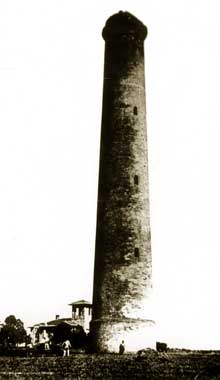
[update] I recently found this old photo that provides a view from beyond the lighthouse:
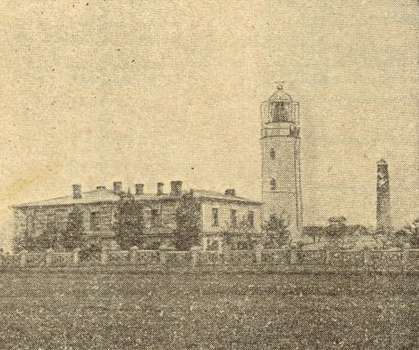
From all the accounts that I’ve encountered the tower was destroyed. But what is this then? I’ll be in Odessa this summer, and I’ll mount an expedition to check this out.
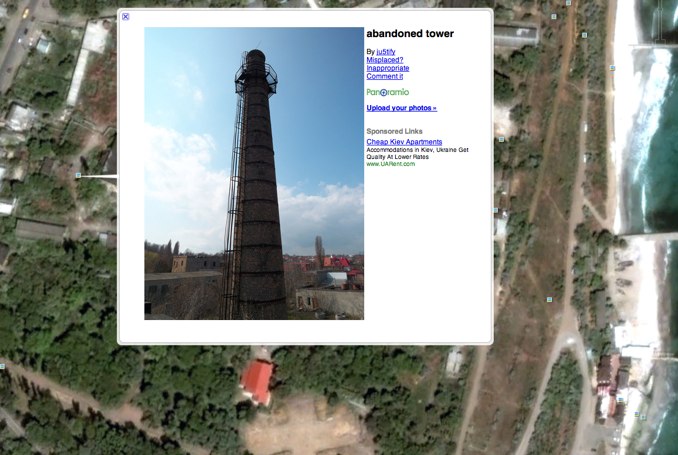
The tower is described as an over-sized chess tower, a tower that looks like a lighthouse, a good navigational aid seen from the sea, and a ominous, dark building.
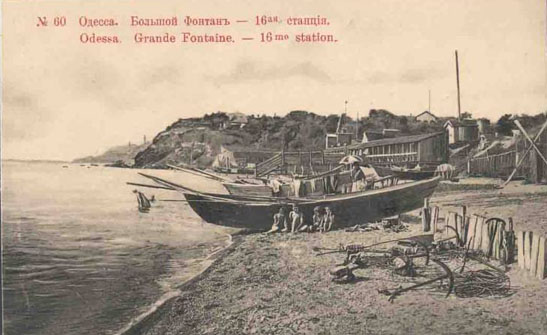
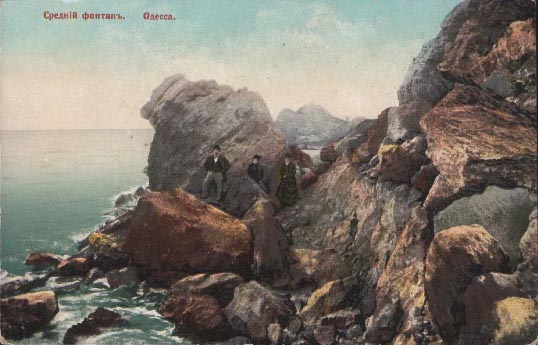
Here are some two old postcards (a photograph and its retouched version) of the Big Fountain cape. There is a lighthouse, and something that looks like a long slender tower. Could that be Kovalevsky’s tower?
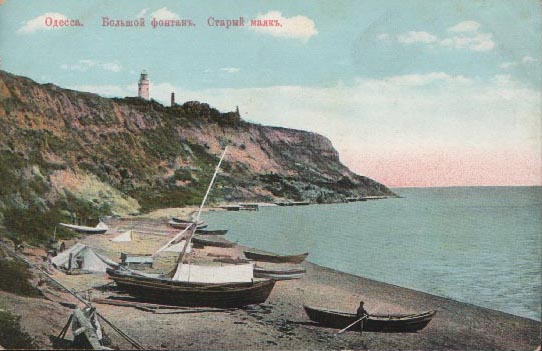
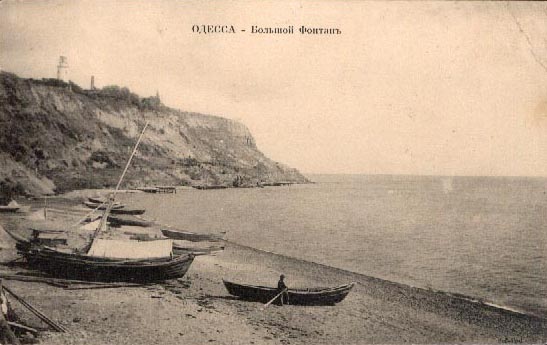
This is what the natural beaches looked like all over Odessa’s coast. I remember beaches near Kovalevskiy’s dacha looking like that when I was little.
Another view of the Big Fountain cape, with a “shalanda” fishing boat. There’s something tower-like in the distance, but it’s very hard to tell.