Amdahl : Business in the Front, Party in the Back

A few years ago I purchased a strange piece of computing history on eBay. Some guy in Canada was selling what he described as a "model" of an Amdahl processor. He did not include a picture with his listing, and because of that I was able to snap it up for about 30 wing-wangs.

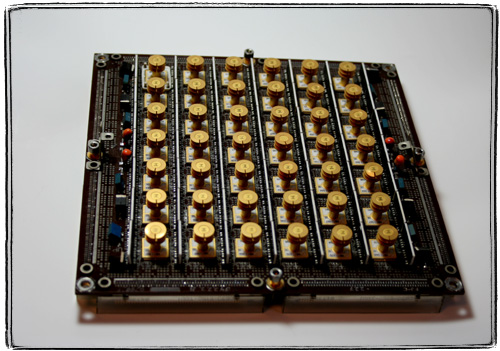
When the package arrived, it turned out to be a real 42 (!) processor board from an old Amdahl mainframe that was "presented to T. Eaton Company for its purchase of Amdahl 5995-3550M processor in June 1992" as the plaque said. T. Eaton Company no longer exists, it was swallowed by Sears. Neither does Amdahl - it is a part of Fujitsu now.

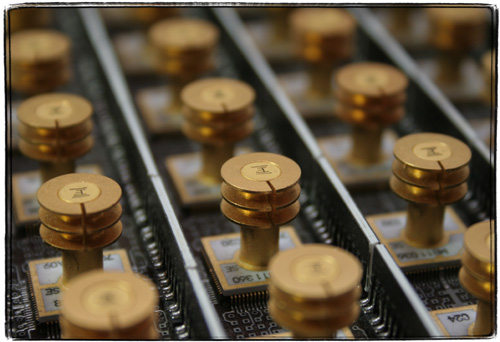
The little cooling towers made it possible to air cool the chips.
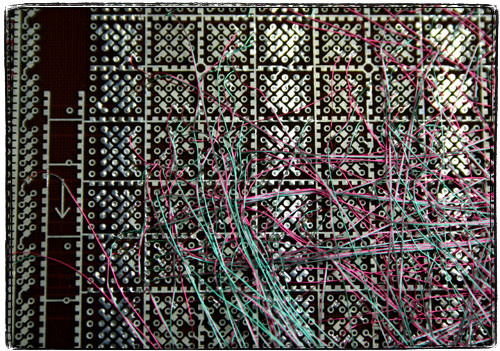
The back of the board was very strange though. All the wiring seemed to be done "point-to-point" by hand. Overall, thinking about how many work-hours went into designing and making that board made me shudder.
[update] Thanks to the Boing Boing liks this seems to have become the second popular post on my site - first one being the Revelation post which gained popularity thanks to being the only google result for "omnioum finis imminet" for a while. I've got some great information from former Amdahl employees:

Tom: "
The item is an MCC (multi-chip carrier) from an Amdahl V8, V7 or V6. Many were plugged into either side of a large frame which connected the MCCs to each other and to power, the console, memory, and the IO cables.

The finned gizmos are cooling towers glued to the top of the individual chips. A plastic cover directed cool air over the towers and fans exhausted it out the top of the frame
hese were used in the 470 series computers. The follow on computer, the 580 used much larger boards about the size of a pizza box. They were inserted into a plenum (which became known as the pizza oven) with ZIF connectors on the side. They had black instead of gold cooling towers with more fins.

The board is circa 1980. The back wiring was done in Japan because they couldn’t find enough people in the US who could do it well. I believe the chips were laser bonded on the front with the hand wiring on the back. Note that the circut boards were multi-layer and the back wiring was only used where they couldn’t get enough paths from the circut boards and for engineering changes after production.
"

NoOneAtAll : "Amdahl used to give out dead hardware and out-of-date engineering samples to their sales guys made into lots of different things. I’ve seen coasters made out of unusable processors, an Amdahl sales binder made from a set of bad carrier boards, a couple of plaques like this one made from DOA MCC modules, pen holders made out of ribbon cable, etc.

An IBM reseller I worked at spent Amdahl’s entire corporate lifetime telling them no. By the time the sales guy gave up, pretty much everyone at the company had been hit up by the guy as a possible lead, and pound for pound there was more dead Amdahl hardware repackaged as kitsch on the desks in sales than we had actually moved in Amdahl equipment. "

[update] Two similar processors just came up on eBay. The picture quality is ghastly, but they seem like a bigger version of the one that I have, with even more complicated back wiring.

P.S. Don't forget to take a look at the rest of my blog, or if you are interested in Amdahl, at the rest of my Amdahl-related posts.

No votes yet

Comments

Fri, 05/20/2005 - 01:36 — Tom (not verified)

The item is an MCC (multi-chip carrier) from an Amdahl V8, V7 or V6. Many were plugged into either side of a large frame which connected the MCCs to each other and to power, the console, memory, and the IO cables.

The finned gizmos are cooling towers glued to the top of the individual chips. A plastic cover directed cool air over the towers and fans exhausted it out the top of the frame.

Fri, 05/20/2005 - 01:41 — jay vaughan (not verified)

quote:Overall, thinking about how many work-hours went into designing and making that board made me shudder.::endquote

see, thing is, i have to say .. whats the big deal? hand-wire my own 42-processor super computer?

hell yeah i'd do that, if i could. sunday afternoons! sheesh, kids these days ....

Fri, 05/20/2005 - 01:50 — deadprogrammer

Right, MCC. I could not find the little piece of paper that came with it that detailed the specs of the old and new mainframes. I think the new one did not use MCCs anymore.

Fri, 05/20/2005 - 01:50 — Schoschie (not verified)

Isn't it weird that the chips are surface-mounted and have lots of rather small pins (typical for stuff built after ca. 1990) but the rest of the board has rather coarse details, and the solder points on the back don't seem to align with what's on the front; and then: hand-wired connections on the back, in 1992? That would be something to be expected from stuff made around the 70s or earlier, wouldn't it?

Fri, 05/20/2005 - 01:52 — deadprogrammer

You know, people who used to wire mainframes were ordinary citizens, not some kind of superheroes. Go for it :)

Fri, 05/20/2005 - 01:55 — deadprogrammer

Yeah, I was pretty surprised to see the back. The board was screwed down to the wooden plaque. I am thinking that maybe they used one of the discarded engineering prototypes for this.

Fri, 05/20/2005 - 01:58 — Tom (not verified)

The board is circa 1980. The back wiring was done in Japan because they couldn't find enough people in the US who could do it well. I believe the chips were laser bonded on the front with the hand wiring on the back. Note that the circut boards were multi-layer and the back wiring was only used where they couldn't get enough paths from the circut boards and for engineering changes after production.

Fri, 05/20/2005 - 02:01 — Tom (not verified)

These were used in the 470 series computers. The follow on computer, the 580 used much larger boards about the size of a pizza box. They were inserted into a plenum (which became known as the pizza oven) with ZIF connectors on the side. They had black instead of gold cooling towers with more fins.

Fri, 05/20/2005 - 02:05 — deadprogrammer

Have you worked for Amdahl? I am pretty much fascinated with all things Amdahl.

Fri, 05/20/2005 - 02:12 — jay vaughan (not verified)

who said anythingn about superheroes? i'm talking about how lazy people seem to be, like how 'spending a few hours working on something hard' is to be avoided at all costs, whatever the rewards ..

leisure-culture shields folk from the reality that most of their life could be doing pretty much whatever they want to do .. for any purpose. build a super-computer, even if it means hand-wiring a few thousand traces? sure!

Fri, 05/20/2005 - 02:14 — deadprogrammer

He heh. Plenum. Here's a word you don't see much, except when buying CAT5 cable. Yet years back I used to hear it almost daily : joint plenum of the Central Committee and the Central Control Commission.

470 series, huh. Again number 47. It's truly a special number, it seems :)

Fri, 05/20/2005 - 02:19 — Tom (not verified)

I worked there from 1982-1990. Amdahl was a great place to work.

I now work for PSI (www.platform-solutions.com) which was spun-off from a research project at Fujitsu/Amdahl. About 80% of the employees here are ex-Amdahl. We even have an Amdahl mainframe and some Amdahl DASD. Gene Amdahl drops by every once-in-a-while.

Fri, 05/20/2005 - 02:20 — Dave (not verified)

I miss the good old days. Wang, Burroughs, Amdahl, DEC/VAX. Too many others to mention.
IBM MVS/OS now considered - legacy.

Fri, 05/20/2005 - 02:27 — deadprogrammer

The previous post I made is about Wang.

Fri, 05/20/2005 - 04:57 — walt (not verified)

I've got two of these, plus some of the newer ones, which have 10 times as many wires on the back. I worked in the Amdahl manufacturing plant for 4 years, then serviced them in the field for another 9 years.

Best company I ever worked for.

Fri, 05/20/2005 - 07:03 — Jedd (not verified)

It's likely that most of that "back wiring" is fixes that were applied after the PC board was already designed. It's pretty common to find mistakes in PC boards and do this. It's likely that this multilayer board was very expensive, leading to the large number of fixes.

Fri, 05/20/2005 - 11:38 — NoOneAtAll (not verified)

Amdahl used to give out dead hardware and out-of-date engineering samples to their sales guys made into lots of different things. I've seen coasters made out of unusable processors, an Amdahl sales binder made from a set of bad carrier boards, a couple of plaques like this one made from DOA MCC modules, pen holders made out of ribbon cable, etc.

An IBM reseller I worked at spent Amdahl's entire corporate lifetime telling them no. By the time the sales guy gave up, pretty much everyone at the company had been hit up by the guy as a possible lead, and pound for pound there was more dead Amdahl hardware repackaged as kitsch on the desks in sales than we had actually moved in Amdahl equipment.

Fri, 05/20/2005 - 15:23 — Cheerful Curmudgeon (not verified)

Fond Memories of Amdahl

Deadprogrammer’s Cafe has a wonderful posting titled Amdahl : Business in the Front, Party in the Back which includes photos of a board out of an old Amdahl 470 mainframe. That was the first “large” computer that I ever used, at the ...

Fri, 05/20/2005 - 22:47 — Mark (not verified)

Ah, such memories. I was in the datacentre of Canada's largest service bureau during the late 70s and early 80s, and then worked for an Amdahl competitor, National Advanced Systems, later Hitachi Data Systems. Among other things, I was in hardware support in the datacentre, and often went into the backplanes of old IBM S/370, S/303x, Amdahl V6/7/8, and of course HDS boxes.

"Dow Jones Prices Up / Buy General Motors Stock"
(the mnemonic for board labelling in IBM backplanes)

Sat, 05/21/2005 - 01:17 — Kent (not verified)

> “Dow Jones Prices Up / Buy General Motors Stock�
> (the mnemonic for board labelling in IBM backplanes)

Man, I'd forgotten all about that one! (wouldn't be so easy to remember these days though ;-)

Sat, 05/21/2005 - 22:33 — deadprogrammer

What does that mnemonic mean?

Sat, 05/21/2005 - 22:36 — deadprogrammer

Wow, I didn't even realize that Gene Amdahl is still alive. Man, if he had a blog, that would be something. I hope he'll write a memoir.

Sun, 05/22/2005 - 00:59 — Kent (not verified)

I'm struggling to remember here, and I could be getting mixed up, but way back when I worked on 3270 and 5250 IBM gear (read mainframe attached and System/36) in the mid to late 80's when engineers actually did detailed diagnosis mnemonics like this were used to help identify the location of connecting pins on a backplane. "Daughter" cards plugged into sockets on a backplane "mother" board. The "sockets" had 16 pins and DJPUBGMS referred to the specific row/column. You also had to identify the particular location of the socket on the backplane so an individual pin ended up with a alpha-numeric code which basically gave it a grid position - I wish I could remember a real example, but hopefully you get the idea.

This was important because if you were doing an engineering change in the field where you maybe had to connect 2 pins with one of those little wires like in the photo's above you had better connect the right pins! And does anyone remember the specific technique and tools you had to use to actually join the wire ends to the pins (wire-wrapping)?! :-)

Tue, 05/24/2005 - 18:00 — Mark (not verified)

Dow Jones Prices Up Buy General Motors Stock was the acronym to remember the arrangements of the daughter boards on the motherboard backplane. There was a 5x4 matrix that was labeled from right to left:

EDCBA
KJHGF
QPNML
VUTSR

with no I or O. (I/O was done in the channel processors... little mainframe humour there... very little...)

The daughter boards were only connected on the second and fourth columns, hence, reading vertically, left to right, DJPU/BGMS. There were sixteen pins, so you might connect a wire from D4 to M10, for example.

I remember two tools: a single (manual) wire-wrap/unwrap tool, and a spring-loaded wire-wrap gun. The blue jumper wires had their ends stripped of insulation, you'd load the end of the wire into the tip of the gun. The tip fit over the pin. When you pulled the trigger, the tip would spin around, wrapping the bare end of the wire neatly around the pin.

I remember that at the company I worked for (I was hardware support manager at the time) we did the first "over 8MB on a IBM 370/168" feature, that was a third-party add-on from National Semiconductor, back in 1979 or thereabouts - might have been a year later, perhaps. It took the crew from NatSemi many, many hours with wire-wrap tools (among other stuff) to do that surgery, to add a 9th megabyte of RAM.

In those days, 1MB of RAM would just about fit in a shoe-box, and cost $100,000.

I'll head over to my rocking chair now...

Thu, 05/26/2005 - 04:54 — deadprogrammer

That is way cool. I have a couple of strange boards with letters, pins, wires jumpers wrapped around pins in the matter that you described and strange thingies plugged into the boards directly. I wonder if this is one of the mainframe patch panels like you described.

Thank you so much for writing this up.

Wed, 08/10/2005 - 11:03 — Scott (not verified)

Actually, -all- the MCCs were plugged into either side of the system in a planar configuration(i.e. the MCCs were edge-to-edge). The 580 changed to a stack configuration.

Notice the 'F' on the top of the gold cooling towers - it's the initial for Fujitsu, the company that mfg'd the chip. Amdahl had to start stateside fabrication in order to meet federal purchasing requirements.

Wed, 08/10/2005 - 11:13 — Scott (not verified)

"... the solder points on the back don't seem to align with what's on the front;"

The reason is that the board had about 14 layers and only the so-called "via holes" went front to back; not the signal traces. The signal traces snaked as far as they could on one layer and if needed, went to another to complete it's route(99.9% s/w routed).

"... hand-wired connections on the back, in 1992? That would be something to be expected from stuff made around the 70s or earlier, wouldn't it?"

The board in the picture is easily a '70s vintage board and definitely not '90s. Those wires(twin lead) were mostly machine bonded and most were there to accomodate the .1% of paths that couldn't be routed by software because of trace availability or signal timing constraints(long paths and races).

Wed, 08/10/2005 - 11:19 — Scott (not verified)

I believe most of the MCC back wiring is there as a result of physical design constraints. Then some were for fixes and some were to implement new features(anyone recall 470/XA; I know no one ever saw it)

Thu, 09/15/2005 - 07:01 — hans (not verified)

Hello,

Could somebody please give me the specs of an amdahl 470 v6. I worked on such a machine as an operator in 1980 in germany. have forgotten everything and would like to give my daughter some comparisons to today's lap top performances.

Thank you,
Hans

Wed, 07/09/2008 - 08:47 — Anonymous (not verified)

The Emitter-Coupled-Logic (ECL) technology required 400hz power. We used either a Motor Generator (MG) or a Frequency Converter (FC) full of ganged giant electrolytic capacitors to change the frequency from 60hz. When I was given one of my first assignments, a couple of the other Systems Engineers (SEs) opened the door of a frequency converter and asked me what did I think. I said uh, don't touch? They smiled and closed the door and told me that was the right answer.

Post new comment

The content of this field is kept private and will not be shown publicly.
  • Allowed HTML tags: <a> <em> <strong> <cite> <code> <ul> <ol> <li> <dl> <dt> <dd>
  • Lines and paragraphs break automatically.

More information about formatting options


 Subscribe in a reader