Blog

  • The Dimmest Lightbulb

    Reading Joel on Software I’ve learned about “rosh katan” and “rosh gadol” – two expressions common in Israeli Army, but very applicable to IT work.

    “Rosh katan”, literally “little head” is used to describe incompetent and/or passive-aggressive behavior. It usually involves following orders literally, without understanding their goal, or understanding, but actively wanting not to achieve it.

    “Rosh gadol”, “big head” – is a way of working proactively, anticipating problems that might arise from orders that are not overly detailed, and following the spirit or the order. You really need to grok your task in order to act “rosh gadol”.

    I asked a co-worker who happened to be an Israeli paratrooper captain in his previous life. He said that they also had a third expression – “rosh nitz-nitz” (I am not sure of the spelling here). “Nitz-nitz”, he told me, is a nickname for an ingenious little device that paratroopers use for identification at night. It’s a little infrared emitter invisible by unaided eye. But when looked at with infrared goggles at night, it allows helicopter pilots to find paratroopers who are ready for extraction.

  • Window Cube

    After more than five years with my current company, I finally snagged the ultimate in attainable by mortal developers status symbols – the window cube. If I crane my neck and recline in my really uncomfortable chair, I can see the same Times Square Building that Joel and his co-workers can see from their comfortable Aerons, except from the opposite side.

    What looks like a fake skyscraper with a hole in the middle is actually a side view of the superstructure that supports the electronic marquee. It looks like there’s a staircase inside the glass-enclosed space.

  • The Ultimate Geek Toy

    Today, for the millionth time someone sent me a link to yet another usb flash drive perversion. Links to usb flash drives made out of weird items seems to facinate blog-reading geeks endlessly. I’ve identified some trends, and I think I came up with an ultimate product that will make all the bloggers absolutely cream their pants.

    Prepare yourselves, iiiiiiiiitt’s the caffeinated open source papercraft usb powered thumbdrive plushy cthulhu katamari sushi tiki ipod cozy voodoo knife holder marital aid with oled keyboard. Did I forget anything?

  • See No Evil

    I don’t care what Sergey says; I think that google.cn is evil. Writing about this in a blog that runs Adsense advertising would be more hypocritical than I usually am, so I removed all Adsense advertising and replaced it with my own ad.

    There. Look at me. I am claiming a slightly higher moral ground.

    I guess I’ll continue using google.com and gmail.com since I am nothing but a drain on their resources anyway. I can’t recall when I clicked on an ad there last time when and it wasn’t a “pity click.” My guess is that they are making their bajillions of dollars from clickbots .

  • Badges And Stuff

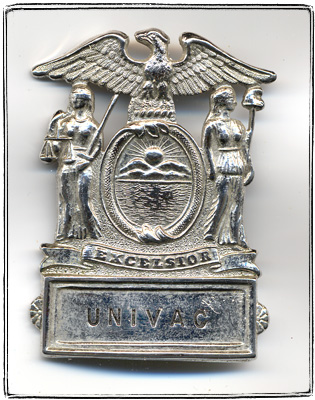
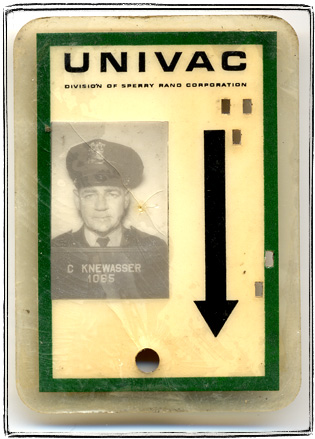
    I picked up for a few bucks this Univac security guard’s shield. Like many security badges it’s based on a New York State Great Seal. The proportions are changed and the figures of Liberty – woman holding a Phrygian cap on a stick (well, actually Liberty pole if you want to get technical) and Justice – woman with a sword and scale. There’s sunrise over Hudson inside the shield, but without the two boats. New York State’s motto Excelsior (which is Latin for “Up Your’s”).

    The plastic laminated id is kind of cool, because it’s a miniature punchcard.

    I guess the manufacturers of rent-a-cop badges are trying to make them subtly similar to NYPD logo, yet different enough not to get in trouble. NYPD badge is based on a similar, yet very distinct New York City Seal. Instead of Liberty and Justice it features American Indian with a bow. The other figure is enigmatic – for the longest time I thought that it was another American Indian holding a dead animal or a tomahawk. In fact, it turns out to be a Dutch sailor holding a “sounding line” – a nautical depth measuring rope. Another useless bit of trivia: Mark Twain chose his pen name from the expression “mark twain”, meaning only two fathoms reading on the sounding line.

    The five stars on the chevron are for the five boroughs, the windmill is for the Dutch origins of New York City. The most unsettling part, is of course the Justice scales that rest on top of fasces, a bundle of sticks with an axe inside – the ancient symbol of authority. Along with the swastika, fasces has been marred as a symbol of Fascism, to which it gave its name.

  • “Dear Japanese Newspeople”

    “No news is good news” – that’s what one of the old Usenet newsreaders used to say when there weren’t any new articles to read in your subscriptions. Is that a coincidence that CNN, one of the two evil companies that employs Lord Vader himself as its mouthpiece, is so obsessed with violent, fiery death? Cartoonist Jeffery Rowland even felt that he needed a special new word coined for this phenomenon.

    CNN.com is a news site that I frequently visit, mostly because the url is so much nicer than http://news.bbc.co.uk, which is superior in all regards to CNN. As far as news goes, I am mostly interested in what’s happening in five countries: the US, Russia, Ukraine, Turkmenistan, Israel and Japan. Why Turkmenistan? Because of the Great Serdar, of course. In any case, not many interesting things happen in Canada or the UK, and I could not care less for France, Germany and the rest of the Snootyland. Communist China and North Korea do not let out any interesting news and news from the entire African continent are usually too depressing.

    Japan, on the other hand, is very close to my heart. Recently I found an outstanding English language Japanese news source, MSN Mainichi Daily News. There’s even an RSS feed for it.

    What’s different in Japanese news? Well, first of all there’s a lot more sex-related news. American news are heavy on violence, but light on sex. MSN Mainichi Daily News are full of headlines very much in the spirit of one famous hacker’s “Dear Japanese People” posts.

    Right now, the headlines are full of stories about a 57 year old fortune teller living with a “harem” of “about 10 women.” An older popular news story featured an embezzling accountant who spent stolen money on 17 mistresses.

    Swimwear photo specials are frequent and highly detailed. Booth bunnies also get photo coverage. Sadly, Japan Swimsuit Association does not have its own website.

    There’s some coverage about “maid cafes” for “otaku” in Akihabara (you can see Kitya’s post for photos.

    Unhealthy Japanese obsession with schoolgirls is clearly present in the news: not a day goes by when there isn’t a schoolgirl sex-related article on Mainichi. Here’s a typical one:

    “A man who licked the tongues of more than 30 young girls after making them open their mouths, telling them he was checking for tooth decay, has been arrested, police said”.

    It gets more complicated than that:

    “The two 18-year-old, third-year high school girls, whose names are being withheld under the Juvenile Law, threatened on Dec. 29 to reveal that the 19-year-old private 1st class had sex with one of them unless he handed over 2 million yen, local police said.

    They forced a 21-year-old lance corporal who was accompanying the private to withdraw 400,000 yen from an automatic teller machine at a convenience store in Sasebo and received the money from him.

    The girls subsequently demanded 1.6 million yen from the GSDF soldiers. However, the soldiers consulted police, who arrested the two girls.

    A fisherman and two other men were earlier arrested for giving the girls advice on how to extort money from the victim.”

    US military men are frequently in the news for murder, rape, tresspassing, and robbery. This is not good, and mostly unreported here, in the US.

    Japanese news agencies are no stranger to violence. A particularly unsettling trend that I noticed is an abundance of stories about family violence in Japan: “Man stabbed parents because they wouldn’t drink his miso soup“, “Man arrested for leaving bed-ridden, elderly mother to die“, “Woman nabbed for fatally kicking boyfriend“. It gets weirder, too: “Jobless man sets fire to futon in house after mom refuses to buy him dolls.” Overall, all these stories feature jobless people.

    Violent (“Homeless man stabs abusive youth in stomach“) and non-violent homeless people (“Homeless man can officially register a public park where he lives as his residence, a court has said“) are often in the news.

    We all think about how safe life in Japan is, but according to the news that I see, if the jobless, the homeless and the US servicemen won’t get you, train crashes, heavy snow, natural gas or sticky rice cakes will: “4 die after train blown off tracks in Yamagata“, “Elderly woman trapped in heavy snow freezes to death“, “Natural gas kills mother and children at hot spring“, “4 Kanto residents choke to death on sticky rice cakes“.

    All those people got killed in heavy snow, yet mount Fuji was missing it’s snow cap last year. Strange.

    The conflict of Japanese whalers and Greenpeace activists gets a lot of coverage: for some reason I’ve never seen this picture of a Greenpeace dude nearly harpooned to death anywhere else.

    Two Japan-specific stories that don’t get much play in the US news is the Livedoor scandal and the badly constructed “twin” condo buildings. The Livedoor news get funny sometimes: “Convenience store chain am/pm Japan has decided to pull an energy drink developed by former Livedoor President Takafumi Horie off its shelves because it doesn’t want to sell items associated with scandal-tainted people, it has been learned“.

    New Year’s cards (“nengajo“) are apparently a very serious business in Japan. From what I understand, they are supposed to be delivered exactly on January 1st. There was a flurry of news items like “Feces in 2 mailboxes stain 140 New Year cards“, “Post office to redeliver New Year’s postcards that arrived too early“, “Post office in Osaka to deliver 35 New Year’s cards a year late“. Big whoop. By the way, while we are on the subject, check out Japanese New Year’s prints by master woodblock printmaker David Bull.

    There’s a section called “WaiWai“(with its own RSS feed). I am not sure what it means, as Wikipedia tells me that “Wai Wai” is a noodle snack.

    The headline writers for Mainichi are prone to using puns and old-fashioned American slang, although not always very smoothly: they really overuse the words “nab”, “pinch”, “clink” (prison). Sometimes it feels like you are reading an old detective story.

    This quote also is kind of unsettling:

    Foreign sex workers get dirty digging for Japanese roots: “Gentlemen may well prefer blondes, but Japan’s not-so-gentle men seem to, as well, sparking a rapid increase in the number of South American sex workers with more yam than Yamato running through their veins to claim Japanese heritage, according to Spa!”

    “More yam than Yamato”? What the hell?

  • What Up

    The following will probably be only interesting to people who build their own computers (and probably not even them), so feel free to skip this post.

    My little Shuttle XPC computer gave up the ghost (the onboard SATA raid controller got really messed up). It took me a good while to frankenstein together a reasonable machine out of all the parts that were stashed away in my apartment, so I am a-computin’ again. I am researching a purchase of a high powered replacement, but meanwhile, let me share some technical tidbits that I’ve learned along the way.

    First of all, it’s really easy to actually fry a floppy drive. Fried floppy drives look like they are working, but they don’t. And without a floppy drive you can’t install (or repair) Windows 2000 or XP on a SATA or IDE raid array. Even if your motherboard claims that it can boot from a USB floppy drive, it probably can’t. Well, at least mine can’t. The moral of the story is that doing away with legacy hardware such as a floppy is not a good idea.

    Anyhoo, it’s a good idea to have separate two drive arrays: one for data and one for the system and programs (it’s a good practice to point data directories such as the desktop to the data array). The data array should run raid 1 (mirroring) – that way if one drive dies, you will still have another. You can periodically backup onto a third drive and hold it in a remote location. With 250 gig SATA drives costing about 100 bucks there is no reason not to do this.

    The system drive should run raid 0 (striping). Striping actually significantly speeds the system up. You can also keep the system drive small, say about 40 gig – and back it up onto the data drive via Norton Ghost. It might be a good idea to splurge on real SCSI drives and a card. In fact, that’s what I’ll probably do for my new computer, as drives seem to be more of a speed bottleneck than RAM or processors.

    SATA drives can be mounted externally: it’s called eSATA. If you have a small computer such as an XPC it’s a very good idea, as the drives become much easier to cool. I am probably going to jerry rig an eSATA enclosure out of an old computer case and some hotswap thingies, but they are also available from these guys.

    I am a big fan of dual monitors – have two 17″ lcds. To run a dual monitor setup you need either two video cards or a “dualhead” video card. Well, I have a dualhead Matrox P750 (bought it because it has 2 dvi outputs), and boy does it suck. Driver installation is a nightmare – there are several versions of video card bios and and a multitude of driver versions. Most don’t work and crash Window. If you do get it to work, the stupid card can’t work well with low color/resolution settings: it shows lines and crazy patterns in bios screens. There’s a bios fix out, but it does not work. More than that, if you want to color match the monitors through a calibration cajigger, you can’t set up individual color profiles on the monitors. In short, I am much better off with two separate cards.

    Ad:


    Did you know that you can color calibrate your monitor with a nifty usb powered gadget so that your digital photos will stop looking like crap? I’ve used one for a while, and it rocks!

    GRETAGMACBETH Eye-One Display 2 (This is the one that I have. People say that it’s a little bit better than the cheaper
    ColorVision Spyder 2)

    ColorVision Spyder 2

  • The Real Estate Hogs and The Coin Counting Robot

    Remember that The Simpsons episode where Starbucks swallows every store in Springfield mall?

    “… Bart, while walking through the Springfield Mall, passing several Starbucks, goes into a store called “In and Out Piercing”.
    Employee: Can I help you?
    Bart: I’d like to get my ear pierced.
    Employee: Well, better make it quick, kiddo. In five minutes this place is
    becoming a Starbucks.
    Bart gets his ear pierced, and has a diamond-shaped clear stone inserted into the new hole. As he leaves the store, it, like all of the other stores above and around it, is transformed into Starbucks.”

    New York City was one of the last markets that Starbucks entered, mostly because of high real estate costs. But besides Starbucks, there are two types of businesses that swallow an enormous portion of commercial space in NYC: drugstores and banks. Whenever you see a sizable store for rent, it’s almost inevitable that it will become a drugstore or a bank.

    The drugstore business is not particularly profitable, but one chain, Duane Reade, seems to be opening store after store. In my neighborhood there are two Duane Reades one block from each other, and several other equally lame pharmacies. There’s an interesting article called The Mystery of Duane Reade which among other things, addresses a question just as interesting as “Who is John Galt.” Unlike Galt, Duane Reade is not really a person. The crummy drugstore chain derives it’s name from the first store that was located on the corner of Duane St. and Reade St. in Manhattan.

    Banks are even worse real estate hogs, and are popping up even faster than Duane Reade and Starbucks. There are two stores that went out of business recently in my neighborhood, and both are being replaced by banks. There’s a bank across the street from where I live, and one or two on almost every block. Yet there are no supermarkets bigger than a tiny little Pioneer in a 20 block radius.

    The stiff competition is forcing banks to offer new services to attract customers. Commerce Bank, for instance, offers a service called “Penny Arcade.” They basically have change-counting Coinstar machines without the fee. All you have to do is get the receipt from the machine, and the cashier will exchange it for paper money.

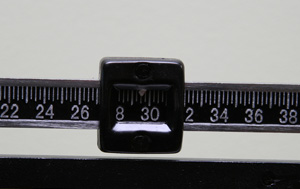
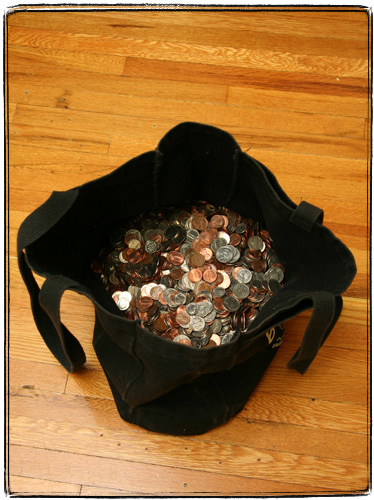
    During the last major cleaning fit that I had, I took my overflowing coin bowl and dumped it into a canvas bag. I weighted it on my Health-o-Meter physician’s scale which is exact to within 1/4 lb. The scale read 29 1/2 lb.

    Here’s what 29 1/2 lb of coins in a Strand bag look like:

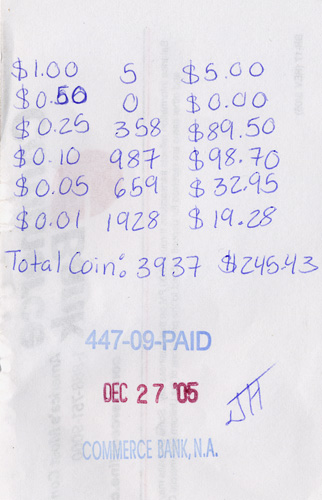
    I dragged the heavy money bag to the bank, and proceeded to empty it out, handful by handful into the Coinstar machine. I had to suffer loud and annoying cartoon voice aimed at kids and overall felt like a dork, but I got rid of all the change and cashed in my printed receipt. As I was curious of the how exact the coin count was, I asked the cashier for a copy of the receipt. She had to do it by hand for some reason, but here it is:

    To calculate how much this should theoretically weight, I need to do a little bit of math. A dollar coin weights in at 8.100g, quarter at 5.670 g, dime at 2.268 g, nickel at 5.000 g and penny at 2.500 g (according to the US Mint)

    This gives us: 5 * 8.100g + 358 * 5.670 g + 987 * 2.268 g + 659 * 5.000 g + 1928 * 2.500 g = 12.423876 kg

    12.423876 kg = 27.3899581 lb.

    That’s about 2.1 lb difference from my original weight. The machine rejected a Chinese coin, two Boston subway tokens and a few coins with gunk on them. The bag probably weights at most 1/2 lb. So it seems that the coin-counting automaton cheated me out of a pound of coins. That’s about 9 bucks by my calculations.

    [Update] I’m told that pre-1982 pennies weight 3.1 grams instead of 2.5, so my calculation is a bit off.

    Of course, my experiment is far from exact. It depends on the number of factors, such as the possibility of my scale being not as precise as I think or the possibility that coins lose some weight after being in circulation. But somehow I highly suspect that the Coinstar machines are undercounting. Wall Street Journal journalist ran an experiment with a remeasured amount of money. I can’t find the original article, but this quote about $87.26 seems to be floating around a lot:

    “For consistency, we began with equal piles of $87.26 worth of pennies, nickels, dimes, and quarters that we had gotten from a local bank in coin envelopes.

    Talk about a tough economy. The machines at both Commerce Bank and Coinstar gave us less back than we put in — Commerce Bank missed by a whopping $7.02, while Coinstar was off by 57 cents.”

    Where is Eliot Spitzer when you need him?

    Ad:


    Health-O-Meter Physician’s Balance Beam Scale: a must have weapon in the battle of the bulge.

    A “rogue” (read “somewhat sloppy, but very interesting”) economist tries to answer tough questions, such as: What do schoolteachers and Sumo wrestlers have in common? How is Ku Klux Klan like a group of real-estate agents? Why do drug dealers still live with their moms? Where have all the criminals gone?

  • New Billboard Day Effect : How to Advertise More Effectively on Your Blog

    Advertising. “The Engine of Commerce”. Ideally, it should work like it does in the Simpsons episode 2F12 “Homer the Clown”:

    “In the middle of driving down the highway, Homer skids to a halt in front of a billboard.

    Homer: [gasps] It must be the first of the month: new billboard day!

    Homer: [reading] “This year, give her English muffins.” Whatever you say, Mr. Billboard! [skids off]
    [stops suddenly at another billboard for barbeque sauce]
    [cars collide behind him and explode]

    Homer: [reading] “Best in the West.” Heh heh heh, that rhymes!
    [looking at the next one] “Clown college”? You can’t eat that.

    At the power plant, Homer piles his purchases (including MSG, “Best in the West”, and English muffins) at his work station. “Well, I got everything I was supposed to get. I’m not going to enroll in that clown college, though…that advertisement had absolutely no effect on me whatsoever. In his daydream, he imagines himself sleeping and dreaming of himself eating a sandwich. The billboard for the clown college batters its way into his thoughts. The Krustys on the billboard start dancing to circus music.”

    Of course, Homer enrolls in the clown college. Having never enrolled in a clown college because an ad told us to, we all go on thinking: “advertisement had absolutely no effect on me whatsoever.” It can’t possibly be true: bajillion dollar industries, such as advertising don’t simply exist if they are not effective.

    During the dot com bubble even large companies mostly failed to earn much from banner ads. Even the heaviest online ad campaigns did not seem very effective and suffered horrible clickthrogh rates. Online ad companies escalated the war for clickthroughs by inventing obnoxious popunder, popover and floater ads. The more the ad was like a flash-bang grenade mistakenly used by NYPD on an elderly woman, the better. For instance, many sites started using larger sizes of vertical banners known as “Skyscraper.” That was not enough though – extreme, flash-driven skyscraper ads with movies and sound, capable of crashing browsers and known as “Godzilla” and “Pagekiller” started to appear.

    The founders of Google decided to address this issue, and as a result, made bazillions of dollars. As a former googler remembered:

    ” Besides, Larry and Sergey hated these kinds of advertising. In fact they hated most kinds of advertising as inefficient, dishonest and a total waste of people’s (meaning their) precious time.”

    We all know that AdWords and AdSense, Google’s advertising programs managed to earn so much money through unobtrusive, mostly text ads. The winning strategy was “relevancy”. Google’s server would read in the page where the ad were to appear, and serve up a relevant ad.

    For instance, after parsing pages on chupaqueso.com, a site dedicated to a cheese snack invented by web cartoonist Howard Tayler, in theory shows ads about cheese. And after reading about chupaqueso’s cheesy goodness, I might indeed be in the mood to buy some cheese online.

    On the other hand, the AdSense algorithm is not too efficient. On some pages in the abovementioned site it serves ads like this:

    Yes, indeed, amongst Howard Tayler’s readers there are a lot of computer geeks. I know I am not a typical web user, but I am a pretty typical web developer. And I have zero desire to “Boost XML app performance.” I also have all the “ODBC drivers” that I need.

    Many of you, my readers, are bloggers or have regular web sites with AdSense ads. Look at them. How many you’d say are “inefficient, dishonest and a total waste of people’s … precious time”?

    I say – about 99.5%. And clickthrough ratios are pretty horrible. People try to tweak them by playing around with ad types, look and feel, positioning and excluding advertisers, but it’s all rather ineffective.

    Google’s ads only pay if people click on them. In the TV, billboard, magazine and the type of advertising that people tattoo on their bodies there’s no such things as clicks. You get paid depending on how many people see the ad. It works really well if you need to make people remember your company’s name or logo.

    Side Note:
    When I was little, in Odessa ( Ukraine, Not Texas) somebody scribbled in almost every public phone booth “[Some girl’s full name] is a whore.” In a city of about a million people this worked like a charm. The mindshare that that advertisement delivered must have been off the charts.

    These 99.5% of unclickable ads can be divided into two categories: a) ad campaigns that build brand’s awareness almost for free and b) those that indeed waste everyone’s time and money.

    I don’t think I ever clicked on any Vonage ads, even though I’ve seen thousands of them. They worked without any clicks — if I did not also know that their customer service sucks and reliability is horrible, I’d have their VOIP service now.

    The ads that nobody ever cares about still do get some clicks. When people come by a useful and interesting site, they tend to click on random ads so that the site owner would get some revenue. This is the untraceable portion of a much scarier phenomenon called click fraud. I am not even going to address this here.

    In short, I feel that even though Google’s ads are a step in the right direction, AdSense sucks, especially for a blog with a smallish audience, such as mine. The useless, stupid ads that clog AdSense are a waste, even though they might generate a few “pity clicks.” Only half of my ad revenue for the site came from AdSense last year. The rest came from my experiment that I think will be of great interest to everyone.

    My thinking went like this: I want to serve ads that are extremely relevant to my blog posts and interesting to my audience. Even more importantly, they must be selling something that I would be interested in. Ads I’d click on.

    When you have limited advertising space, the problem with AdSense is that it often tries to sell things that your readers don’t want. What you want to do is advertise things that people aready want. As an example of such salesmanship, let me direct you to a post on the very popular waiterrant.net, where The Waiter describes selling dessert to calorie-conscious women:

    “”Ladies,” I say sweetly, “We have some excellent desserts tonight.”

    “Oh, nothing for me,” Bubbly Blonde replies.
    “No dessert,” Severe Brunette says, holding up her hand.
    “Me neither,” Lawyer Babe says firmly.

    The fourth woman, a Soccer Mom type, looks at her companions and sighs. She wants dessert.

    I see the longing for chocolate in Soccer Mom’s eyes. She’s my weak link. My in.

    “Would anyone like some coffee?” I ask. Suggesting coffee is the first stage in selling dessert to calorie resistant ladies.”

    “The ladies pay the bill, tip well, and leave. As I watch them go I think about how I got them to order dessert. To be a good salesman you have to have a seductive quality about you. Don’t believe me? Look at pharmaceutical reps.”

    That’s what I want to do! This means that I need to find something that will be the equivalent of selling chocolate dessert to Soccer Mom types.

    I believe that my 1000 readers are a lot like myself. And what do I spend a huge amount of money on every year? Books, movies, cds and gadgets. Also I purchase some rather esoteric items on eBay too, but the majority of my spending happens squarely at Amazon.com. My wishlist there is humongous, and in fact, I spent my advertising revenue there.

    Luckily, Amazon has a pretty generous associate program. You can link to any of the products they sell and get a cut of the sale price, if the sale happens as a result of your clickthrough. In fact, you get a cut of the entire shopping cart amount (I am not sure, this could be only the items that were added after the click). In any case, it’s decent money, and most importantly, a great selection of new and even used items to sell.

    What to sell, of course depends on your audience. I found some success selling items that tempt me. In fact, many times it’s the items that I am planning to buy or already bought.

    In some cases, relevancy is important. My article with pictures from Fog Creek’s party sold 4 or 5 of Joel’s books. It was a combination of a very desirable in this particular audience product with a closely related article. Interestingly enough, I tried to sell the toy that you can see in the picture as well, but none sold. As I own both books and don’t own the toy, this seems logical.

    I might have tried selling flat panel monitors and Aeron chars (WOW, Amazon sells them too! ) ,that make Joel’s office so nice (in fact, at home I have the same exact dual monitor setup, an Aeron chair and a window with a view, and I had id before Joel wrote about his bionic office). These are big ticket items though, and the likelihood of someone buying them on a whim is lower. But then again, so are rewards.

    The relevancy does not matter as much as I thought, though. For instance, I advertised “Make” magazine subscriptions and Shure E2c headphones, and sold a few.

    In fact, I think that the approach to selecting products should be somewhat similar to the one that Kevin Kelly uses for selecting items on his website Cool Tools:

    “Cool tools really work. A cool tool can be any book, gadget, software, video, map, hardware, material, or website that is tried and true. I am chiefly interested in stuff that is extraordinary, better than similar products, little-known, and reliably useful for an individual or small group.”

    In short, advertising video iPods is good, advertising “The world’s greatest 3D IM” is not!

    Side Note:
    My former co-worker won a $300 gift certificate for a certain gadget catalog in a contest. Now, he’s a guy who spends a lot of money on gadgets, like the uber geek that he is. I mean, he owns planetofthegeeks.com domain. But despite that, he had a lot of trouble picking something to spend $300 of free money on in that catalog! Not only was everything overpriced, but there were very few things he’d be interested in owning!

    The great thing about selling items from Amazon is that you know that the prices there are very Wal-Mart-like, and most of your readers already shop there. Some people prefer not to patronize Amazon because of software patents or other issues, but there are “organic” alternatives, like for example Think Geek (in fact they sell through Amazon too).

    The one gripe that I have with Amazon is the difficulty in creating the links. The tools that they provide want you to use iFrames to create image wrapped links, which of course do not work well in RSS Readers. This brings me to my final point, the specifics of blog advertisement.

    A blog is a two-sided entity: it generates page views from people who don’t use RSS aggregators and those who come in from search engine referrals. And then there are the views from within RSS aggregators, in case you are serving up the entire text of the article in the feed. Some blogs don’t do this, serving up only the title or a title and a teaser. The thinking is, readers will click through to the page where they will see ads and thusly generate revenue. Some do this because they don’t serve ads and want to limit their traffic, and yet some do it because they use a default setting in their blogging software and don’t know better.

    The great thing about my advertising scheme is that you can serve ads in-feed. A New York blog Gothamist, for example serves atrociously uninteresting ads that repeat. At some point they had a long run of a flashing ad for something that made me unsubscribe from the feed. If they started selling interesting items, they could greatly increase their advertising revenue.

    Advertising my way does not detract from regular content and isn’t cheesy. It is clearly marked, unlike those fake editorials in magazines and newspapers. Advertisement can be entertaining in itself! Since the early years of Sears, Roebuck and Co. catalog, people look through catalogs like Levenger, Victoria’s Secret Penzeys Spices and Think Geek for fun! My wife has a lot of gardening catalogs that she looks through now and then. After finishing an interesting post, readers would not mind learning about an interesting gadget or book they might want. In fact, they might already be in the mood to buy it! There is no reason to serve partial RSS feeds with this type or advertising.

    P.S. I turned off comments to this article because for some reason it attracts a ridiculous number of spam comments. If you would like to contact me, see about the author section. I also changed to a different way of displaying Amazon’s related items.

  • I’m Still Here!

    As you might have noticed, dear readers, my blogging frequency is not what it used to be or should be. It’s not that I have writer’s block – in my GTD project folder I have enough notes for several hundred posts. But with the time constraints that a new baby, a demanding day job and several Quadrant II projects put on me, I have trouble finding motivation to sit down and craft my posts.

    Still, blogging in itself is a Quadrant II activity, and even though so far I failed to make any real-life friends with it or attain any career-related connections, there’s the question of monetary gain. Belieive it or not, but even a small blog like mine, with only about 1000 readers or so, makes me enough money to pay for the hosting fees, and then buy myself a significant New Year present. I am talking a rather nice and expensive lens kind of money. Over the time, I had some thoughts about online advertising, and today, in order to make up a little for my blogging hiatus, let me share them with you in the next post.