

Blog
-
Happy New Year!

I don’t know if anyone is still reading this blog, but here’s the latest digital (and prophetic) New Year’s card. This was a good year, and things are looking good for 2015. I’ve lost most of the weight that I gained in the previous 5 years, got a new job, completed a number of interesting projects.
Happy New Year!
-
Aspirational Sugar
Instead of a usual blog post I decided to do something akin to a “trail” that Vannevar Bush was talking about in his famous essay. It’s a jumble of quotes and a story all on the subject of happiness and wealth.
My grandfather once told me a story about aspirations in 19th century Russia. Sugar was considered a luxury item back then, and did not come in highly refined granules. Instead it was purchased in the form a sugarloaf, a gigantic cone of pressed sugar. A sugarloaf would be stored in a special box, and pieces of it would be snipped off. These lumps of sugar were not like modern sugarcubes, they were darker and did not dissolve as easily. Those Russians who could afford sugar would usually drink tea “vprikusku” — through a lump of slowly dissolving sugar held on a tongue. It was considered to be more economical than dissolving sugar in tea, which was known as “vnakladku”.
So the story goes like this. A peasant is drinking tea with no sugar. But he dreams: if I were a merchant, I’d drink tea with sugar “vprikusku”. If I were a nobleman, I’d drink tea with sugar “vnakladku”. But if were the czar, I’d make a hole in the sugarloaf and drink tea out of it.
Felix Dennis’ rich/poor scale from “The Narrow Road: A Brief Guide to the Getting of Money”
£1m – £2m The comfortable poor
£3m – £4m The comfortably off
£5m – £4m The comfortably wealthy
£16m – £39m The lesser rich
£40m – £74m The comfortably rich
£75m – £99m The rich
£100m – £199m The seriously rich
£200m – £399m The truly rich
£400m – £999m The filthy rich
Over £1bn The super rich
The famous dialog from Office Space:
Peter Gibbons: What would you do if you had a million dollars?
Lawrence: I’ll tell you what I’d do, man: two chicks at the same time, man.
Peter Gibbons: That’s it? If you had a million dollars, you’d do two chicks at the same time?
Lawrence: Damn straight. I always wanted to do that, man. And I think if I were a millionaire I could hook that up, too; ’cause chicks dig dudes with money.
Peter Gibbons: Well, not all chicks.
Lawrence: Well, the type of chicks that’d double up on a dude like me do.
Peter Gibbons: Good point.
Lawrence: Well, what about you now? What would you do?
Peter Gibbons: Besides two chicks at the same time?
Lawrence: Well, yeah.
Peter Gibbons: Nothing.
Lawrence: Nothing, huh?
Peter Gibbons: I would relax… I would sit on my ass all day… I would do nothing.
Lawrence: Well, you don’t need a million dollars to do nothing, man. Take a look at my cousin: he’s broke, don’t do shit.
-
How To Become Rich By Reading (Not Writing) A Self-Help Book
There’s a moment in just about every reader’s life. A moment when you get a temptation to pick up and read a self-help book. Well, what if I’ll learn how to win friends and influence people (you do it with positive thinking), study the 7 habits of the highly effective people (most of the habits have to do with positive thinking and buying a nice leather organizer), learn “the Secret” (“the Secret” is positive thinking), get things done (you write down all your brilliant ideas in a whole bunch of folders and buy a really nice label printer) — maybe then I’ll become rich, you think.
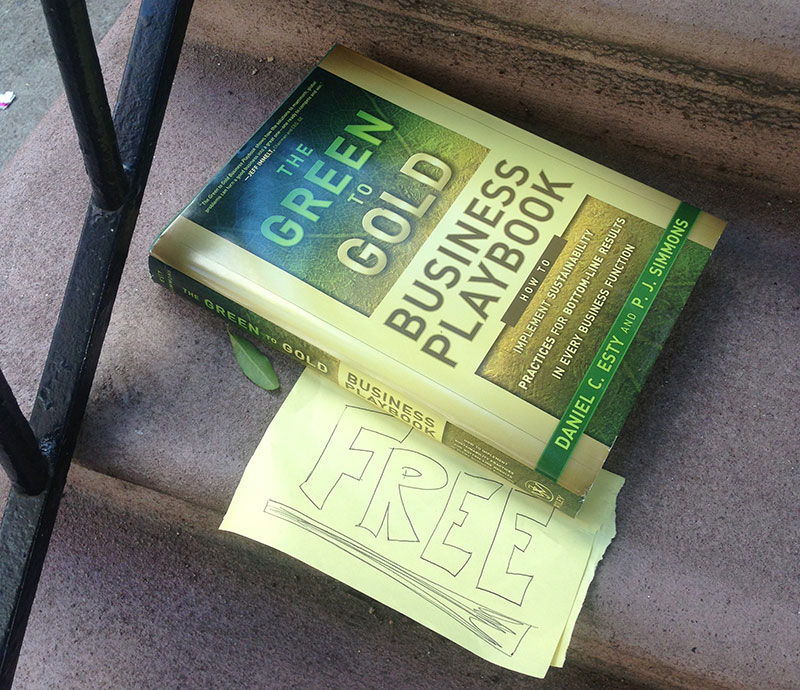
Yes, the self-help industry probably created a lot of millionaires. Most of them are the people who sell the books, seminars and organizing tchotchkes. I’ve also heard about one dude who found an obscure Victorian era self-help book, scanned it, replaced all the outdated words in it, turned it into an eBook and made some serious bank selling it on a website.
Maybe there are people who have awoken the giant within and now have a 4 hour work week. I simply don’t know. I’ve met a few billionaires and a many millionaires, and I’ve listened to many of them telling the story of how they became rich. Most of the stories involved luck, very good sales and people skills, perseverance, and hard work. But only twice I’ve heard a self-help book with a preposterous title mentioned by these people. This book did wonders for them. I’ll tell you what this book if you’ll buy my book or send me $100 via PayPal. Well, all right, since you’ve been reading my blog for so long I’ll tell you. That one book is … drumroll … Sams Teach Yourself Perl in 24 Hours. The funny thing is that wealth creation can be accomplished with magic words that look similar to this:
my $dbh = DBI->connect(
        "DBI:$driver:$database",
        $user, $password,
    ) or die $DBI::errstr;
Side note: there’s no apostrophe in “Sams” because the company is named after not after somebody named Sam, but after Howard W. Sams, a contemporary of Dale Carnegie.
In any case, the internet is lousy with stories of absolutely ordinary people who became rich after picking up a computer language book. You don’t believe me? Read this one and let me know what you think.
-
The Turkish Coffee Syndrome
There are two Turkish restaurants near my house. Both are inexpensive, authentic places ran by native Turks. They sell the usual fare: lamb shish kabobs, adana kabobs, cigara boregs, tripe soup, fresh Turkish bread. There’s one thing that is missing from the menu: Turkish coffee.

Photo by vagabondtravelsThat’s right. I’ve asked for it a number of times, and I’ve heard numerous other restaurant patrons ask for it only to be told that it’s not on the menu. Recently a friend of mine, also incredulous at this glaring omission, asked our waiter why exactly Turkish coffee is not served there. The waiter, apologetic, explained that they used to serve Turkish coffee in the past, but it encouraged local retirees to take up the valuable table spots while buying a single cup of coffee. He pointed out that they now migrated to the nearby Dunkin’ Donuts, where now you can’t find an empty table.
Interestingly enough, prior to learning the mystery of the missing coffee, me and my friend were talking about certain technological deficiencies which were caused not so much by stupidity, but by near-pure malice. I also told him about my (now over a decade old) theory that I call “Reverse Hanlon’s Razor“. I think “the Turkish coffee syndrome” is a much catchier name.
In looking at CMS design or hosting nightmare, I often remember this passage from Ellen Ullman’s book:
Well, sometimes it is stupidity. But more often than not the problem is not technogenic in nature. Often it’s political or business-driven. It’s not that the restaurant owners don’t know how to make Turkish coffee. The coffee pots (cezve) and finely ground coffee are sold next door. It’s not even that it takes too long to make the coffee (although that might be a part of the reason). It’s just that the rents in my neighborhood are very high and the table space is at premium, and coffee drinkers tend to linger.
-
Valuable Photos
An acquaintance of mine spends a lot of money on travel and cameras, more than just about anyone I know. But you won’t find photos of famous landmarks amongst his pictures unless he’ll find a way to take a picture of something that nobody photographs – like a bathroom or a service entrance. His photos will stand the test of time.
Collectors of old photos know this: photographers have a herd mentality. In early photographs portraits are very common, but pictures of anything other than people are rare. Yes, old cameras were bulky and hard to use outside, but it’s still not a good reason: the earliest surviving photo is a view out of a window.
There’s a type of a photo that I despise the most: one of a flower. If you have an expensive camera with a nice lens you can go to a botanical garden and take a hundred gorgeous pictures of pretty plants with a pretty blurred background (coin-a-sewers of this type of photos like to discuss “bokeh” – the quality of the blurred background specific to a lens).
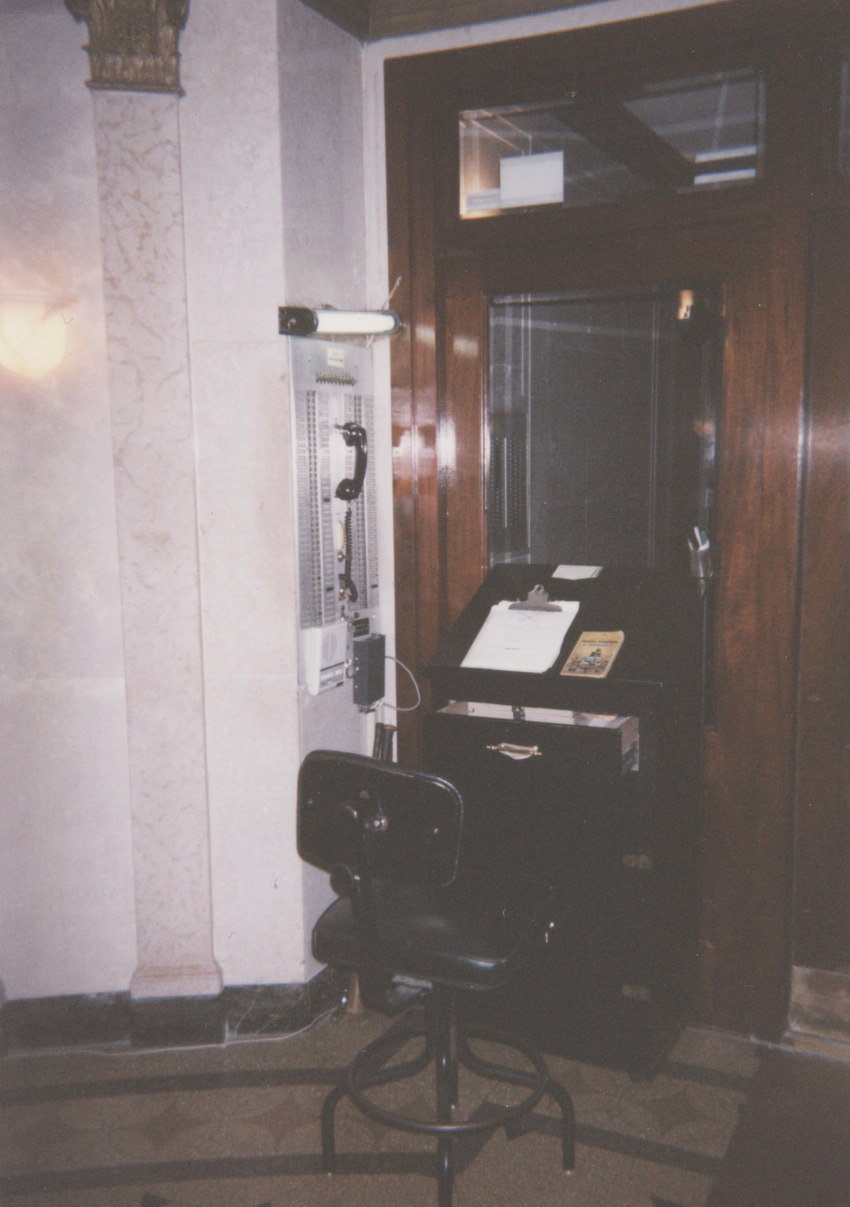
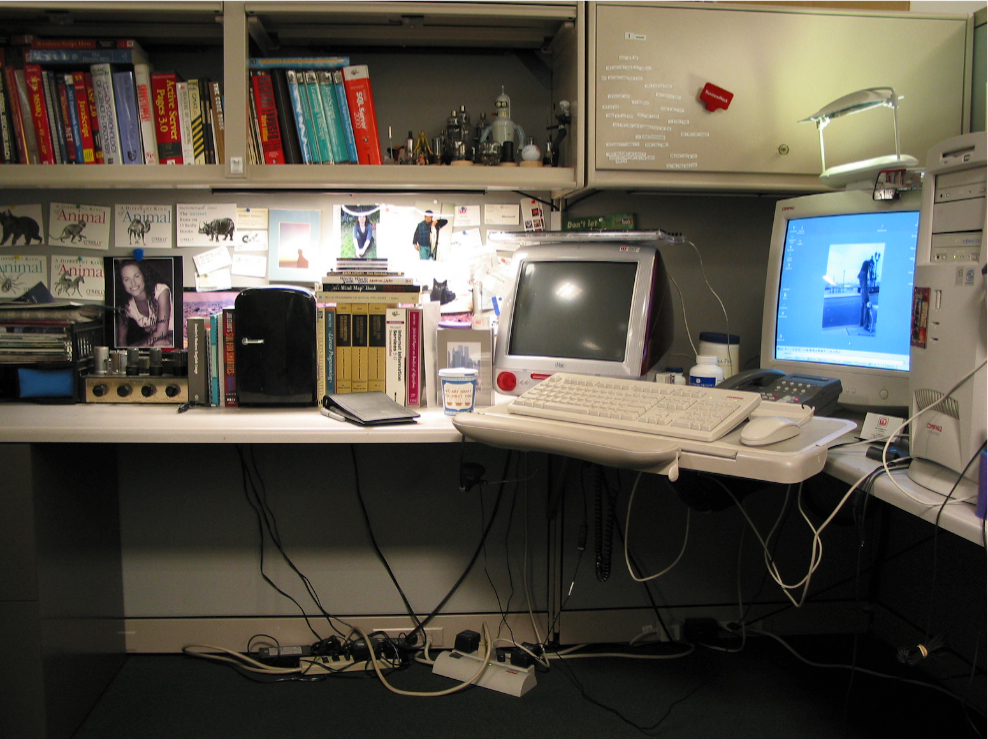
And then there’s one type that I like a lot: pictures of workspaces. My advice to you is to take more of those. Forget flowers, sunsets and landmarks: looking back you’ll enjoy these much more.
Here’s a blurry photo of my doorman’s desk from college years:
And here’s my desk at TV Guide.
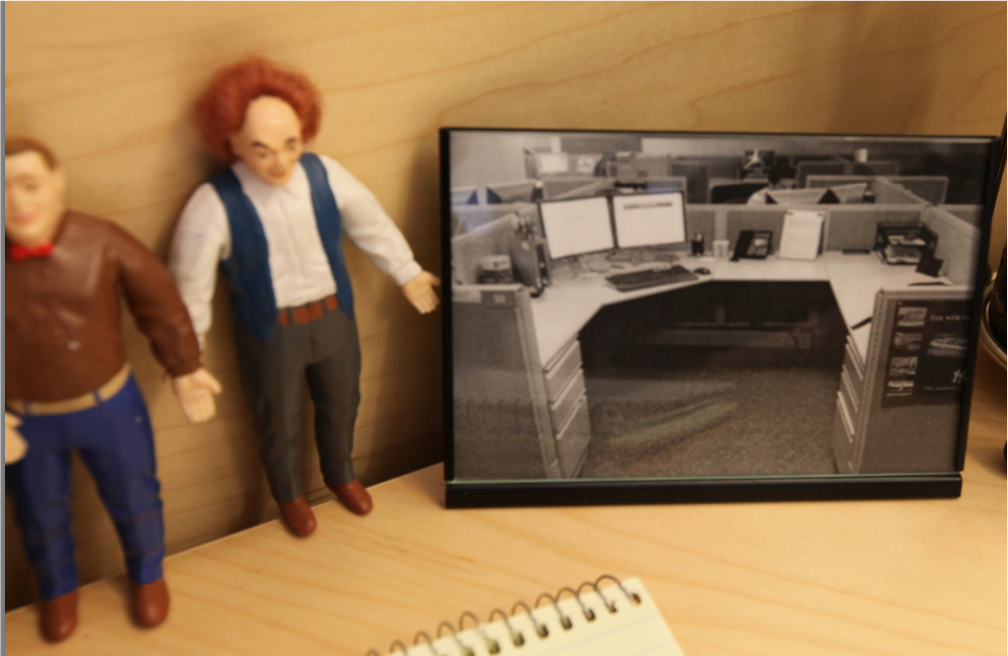
A co-worker of mine kept a picture of his old workspace instead of anything else. He could never explain why he did it, but I found it funny enough to take a picture of it. I always kind of wished I had the foresight to keep taking pictures of my desks recursively – which is a great idea, I think.
-
Startups and Other Problems
I cringe a little bit when I hear the word “startup”. This word has several different meanings in modern newspeak. In Silicon Alley (this is what New York’s startup scene was called in 2000) it appears in several typical phrases such as: “well, we can’t afford that – we are a startup” and “we are a startup, but we are very well funded”. This word is basically used either as an excuse for wanting below-market labour or an excuse to flaunt investor-supplied riches. In the first phrase it means that the company has been burning dumb money for at least a few years, in the second – it’s just starting. One “startup” that I worked for (and have fond memories of) began in 1997 and gave up ghost in 2012. UGO was truly the Dick Clark of companies (except not as successful).
Recently I was researching an engineer who designed the Wright 2600 keypunch. An article about him on Tripod (another blast from the past) has a very interesting quote: “After retiring from US Gov., he volunteered for SCORE, the retired executives helping businesses with start up and other problems.” Startup is not a type of a business! It’s a problem that businesses have!
The term “serial entrepreneur” has also acquired a thick patina of sleaze. The thing is, entrepreneurs are not really like flying aces (I think I read somewhere that most military pilots are either aces who shoot down 5 or more planes or the ones who are shot down). No. You only need to take a look at Jerry Kaplan, who wrote “Startup: A Silicon Valley Adventure” and probably set some kind of a record in running companies that don’t make it. A large percentage of startup money is made through sales to larger, lumbering companies. Was broadcast.com a great deal? Nobody remembers it when watching its founder wearing relaxed fit shoes. There certainly a lot of money out there chasing some not very viable ideas. Unfortunately the startups of yesterday and today are either huge failures or huge successes. Or both (but not for everybody).
Luckily these days startup costs are at all time lows. To create a huge failure of a company you need a lot of money. On the other hand, to barely succeed all you need is some pocket change. Forget about Y Combinator. The Pinboard Investment Co-Prosperity Cloud will “barely invest” and try to help you to “barely succeed” – in other words to encourage you to build a business that realistically aims to be profitable. Forget “go big or go home”. Just try to honestly to build a business. Screw freemium. Forget about “incubators”. All you need is $37. And The Pinboard Investment Co-Prosperity Cloud will maybe give it to you. If you’ll get a rejection – dig deep.