
Reading a book about Steinway history (my wife’s father works there).
Henry Steinway is writing a letter after immigrating to America :
“I cannot advise you to come here if you are able, by diligence and thrift, to make a living in Germany. People here have to work harder than abroad, and you get so used to better living that you finally think potato soup tasted better in Germany than the daily roast here.”
Hmmm, all too true.
Blog
-
Untitled
-
Untitled
I wonder, what’s in those conduits?

Crawling back home

Sad memento

-
Untitled
Ok, I’ve made an extravagant purchase. But I wanted it so, so much!
What was the object of my desire? It was a book of photographs called “Cray at Chippewa Falls”.It was an album by Lee Fridlander that was commissioned by Cray Research. The book was given to employees and was sold in Cray company store to visitors, but there were only about 5000 copies made.
The photographs are of unspeakable beauty. Friedlander starts with outskirts of Chippewa Falls – the waterfall, forest, fields. Then the photographs depict a typical small town – a railroad track, broken down pickup truck, suburban houses. Then the center of the town: a barber shop, Radio Shack, some fast food stores. Nothing extraordinary (except for Friedlander’s photographic talent). But then the magic begins. The book is full of photographs depicting highly concentrated men and women among chip making equipment, chassis of supercomputers with garlands of wires, computer terminals. Everybody is filled with a sense of purpose and pride – they are making the most advanced thinking machines in the world!
Seymour Cray, the Superman of Supercomputers
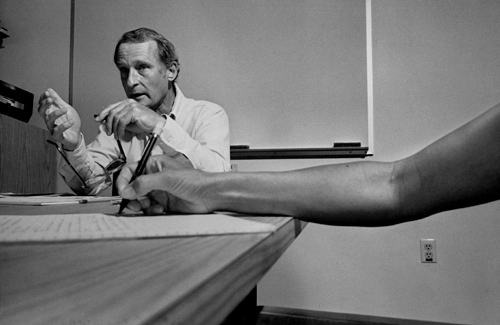
That’s Cray 1 in the background. Notice a nice little leather covered bench around the chassi. It was meant as a place where technicians could sit and warm themselves after spending a long time in an air conditioning room. In reality, few technicians would sit there for the fear of breaking the multimillion dollar machine.

Aaaaa! I am swallowed by a supercomputer!
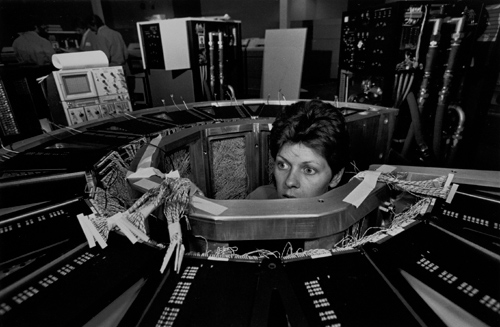
That’s a lot of wires. But if they put their heads together…

Even though I paid $250 for this album (and it is worth every penny), the copyright of course does not belong to me. But I am pretty sure that showing you these photos falles under “fair use”.
From http://www.louisville.edu/~ddking01/mmgdl01.htm :
“Under these guidelines a photograph or illustration may be used in its entirety but no more than 5 images by an artist or photographer may be reproduced or otherwise incorporated as part of an educational multimedia project”
So if anybody asks – this is an educational multimedia project. -
My favorite web comics Part I
I like comics. I really do. Never mind that they’ve been labeled as lowbrow entertainment. Ok, maybe the Sturgeon’s law is more severe in regards to comics (probably 99.9 percent of all of them are crap), but still…
In print I like to read comics that are more properly called “graphic novels”. Ones like Neil Gaiman’s “Sandman” and Ben Katchor’s “Julius Knipl, Real Estate Photographer”.
I also enjoy funny pages of newspapers and political cartoons. I don’t really read newspapers, but conveniently these are available on the net. I use a small program that puts most of the comics that I like on one page (available here). I am going to write a better program when I have the time. For political stuff I go here.
But my favorite comics fall into “web comics” category.
Dr. Fun – first (and probably the best) comic on the World Wide Web. Dave Farley’s edgy, random and somewhat obscure sense of humor is absolutely great! His drawing style is amazingly expressive. Sometimes you need to know certain things to appreciate the humor. You need to know who Don Knuth is to understand this or it helps if you read Henry Kuttner’s “Twonky” and know what a Handspring module is before looking at this(it’s funny even if you don’t). The jokes can sometimes be hilariously off-color.Certain themes recur frequently in Dr. Fun – squirrels, snacks, microorganisms, Mr Potatoe Head, bathrooms and Star Wars, the Amish and many, many other topics dear to my heart :)
Dr. Fun logos are amazing pieces of art.
Read the FAQ and then go here and read, read, read. Dr. Fun book is coming out soon, email Plan 9 publishing at question @plan9.org and tell them that you want it.
-
Sheepshead Bay station in IR

Everything looks so freaking dramatic in infrared. -
Best Sci-fi You Haven’t Read Part III or Call Time Police – We’ve Got a Time Traveler
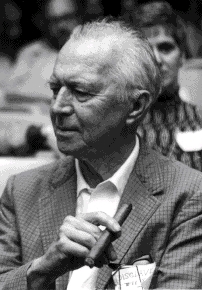
William Fitzgerald Jenkins, better known under his pen name Murray Leinster, was born in Norfolk, Virginia on June 16, 1896 (or so they tell us). I have many reasons not to believe this. He earned his living entirely through freelance writing, except when he worked as a researcher in the War Department during WWI and WWII. In his early literary career he wrote various junk, including “cautionary tails of the perils that could await a young woman, who, in all innocence, failed to insure that she was properly chaperoned at all times” (I am still trying to locate those). In 1919 he witnessed a clock being reset on a building across the street, and rapidly rotating hour and minute arms of that clock gave him an idea. He wrote a story about time travel called “The Runaway Skyscraper”. Since then he wrote mostly science fiction. Good science fiction too, for instance he won a Hugo for one of his stories (becoming the only person who wrote before 20s to win a Hugo).As I mentioned, he served in two World Wars as a researcher. I bet that most of his work was classified, but I’ve seen mentions that it had something to do with submarines. Crypto, nuclear propulsion – your guess is as good as mine. Seems pretty strange that a freelance writer would also turn out a brilliant technologist, because he was definitely a good engineer : he got two patents for “Front Projection System” (frigging Delphion is charging for access these days, so I can’t really look up what they are) which he later sold to Fairchild Camera.
How does a “cautionary tail” writer becomes a great sci-fi writer, submarine researcher and inventor? I think that he was replaced by a time traveler. He wasn’t alone, he had friends too.
Here is an excerpt from and introduction Will Jenkins wrote for an anthology “Great Stories of Science Fiction” that he edited:
“During the late lamented World War Two, the FBI had occasion to check on me. They decided that I wasn’t subversive, and made due note of the fact. As a consequence, one day I had a telephone call. A voice said pleasantly that it was the FBI calling, and they’d like to talk to me. I searched my conscience hurriedly, and then asked where I should come to talk. The voice said graciously that he’d come to see me. He did. In a hurry. With a companion.
One was a large man with a patient expression, and the other was quite young and looked rather shy. They produced credentials and proved who they were, and I obligingly proved who I was, and then one of them said, “Tell me, have you ever read the Cleve Cartmill story, ‘Deadline’?”
I said I had. The larger FBI man asked interestedly, “What did you think of it?”
“A pretty good story,” I said, “and the science is authentic. Quite accurate.”
Then there was a pause. A rather long pause. Then he sighed, and reluctantly inquired, “Well, what we want to know is: could it be a leak?”
At this point my hair stood up on end and its separate strands tended to crack like whiplashes. Because “Deadline,” by Cleve Cartmill, was a story about an atomic bomb, and this was a year before Hiroshima. The bomb in the story was made of uranium-235, it was to explode when a critical mass was attained, and there were other details. The story described most minutely the temperature of an atom-bomb explosion, the deadly radiation, the lingering aftereffects, the shock-wave, the heat-effect, and all the rest of the phenomena that a year later were observed at Hiroshima and Nagasaki. But I was being asked about it before Hiroshima, and the Manhattan Project was perhaps the most completely hush-hush of all the hush-hush performances of the war.
My copy of this book is of course signed :)
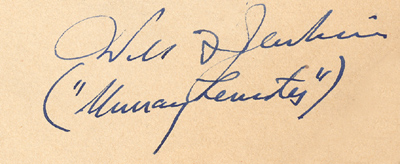
But that is nothing, nothing I tell you, compared to what Will Jenkins himself wrote. You see, he wrote a story called “A Logic Named Joe” in the year 1946. Here is an excerpt
“I’m a maintenance man for the Logics Company. My job is servicing Logics, and I admit modestly that I am pretty good. I was servicing televisions before that guy Carson invented his trick circuit that will select any of ‘steenteen million other circuits—in theory there ain’t no limit—and before the Logics Company hooked it into the Tank-and-Integrator set-up they were usin ’em as business-machine service. They added a vision-screen for speed—an they found out they’d made Logics. They were surprised an pleased. They’re still findin out what Logics will do, but everybody’s got ’em.
…
You know the Logics set-up. You got a Logic in your house. It looks like a vision-receiver used to, only it’s got keys instead of dials and you punch the keys for what you wanna get. It’s hooked in to the Tank, which has the Carson Circuit all fixed up with relays. Say you punch “Station SNAFU” on your Logic. Relays in the Tank take over an’ whatever vision-program SNAFU is telecastin comes on your Logic’s screen. Or you punch “Sally Hancock’s Phone” an the screen blinks an sputters an’ you’re hooked up with the Logic in her house an’ if somebody answers you got a vision-phone connection. But besides that, if you punch for the weather forecast or who won today’s race at Hialeah or who was mistress of the White House durin’ Garfields administration or what is PDQand R sellin for today, that comes on the screen too. The relays in the Tank do it. The Tank is a big buildin foil of all the facts in creation an’ all the recorded telecasts that ever was made—an it’s hooked in with all the other Tanks all over the country—an everything you wanna know or see or hear, you punch for it an you get it. Very convenient. Also it does math for you, an’ keeps books, an acts as consultin’ chemist, physicist, astronomer an’ tea-leaf reader, with a “Advice to the Lovelorn” thrown in. The only thing it won’t do is tell you exactly what your wife meant when she said, “Oh, you think so, do you?” in that peculiar kinda voice. Logics don’t work good on women. Only on things that make sense.Logics are all right, though. They changed civilization, the highbrows tell us.All on accounta the Carson Circuit. “
Holy Crap! How did the time police miss this guy??
By the way, notice some military humor there. Do you know what SNAFU means?If you would like to read some of Murray Leinster’s stories, a good place to start is “First Contacts: The Essential Murray Leinster”
-
Best Sci-fi You Haven’t Read Part II or Yes, Virginia There Is Synergy
Despite what marketing droids and sleazy investment gurus may have lead you to believe, there is such a thing as synergy. Yes, 1 + 1 is sometimes equal to 100. And Henry Kuttner and his wife C.L.Moore are a case in point.
Henry Kuttner started out a bad science fiction writer. A real stinker. He had some cool friends though. Howard Phillips Lovecraft was one, Raymond Douglas Bradbury was another. At first he wrote a whole bunch of Lovecraftian tales. Not really bad ones, but completely and thoroughly copying Lovecraft’s style, settings and characters. Well, not many good things come out of copying. Then he started writing and getting in print bad pulp sci-fi and fantasy stories. Yech.
Catherine Lucille Moore also wrote crappy fantasy stories. Nothing really worth mentioning. Pulp, dreck.
And then they met each other and got married. That’s where the synergy effect came into play. One after another they started publishing stories of absolute brilliance. Real classics. “The Twonky”, “Mimsy Were the Borogoves”, “Nothing but Gingerbread Left” – some of the best short sci-fi stories ever written. An then the “Gallagher” series and “Hogbens” series. Most of these stories were written under pseudonym “Lewis Padgett”, and for a long time nobody could believe that that was really Henry Kuttner and C.L. Moore. Some bizarre rumors about the true identity of the author of these stores still float around on the Usenet.
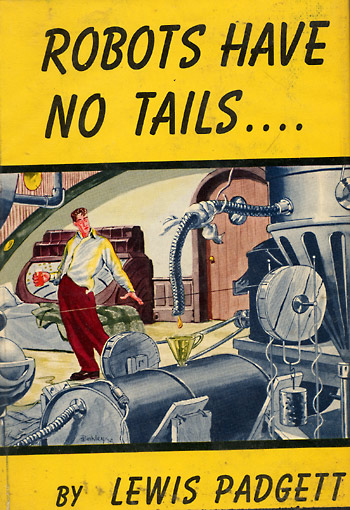
What got me hooked on Kuttner/Moore was a story called “The Proud Robot”. It was about an alcoholic inventor by the name of Galloway. While drunk, he made himself a robot, but then could not figure out what the robot’s purpose was. That became my favorite short sci-fi story of all times. What I didn’t know, there were 4 more stories in the series: “Gallagher Plus”, “The World is Mine”, “Ex Machina” and “Time Locker”. They were collected in a book called “Robots Have No Tails”, of which there were only two editions. The first one (Gnome hardcover), became exceedingly rare (and expensive I might add): you see, in every story Galloway’s alcoholic subconsiousnes was making trouble for sober Galloway. An alcoholic protagonist was not politically correct, and thus the book suffered very slow library sales.
I’ve learned two interesting things from less rare second edition (Lancer paperback). The book got it’s name because when Kuttner was asked about the title, he said something to the effect that he did not care even if it was called “Robots Have No Tails”. The second is that Kuttner made a mistake: he called the protagonist Galloway in one story and Gallagher in another. When confronted by C.L. Moore, he corrected the mistake, explaining in another story that Galloway is the first name, and Gallagher is the family name.
This is probably the only place on the internet, where you can see a scan of the cover of the first edition of “Robots Have No Tails”
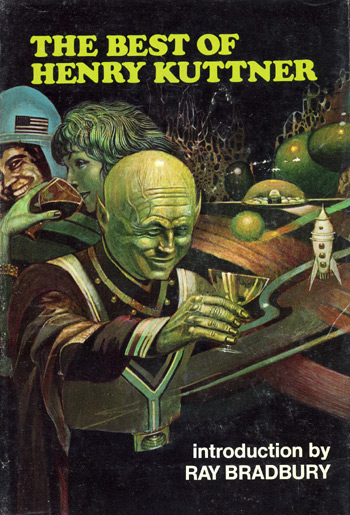
I would recommend starting with a compilation of Kuttner’s short stories, like this “Best Of..” edition with a funny cover. The alien looks very much like John Paul II :)
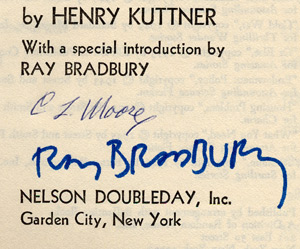
My edition is signed:
Henry Kuttner died young, at the height of his career. His health was damaged in the battlefields of WWII. The books he wrote with his wife are hard to find, but they are most definitely worth the effort and expense needed to obtain them. http://www.abebooks.com is probably the best place to find them.
-
Best Sci-Fi You Haven’t Read Part I or Psywarrior
Dr. Paul Myron Anthony Linebarger was a son of Judge Paul Myron Wentworth Linebarger. Interesting facts about him included:
- Godson of Sun Yat Sen
- Blind in one eye due to childhood accident (wore a glass prosthesis)
- Traveled all over the world
- PhD in political science at an age of 23
- Rose to the rank of Colonel in Psychological Warfare Branch of US Armed Forces
- Was involved in PsyOp operations in WWII and most “small wars” (except Vietnam, which he passed up on principle)
- Was a devout Christian
Some of his non-fiction:
- “The Political Doctrines of Sun Yat-sen”
- “Government in Republican China”
- “The China of Chiang Kai-shek”
- “Psychological Warfare”
Here is an interesting excerpt from “Psychological Warfare”, which was, and still is an authoritative book in the field:
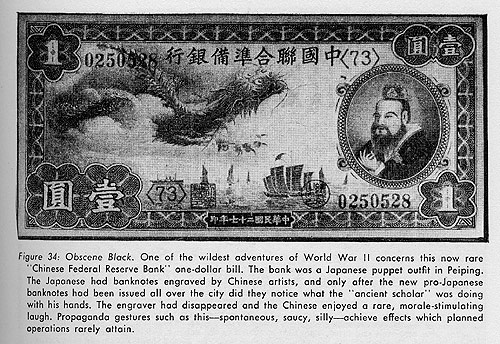
Enlargement of what the “ancient scholar” was doing with his hands:
But what I really love Paul Linebarger for is his science fiction stories, which he wrote under pseudonym Cordwainer Smith.
Cordwainer Smith’s science fiction is amazingly ambitious: he wrote a “history of the future” spanning years 2000 through 16000 (click here for a timeline). His prose is lucid, coherent, poetic, logical and very entertaining. The story that got me hooked was “Scanners Live in Vain”, which was one of those stories that makes you go “Oh, I’ve got to read everything this guy ever wrote”. My other favorite is “The Lady Who Sailed The Soul”, which is probably the most romantic sci-fi story that I know. Something really interesting and unusual abut these stories are religious overtones and Christian symbolism (which are really, really hard to notice on the first reading).I highly recommend “The Rediscovery of Man: The Complete Short Science Fiction of Cordwainer Smith” to get started.
Cordwainer Smith sites (I used some of them to gather information for this post):
The Remarkable Science Fiction of Cordwainer Smith (site by PMA Linebarger’s daughter)
Cordwainer Smith Unofficial Biography Page
Christianity In the Science Fiction of “Cordwainer Smith”
The Universe of Cordwainer Smith
Cordwainer Smith Illustrated Bibliography, by Mike Bennett


