If you live in New York, chances are pretty high that you live in an apartment building. We, young generation X-ers, face a tough choice. To be able to afford a house without Google stock options, you need to move either to New Jersey (technically ceasing to be a New Yorker) or to Staten Island. Which is a fate worse than death. The rest, find refuge in the bajillion of apartment buildings on the Isle of Long or in Manhattan itself. There are also some in Jersey City, Queens and the Bronx. Apartment living is a reality for most Manhattanites and card-carrying members of the Bridge and Tunnel society, such as myself.
I don’t think I’ve ever seen central air heating in a New York apartment. Apartments here are heated with radiators. Radiators are noisy, prone to overheating and generally troublesome. As the heating season is about to start, let me share with you my wealth of radiator knowledge.
There are three major heating system types common to the New York area: water, one pipe steam and two pipe steam. Only the oldest buildings have water heating, if you have one of those, you are on your own. I’ve never seen a two pipe steam system either, so the only one I can tell you about is the almost century-old technology – the one pipe steam radiator with a Hoffman valve. It’s very, very likely you have one of these.
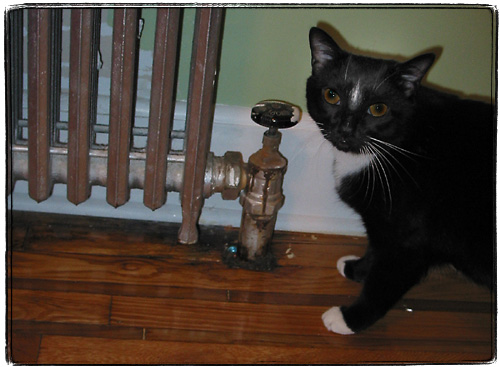
In this picture Gary the cat shows you what a typical single pipe system looks like. It’s basically a steam-carrying pipe sticking out of the floor, connecting with your radiator via a valve. A mistake that most people are making, is thinking that by twiddling with this valve it’s possible to control the temperature. This is absolutely wrong. In theory, you should be able to open and close this valve to start or stop the flow of steam. In practice, as most of these are very old, the gaskets don’t hold steam at all even in the closed position. Closed and half-open position usually does not result in much other than noise from the condensed water that can’t get back down and leaks.
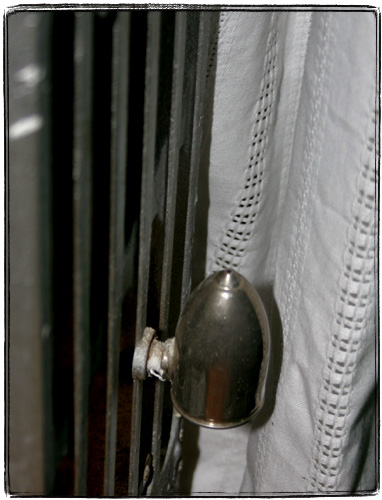
This heating system is very simple. Steam enters the radiator through the pipe, condenses as water and leaves down the pipe. It has numerous advantages: steam is more efficient than heated water, there’s next to no chance of the system freezing (when that happens to a water-heated radiator on the coldest day of the winter, it’s not a lot of fun – just ask Joel). Steam radiators like this existed in Victorian times as well, with one exception. They tended to explode if too much pressure was applied, maiming and killing hapless apartment dwellers. That’s why so many brownstones have water-heated systems.
In 1913 George D. Hoffman started a company that produced an ingenious little device that made steam radiators safe. If you look at your radiator, you’ll find a little vent that usually looks like a miniature rocket ship (as you can see both my radiator and the valve have Streamline / Art Deco styling very popular in the period when my building was built). Chances are, it will be a Hoffman Specialty Model 40. This device works like a not very bright Maxwell’s demon: it lets air enter the radiator or escape, but stops steam from escaping.
The whistling noise that you hear at night is air escaping the radiator when it fills up with steam. If the vent is not correctly sized or, which is more frequent, got clogged up with mineral deposits, you will hear water and steam spurting out of it and destroying your neighbor’s ceiling. Worst case scenario – the valve gets stuck on open and fills your entire room with steam, ruining the walls and possibly burning you. When changing a clogged valve, make sure that the steam is off and is going to stay off while you change it, and be around when the steam is going back on to make sure that there are no leaks.
Even if you have a properly sized and regulated valve and you pitch the radiator towards the pipe to let the water drain without making much “water hammer” noise, it’s likely that your apartment will be overheated. Most are. As the intake valve is usually out of commission, the best way to turn off the radiator is to close the steam valve by turning it upside down (I’ve heard about this trick on This Old House. This is rather inconvenient and a bit dangerous – you might strip the threads and end up with a whole room full of steam. My guess is that there would not be an explosion as the valve is engineered to open if the pressure is excessive. Maybe not, I don’t know.
The best thing to do is to purchase a regulated thermostatic valve. These are improved valves with a sensor that closes the valve when the temperature reaches a certain level. While not perfect, these really let you exert a tiny bit of control over your apartment’s temperature. It also lets you easily shut down the radiator, as sometimes the buildings overheat so much, that you don’t need heat at all.
The kit usually consists of three parts: a temperature control device, an adaptor and a Hoffman-type valve. This will run you about $100 altogether. I have one on two radiators, and let me tell you, these are worth every penny.
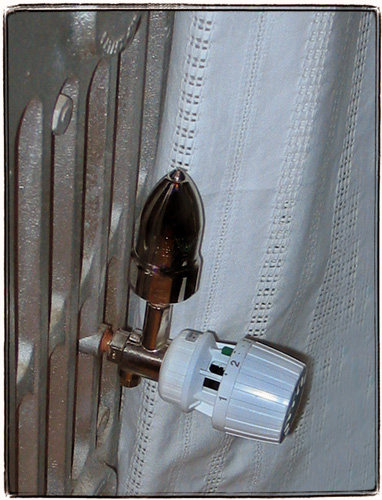
P.S. I am rather curious as to what George D. Hoffman looked like and what his life story was. Somehow I imagine him as a fat dude in a three piece suit with some ridiculous Victorian hair and beard-style. If you ever find a picture of him, please let me know. All I could dig up was an old brochure (PDF) that featured the Hoffman company logo: “The Use of Hoffman Valves Make a Poor Job Better A Good Job Perfect.”
Ad:
Don’t you wish you could peer inside the walls to see if there are electric wires there, or leaking pipes? Well, now you can with a Fiberoptic Borescope for way under 200 bucks!

Milwaukee drills are some of the finest drills ever.
Basin wrenches are some of the most useful tools missing from most toolboxes.