
Recently had a dream, in which I was in India. I needed to meet somebody important in some remote area. With great difficulty I purchased a train ticket and boarded a train. For some reason I was riding right on the top of the steam locomotive that was moving with great speed. I decided to check my ticket, and as I took it out of my wallet, a gust wind ripped the ticket out of my hand. I started thinking about what to do, but the ticket continued flying right behind me, flapping in the wind. I made sure there was no tunnel ahead, stood up and caught the ticket. It wasn’t the original ticket but a copy, but it was just as good. Just as that happened, I realized that the train got lost. It wasn’t a big deal though – it missed a turn and looped back. I remembered the road and would have been able to tell the machinist where to turn.
Tag: India
-
Deadprogrammer visits Odessa : Part I : Introduction
I live on a high floor of an art deco tower facing a busy Brooklyn street. The acoustics of the building and the street are such that I can sometimes hear what’s going on in the street right from my desk. Once I heard the sounds of a minor fender bender followed by an angry exchange unpleasantness that was escalating into some creative Russian profanity. The driver who rammed the other car was pretty unapologetic and criticized the driving skills of the one who got rammed. Then followed the exchange that made me laugh out loud – the driver who got rammed said – “the way you behave, man, you must be from Odessa.” “Yes, I am,” – answered the other guy, and added – “and you still drive like a moron.”
Odessa, Ukraine, my hometown, is a very special place. It has a Bizarro mirror twin, Odessa, Texas.
Odessa is a resort town situated on the shore of the Black Sea, right across from Turkey. Culturally it’s a bit like Brooklyn (or Brooklyn is a bit like Odessa because of an almost constant infusion of Odessans) – a city with an attitude, a city where a lot of famous people are born and famous people come to live. Architecturally it’s a lot like Vienna and St. Petersburg: a city built on a grand scale (but with softer edges), by the best architects.
Odessa’s ancient past is obscure: a Greek colony, a small town controlled by Kievan Rus, the Golden Horde, various Khanates and Kaganates, and finally a Turkish fortress. Odessa’s fortunes have turned when Russian forces invaded it in late 1700s. Catherine the Great apparently wanted to fortify the newly won land, and committed the people and resources needed to make the new city of Odessa a success.
The founding fathers of Odessa were a bunch of distinguished foreigners in the service of the Russian crown: General José Pascual Domingo de Ribas y Boyons, Armand Emmanuel Sophie Septemanie du Plessis, duc de Richelieu, and Count Louis Alexandre Andrault de Langéron.
Richelieu, or the Duc, as he’s commonly known in Odessa, will forever be loved by Odessans for his accomplishments. The way I imagine the Duc is sort of like the 18th century Steve Jobs, with a reality distortion field of his own, except without being an asshole (Richelieu was known for his kindness and indifference to money). Somehow – nobody know exactly how – Richelieu got Odessa the status of a “free port“. This meant that goods could be unloaded without paying the taxes within the city limit. This brought about an unprecedented influx of wealth, which in turn fueled the building of Odessa by the best European architects in the European manner. Odessa’s opera theater is only slightly smaller than Vienna’s, and is by the same architect.
Another unique aspect of this new city was the ethnic makeup. Besides the usual for Ukrainian cities mix of Ukrainians and Russians, Odessa became a melting pot. Frenchmen, Greeks, Turks, Germans, Armenians: all rushed into Odessa. Even the Jews were allowed in, and not being limited to certain occupations or living in a ghetto. Odessa is a very Jewish town despite what the author of Everything Is Illuminated might have you believe.
I left Odessa when I was 16. I came back for a 10 day visit 15 years later.
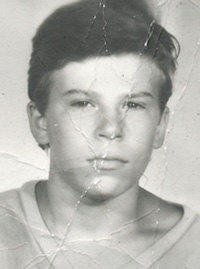
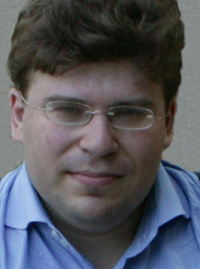
Odessa is a a city that makes you nostalgic, and I kept seeing it in my dreams. Luckily there’s a small international airport in Odessa and President Yushchenko kindly lets the holders of an American passport into the country freely, with no need for a visa.
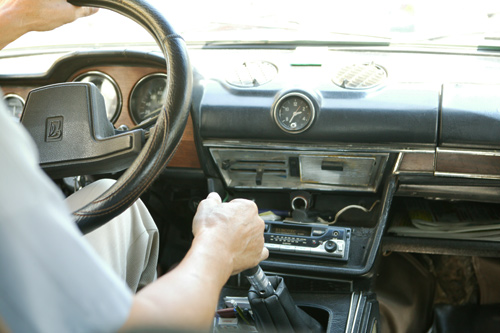
12 hours and $1300 later I was standing in Odessa, looking for a cab. A pushy cabby was very surprised when I did not want to ride in his clean BMW and chose a cheaper and dearer to my heart filthy Soviet-vintage car.
As far as hotels go, Ukraine is much more reasonable than Russia, but there are still no Marriott-like affordable and well-designed chains. There are overpriced hotels with decor that will burn your eyes out, cheaper, but scarier hotels, and apartments that you can rent which cover the gamut. Odessa has a population of about a million, but it swells to twice the size in the Summer season. Because of that there are thousands of very reasonably priced rental apartments with great amenities. Unfortunately I did not plan enough ahead, and ended up reserving a very cheap room in a brand new hotel Zirka that recently opened right in the center of the city.
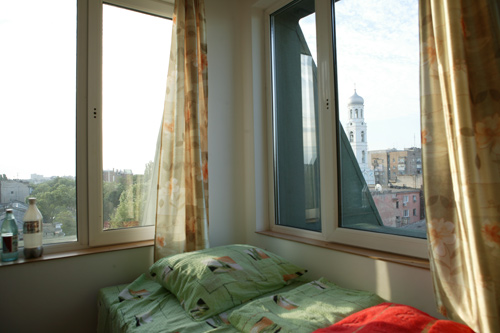
For a very reasonable $35/night I lived in a tiny-tiny, somewhat flimsily outfitted, but very clean room with a fully functioning shower, air conditioning and beautiful views, right in the historic center of Odessa.
The hotel was still being built when I lived there, and I herd later that it was becoming a bit notorious for renting the rooms at hourly rates.
As far as I’m concerned, you really can’t beat their amenities, their location, and their prices. Also, the staff was very courteous and professional. It was very quiet there during my stay – but worst case scenario – you might overhear noisy sex, from which you are not guaranteed at almost any hotel.
It’s hard to see on picture, but the towels had little dollar sign designs.
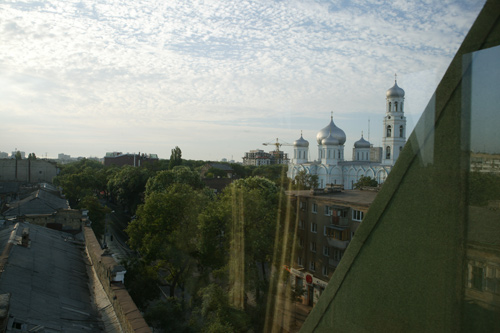
My hotel room reminded me very much of the affordable hotel room that I lived in in Japan, down to the picture of soft drinks that I took there.
In Odessa I mostly drank Borjomi, a Georgian mineral water. Borjomi, as far as I’m concerned is the tastiest mineral water in the world.
Odessa has its own mineral water, Kuyalnik, but it’s not sold in restaurants for some reason. I found a few bottles in a convenience store closer to the end of my stay. More about Kuyalnik later – I have a very special connection to it.
Apparently in Europe Diet Coke is marketed as Coca Cola Light, is sold in frosted bottles, and as far as I can tell, in a different formulation. It did taste different, and I know my cokes.
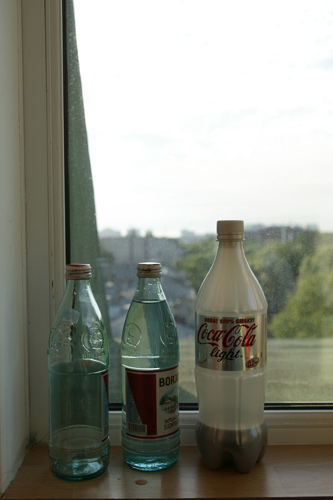
I quickly unpacked, grabbed my camera and went for a walk.
You really can’t enter the same river twice. I left Odessa when the Soviet Union was still intact. When I came back, a lot of things stayed the same.
There’s still a fountain in the City Square, the live band is still playing on Sundays and the pairs still dance.
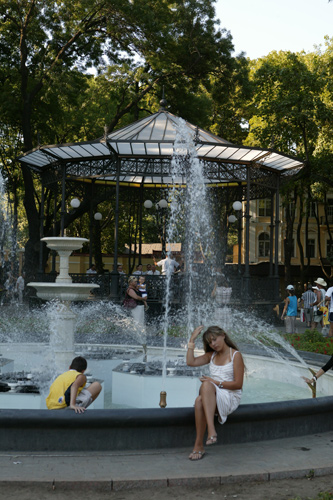
Acacia trees, the most common plant and the symbol of Odessa, are still filling the city with the aroma and sidewalks with their yellow flowers. Cleaning ladies (and men) still sweep the sidewalks with brooms made out of small branches. I brought a small jar with acacia blooms with me – the smell of nostalgia.
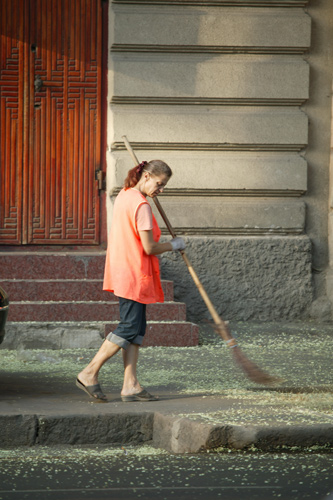
Remember that ethnic markup that I described earlier on? Well, somehow that mixing of genes resulted in the hottest women on the planet. Odessa is still the city of super hot women. This brings a large contingent of sex tourists and mail order (in this case – cash and carry) bride seekers. I was approached (probably because I was typing away on a laptop) by a most distressed gentlemen in a cafe: he could not get online. His hands were shaking. I fixed some gnarly windows crud setup options and wi-fi started working. All he cared about was getting to a dating site, and when it loaded, his hands finally stopped shaking.
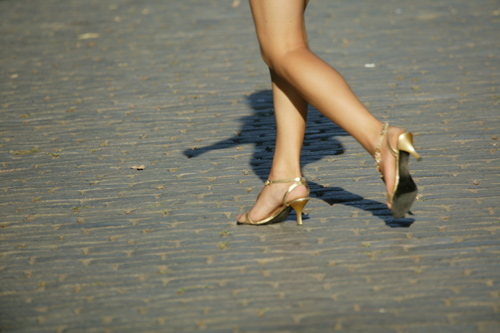
Things have changed though. Odessa took on some qualities of Havana, Cuba. Historic buildings are deteriorating, old cars are kept alive way past what’s reasonable.
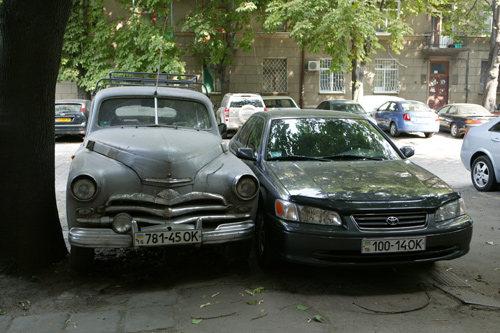
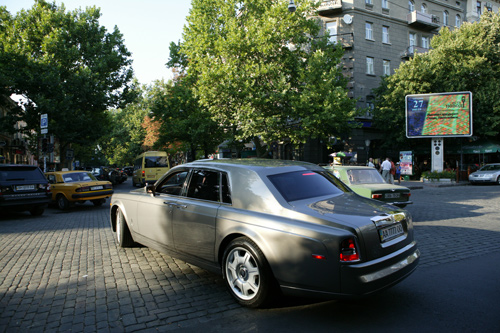
It’s not like Havana because people seem to prosper. Even the pensioners do not go hungry, there is a lot of new construction, and the rich are really, really rich. I’ve seen just about every expensive car I know in the streets, except maybe a Maybach.
A few things about the new Ukrainian economy. The salaries are paid in US dollars, but dollars are not accepted anywhere. You can easily exchange them into hryvnas and back very easily, and the rate is somehow kept at about 5 to 1, without even having to shop around for a rate.
Real estate is amazingly expensive: for instance the apartment that my parents sold for something like $5K costs about $500K. At the same time the mortgage industry is almost non-existent.
I’m told that the government officials are amazingly corrupt, and they constitute a major portion of the upper crust. A police captain can easily become a multimillionaire, and so can just about any government bureaucrat. There’s a practice of “otkat” – kickback from a government project is rampant. High ranking policemen and bureaucrats are almost outside the law, like in India.
At the same time, even with all the corruption and bribery, the economy is pretty healthy, even without Russia’s oil.
Price-wise Odessa is not the bargain that it once was. For most things I’d estimate the cost of living at about 60-70% of Brooklyn prices. Food and rent is pretty cheap, but electronics, clothing and cars are more expensive. In particular, cars are taxed so much that they cost about 2 to 3 times more than in the US, which makes all those Rollses that I’ve seen even more impressive, and explain the Soviet-era cars.
Deadprogrammer Visits Odessa : Part II : Balconies and Yards.
-
O’Reilly Book Covers
Joel Spolsky wrote about an interesting limitation that he encountered when choosing a cover design for his book:
“And although they would not put a doggie on the cover of my book as I requested, because a certain other book publisher threatens to sue his competitors when they put anything animal like within 90 feet of their covers, their graphic designer worked overtime to create underground cover art called “User Interface Design for Doggies” complete with three golden retrievers, which they framed and sent to me. All in all a classy operation and highly recommended if you’re thinking of writing a computer book.”
The publisher is, of course, O’Reilly Media
. The are famous for publishing computer programming books with engravings of animals on the covers. Like any programmer’s, my bookshelf holds a pretty sizable zoo of these critters. The question that always comes to mind is what guides the selection – how the publisher decides which animal to match with which technology. Here’s what O’Reilly editors say:
“Our look is the result of reader comments, our own experimentation, and feedback from distribution channels. Distinctive covers complement our distinctive approach to technical topics, breathing personality and life into potentially dry subjects.”
Well, with some books it’s clear – a spider for a webmaster book and a python for a Python book, for instance. But why does the Perl book have a camel? Wouldn’t an oyster make a lot more sense?
Update: Joe Grossberg commented that camel was chosen “because Perl uses camelCase for capitalizing variables”. John (website or last name not included) said that “camel was picked for Perl because of the quip that it was a ‘horse designed by a committee’”. I like John’s version much better :)
Joe also started a Wikipedia article on the subject.
One of the more understandable conventions is using Javan animals on Java-related books. For instance, the Java book has a Javan tiger and the JavaScript book has a Javan rhino.
O’Reilly colophons rarely give too much insight into why that particular animal was chosen for the cover, but sometimes you might read between the lines:
“Like the crustaceans after which they are named, crab spiders walk sideways or backwards. They feed on bees and other pollenizing insects, often laying in wait for them by hiding on flowers.”
“Both male and female pythons retain vestiges of their ancestral hind legs. The male python uses these vestiges, or spurs, when courting a female”
“Folklore has long held that the horn of the rhinoceros possesses magical and aphrodisiacal powers, and that humans who gain possession of the horns will gain those powers, also.”
“Tigers are the largest of all cats, weighing up to 660 pounds and with a body length of up to 9 feet. They are solitary animals, and, unlike lions, hunt alone.
…
There are some tigers, however, who have developed a taste for human flesh. This is a particularly bad problem in an area of India and Bangladesh called the Sunderbans.”
The ironic thing is, Javan tigers are extinct and there are only about 100 Javan rhinos remaining. Is that a dig at these languages?
One of the most ironic, yet clearly unintentional choices was that of a stingray for the cover of ASP.NET in a Nutshell.

-
Seinfeldiana
You know, living in New York you actually get to experience many Seinfeldian moments. The Soup Nazi’s store is shuttered and for sale, but it’s still there for the moment. Almost everyone I know, me including, got an unvitation (aka nonvite) to a wedding in India at least once. Loads of people are celebrating Festivus. And if you want, you can get to see Dominicans rolling cigars right before your own eyes. For 400 bucks you can hire them for your party (that comes out to 8 bucks per cigar which is not bad at all). Cigar rolling is a very intricate art and a very cool thing to watch.
La Rosa Cubana cigar store/factory is located on 6th avenue between 30th and 31st.

The guys there were kind enough to let me take a picture. Here is a cigar maker’s workstation, complete with inspiration.

Unlike in that Seinfeld episode, these guys know how to roll cigars just right. Their King Churchill is very good.
-
The World Is Your Spitoon
BoingBoing writers don’t seem to be able to shut up about betel lately. This reminded me of a 4th or 5th grade report on India (great friend of the Soviet Union, emerging economy, blah, blah) that I had to do in school back in the Soviet times.
I remember the teacher get very interested about betel chewing and prematurely praise it as a great habit. Then I reminded her that importing such a thing would mean having to deal with bright red spit all over. It’s not like the Soviet Union did not have its own share of hygienically questionable customs.
Back then Soviet sci-fi writers promised us Communism with goods being teleported right into our crystal palaces for free from anywhere on the globe. I guess that (and my flying car) did not work out, but today Capitalism brings us the ability to order almost anything from almost anywhere through electronic computers.
So, if I want to try some betel all I need to do is pick between The Basement Shaman and Shaman Palace or many other fine merchants.
Who knew that there are so many stores catering to shamans. At leats now I know where the Suburban Shaman.
Hmm, I guess I could get one of these and try to rid my cubicle of the sick building syndrome.
-
Personhole Covers
Forgetting for a second about my gender neutral language skills let’s talk a bit about manhole covers.
In case you haven’t noticed, they come in an amazing variety of shapes, sizes and designs. The designs are often amazingly elaborate and beautiful. Just like I am not the first programmer to be asked “why manholes are round and not square” in an interview, I am not the first person to notice and write about the designs.
Probably the most popular photography book about manhole covers is Manhole Covers by Mimi and Robert Melnick. I have it, and it’s outstanding. This time when I checked at Amazon, there was also Quilting With Manhole Covers – A Treasure Trove of Unique Designs from the Streets of Japan as well as copycats Designs Underfoot and Treasures Underfoot.
Amazon also has these kick ass fake covers for hanging on the wall (as it’s nearly impossible to hang a real 600 lb manhole cover and rim on a wall ).
Just like there’s no shortage of books, there’s no shortage of websites as well. Staring into the hypnotic designs can be very relaxing.
Why did I decide to write about manhole covers today? Simply because New York Post recently ran a story about a somewhat fleshy skateboarder who fell backwards onto an electrified Con Ed manhole cover. That resulted in her getting literally branded with a design on her back. Even a few letters of “Con Edison” are visible:

The girl is lucky – manhole covers are known to shoot high up in the air due to steam buildup– and a flying 600 lb cover could leave a stronger impression.
Also it could be “Made in India” instead of “Con Ed” as most of the new manhole covers are produced there for 25 cent a pound these days. There’s an excellent article about it from which I just have to pull a few choice quotes :
“In India, the making of manhole covers is vastly man’s work – and it has been for generations. “They say the skill can only be done by a man,” Agarwal said. “The molding can never be done by a female.” “
“The progressive nature of an otherwise primitive workplace exhibits itself in other ways. Inspirational sayings written in English are hung throughout the foundry, such as “Quality is free, but it is not a gift.”
Ironically, few workers can read the sign, let alone the names of the cities on the covers they create.”
Now, unless you are a programmer who’s encountered the ubiquitous manhole question, you must be wondering, what’s the right answer to the question? Why aren’t they square? Let me give you a geek’s answer.
First of all they are not all round – there are square, rectangular, hexagonal and other ones. Here’s an example a of a square manhole cover (Note “India” on the bottom). This is a small one, but much bigger ones exist as well, I just can’t find a good example that’s both square and says “India” right now.

The answer they are expecting is that it is impossible to drop a round disk into a round hole of the same size. But there’s also a shape called the Reuleaux triangle that has the same property:

With the help of a Reuleaux triangle shaped bit and a template it’s possible to drill square holes. Unfortunately I can’t seem to find any of these drill bits for sale.Also, a round manhole cover is easier to roll. Duh. You might also tell the interviewer about my fishing buddy Michael Prior’s echinterview.org and
‘s techinterviews.com -
Lunchtime Observations
Girls who work at Wendy’s downstairs have the coolest names: Tenece, Girly, India, Carlotta.
There used to be a poster signed by Dave Thomas there, but after Dave died it was replaced by a different poster of him waving goodbye with a spatula.
At Wendy’s customers are always referred to as “guests”. I wonder if that is true in all other fast food places.
Mike’s lunch: two pieces of GG Brand Scandinavian crispbread + Classic Triple® with cheese – onions – buns.
789 calories + 6 net grams of carbs. Interesting, the patties contain 40% of daily value of iron and 6% of calcium. What’s in them? Teeth and cowbells?