Month: May 2006

  • Quotin’

    I am currently reading Douglas Coupland’s latest book, “Jpod” and absolutely loving it. My favorite quote so far:

    “Here’s my theory about meetings and life: the three things you can’t fake are erections, competence and creativity. That’s why meetings become toxic–they put uncreative people in a situation in which they have to be something they can never be. And the more effort they put into concealing their inabilities, the more toxic the meeting becomes. One of the most common creativity-faking tactics is when somebody put their hands in the prayer position and conceals their mouth while they nod at you and say, “Hmmmmm. Interesting.” If pressed, they’ll add, “I’ll have to get back to you on that.” Then they don’t say anything else”.

    By the way, according to his website, on 14th of June 2006 at 7 pm, Coupland is going to be at Barnes & Noble Union Square, apparently promoting “Jpod.”

    One of the running themes in the book is the never ending references to the Simpsons cartoons. By my estimation, probably good third of my posts have an Simpsons quote. And you know what, I feel rather pathetic while watching old episodes I stumble upon obscure references that are not even documented in very, very obsessive snpp.com.

    Here are two latest ones that I found. I’ll let you guess, and then announce the right answer. My hope is that some of you are at least as nerdy as I am for knowing this.

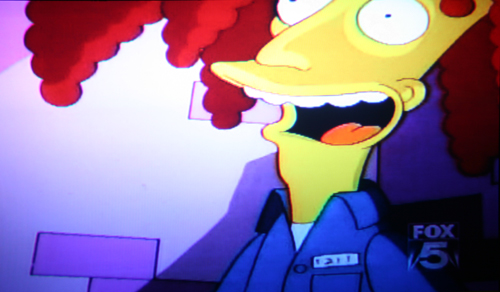
    What is the significance of Bob Terwilliger’s prisoner number, 1211 in episode [9F22] Cape Feare? (this one’s is too easy for some of my friends :)

    Answer: Newscorp headquarters are located at 1211 Avenue of the Americas

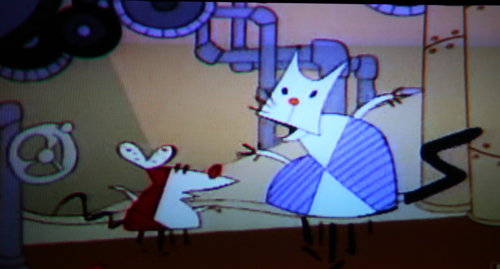
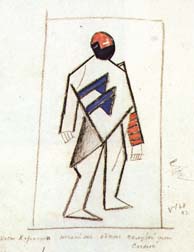
    In episode 9F19 Krusty Gets Kancelled what is “Eastern Europe’s favorite cat-and-mouse team” based on?

    Answer: They are based on Kazimir Malevich-designed costumes for a futurist opera “Victory Over the Sun”. This 1913 opera was written in Zaum, an artificial avant-garde language, similar to glossolalia or “speaking in tongues”. And I thought that Malevich only drew black squares

  • Homemade Sashimi

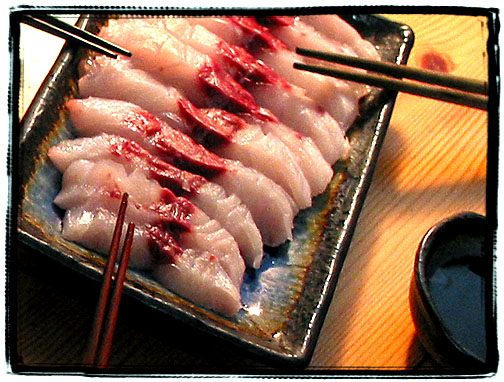
    I did not get to go fishing as much as I wanted to lately, and a recent winter flounder trip that despite amazing weather resulted in only one keeper fish is not a highlight of my fishing career. But the flounder sashimi that I made out of it was absolutely awesome.

    Fluke Sashimi

    Here’s a picture of striped bass sashimi that I made a few years back. I’m told that the dark brown (looks red in the picture for some reason) meat should be removed from fillets. It was very tasty anyway.

    Striped Bass Sashimi

    Food safety is not something to be taken lightly, of course. A lot of people gasp – homemade sashimi? That’s suicide! But if you ask me, food police, fear of lawsuits and American germophobia goes a little too far.

    Over the years I ate a lot of potentially deadly stuff. Street vendor food, for example. Did you ever wonder how those guys go to the bathroom? Cafeteria food. Oh, and not only American street vendor food and cafeteria food. Soviet too. I ate a lot of sushi and sashimi. I’ve had raw Korean beef. A lot of oysters, some rare steaks (usually I order medium-rare). In Ukraine I liked to snack on raw chicken eggs. I ate fish that I caught in the uber-polluted Black Sea. I even ate raw mussels (and they concentrate all the bad sea crap) there.

    And you know what? While long term health effects of my omnivorous eating are not known yet, I had a very mild case of food poisoning only once. From a reportedly unexpired can of Alaskan salmon.

    Alleged time traveler John Titor wrote this about American food:

    “What are people thinking? You willfully eat poisoned food. It’s very hard for me to find food here. It all scares the Hell out of me. I am amazed at the risks people here are willing to take with processed food. All of the food I eat here is grown and prepared by my family or myself.”

    I am scared myself. Food here for the most part does not taste right. The large scale growing and processing does something to it. I highly suspect that it’s one of the major contributing factors in the obesity epidemic.

    In any case, I remember watching Anthony Bourdain’s “No Reservations” where he sat in a French bistro and pointed out half a dozen things that would be completely illegal in an American restaurant, but actually make a eating in that bistro amazing.

    As far as homemade sashimi is concerned, I hear a lot of talk about freezing fish overnight in a freezer to kill parasites before eating it. I’ve tried this, and it makes the texture of the fish mushy. I am not sure about this, but it seems to me that the only fish that gets that treatment is tuna – I’ve seen huge frozen carcasses in the Tsukiji fish market. In any case, raw fish that I caught myself if probably the freshest that it can be. The only way this sashimi could be any fresher is if I cut and eat the still alive fish right on the boat.

  • Civic Fame

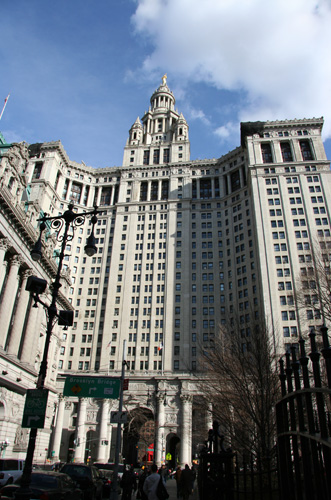
    Municipal Building in Manhattan is said to be the one that directly influenced Soviet architecture because Stalin really liked its look. What was called “City Beautiful” style in America in 1880s, with some alterations became known as Stalin’s Empire, Stalinist Baroque, Socialist Classicism and simply as Mustachioed One’s Wedding Cakes. In fact there are 7 buildings in Moscow that look very much like it.

    These 7 sisters, as the buildings are known are shrouded in legend. I’ve heard that because of the lack of metal girders their walls are tremendously thick at the bottom. I’ve heard that they go down into the ground as far as they go into the sky, that there are old explosive self-destruct charges left over in some of them, that there is a huge monument to Stalin stored in one of the huge cellars. I’ve heard that the super secret “Metro 2”, the secret subway running underneath them.

    It’s very ironic that Stalin picked this very American, capitalist style for his favorite buildings. Even more ironic is the way that the Objectivists lead by Ayn Rand picked an art aestetic art aestetic very similar to socialist realism, maybe with a little more art deco thrown in.

    There is a common theme that runs through Ayn Rand’s life and work – grand ideas and ideals not realized. Rand herself, was so obsessed with capital and investement, yet never invested much of her money. She opposed government monetary control, yet supported Objectivist #2 – Alan Greenspan himself.

    Rand’s work is full of references to things that never came to life. In “Fountainhead”, Roark’s boss, Henry Cameron, has a blueprint of an unbuilt skyscraper on his wall. Also in that book, there’s the statue of “Industry” that never went in to the lobby of the fictional Cosmo-Slotnick Building, described as “.. a slender naked body of a man who looked as if he could break through the steel plate of a battleship …”.

    I am endlessly fascinated with ghostly architecture. There’s a special space in my mind’s eye for ghost structures. The fictional ones, like Henry Cameron’s Dana Building. The destroyed ones – the World Trade Center, the Singer Building, the old Penn Station, the Zeppelin mooring tower on top of the Empire State Building, and many more. And the ones that were never built – like the 8th Stalinist sister, the Palace of the Soviets, with a gigantic statue of Lenin so big and so high up top, that it needs shortened legs and torso to preserve the perspective.

    The very real Municipal Building also has a giant statue on its top. While not as huge as the Lenin one, still, in New York it’s only second to the Statue of Liberty in size. The statue by Adolf A. Weinman is called “Civic Fame”. She battled wind, rain, snow and smog for almost a hundred years now. Her hand dropped through a skylight in a cafeteria on 26th floor in ’36 and had to be repaired, and in ’91 she took a helicopter ride up and down for cleaning and further restorations.

    The model for “Civic Fame”, Audrey Munson, had an even harder and more intense life. At the turn of the century she was a supermodel for sculptors and painters. In some sense that yielded a much more permanent record of her than most of today’s supermodels will enjoy as there are literally dozens of important sculptures of her in New York City and around the world bearing her likeness. When the movies came about, she became an actress and entered history books as the first known woman to star in a movie naked. Well, tastefully, as an artist’s model.

    There’s a book about her life, the Wikipedia article, this woman had the most unusual and tragic life. From the height of fame, through the court case involving a doctor who killed his wife to be with her, to financial destitution and into the mental asylum at 39 where she died at the age of 104 (!).

    I wonder what she felt like standing in front of the Municipal building, knowing that it was her at the very top, with a shield and a crown.

    The city website says that the crown has some dolphins on it, but even with this magnification I can’t see them.

    All I know is, now I just have to find as many instances of Audrey Munson in New York City’s buildings and museums. That will be an interesting photographic project. I wonder if it’s her on the Eastern Airlines Building mural.

  • Victory Day

    Time is slowly erasing the traumatic memory of the two world wars. That is to say that the people who fought in it are dying out, and the younger generations do not like to think of the horrors that the two great wars brought.

    When I was growing up, World War II did not seem very exciting to me, from the infantile militarism standpoint. Bootleg American movies, like Rambo and Star Wars seemed oh so much cooler. WWII killing machines seemed outdated and andand reminiscences of veterans who were invited into Soviet classrooms prior to every May 9th – boring.

    I did like the Polish movie serial about WWII, called “Four tankers and dog” (“Четыре танкиста и собака” in Russian and “Czterej pancerni i pies” in Polish). It was an awesome, awesome serial about a Polish tank’s crew in WWII. Recently I purchased it on DVD from a Russian movie store as a present for my childhood friend. We watched it a bit, and I’ve got to tell you, it held up amazingly well.

    Later, I realized that “Star Wars” technology was based on WWII, down to space battles mimicking real aerial dogfights. The rest of ideas Lucas lifted from Kurosawa’s The Hidden Fortress. That was probably one of the reasons why the original 3 episodes were so much cooler then the new ones.

    WWII is all the rage these days. You can’t swing a dead cat without hitting an awesome WWII game. Mike Mingola brought back WWII chic in his Hellboy comics, Nazi mad scientist and all.

    I particularly like WWII-style superheroes, without overabundance of superpowers and in baggy costumes with many gear pockets and bandoliers. In Hellboy’s origin story, there’s a panel where a group of Allied soldiers poses for a picture with Hellboy and Liberty Torch, a wartime superhero, that appeals to me a lot. I also liked how in Batman: Year One Batman uses thermite as a weapon that he gets from his military-looking bandolier belt.

    For the firts time since Augusta Ada King, Countess of Lovelace and Charles Babbage, computer programmers became active, this time being driven not by intellectual curiosity, but by a dire need to break Nazi codes. If not for the Polish scientists who created the first Enigma-breaking mechanical “bombes”, Alan Turing and the rest of the computer pioneers, me and my dad not only wouldn’t be computer programmers, but probably would not have been born.

    That reminded of an echo of WWII that I once encountered. I used to work as a doorman, porter and elevator operator in an Upper West Side residential building where Robert Oppenheimer was born. There was a very nice old man who lived alone in a huge pre-war apartment. Every year he asked one of the staff to help him set all the clocks in the apartment during the daylight savings switch. It remains one of the more memorable experiences for me from my employment there. I remember a huge apartment with many clocks. The old guy seemed to be very anxious to have all of them set, and all of them set correctly, asking me several times to check and doublecheck. Must have taken me half an hour to get them all. Once I set all the clocks he became very relieved.

    I guess the guy had a very special relationship with time. My boss told me he saw a number tattoo on the old man’s arm. That most likely means that he had a “user id” for an IBM punchcard machine in Auschwitz.

  • Reading List

    Blogs

    People I Know

    Livejournal Based Blogs