Month: April 2006

  • Nippon on Hudson

    What is the the first ever sister city to be twinned with NYC? That’s right, Tokyo, Japan. And nowhere it’s more apparent than in Brooklyn, at the annual Cherry Blossom Festival (aka Sakura Matsuri) that is held at the awesome Brooklyn Botanic Garden.

    You know that word that the Naked Chef likes to say a lot? “Pukka”? It turns out to be a Hindi word meaning “authentic” and “first class.” Well, on the minus side many Japanese things in Brooklyn Botanic are not pukka at all.

    For instance, the Japanese Hill-and-Pond Garden is a masterpiece of true Japanese garden design. But the house and the Shinto shrine are empty shells and not authentic at all. If you want to see a real Japanese house you have to go to Philly to see Shofuso. I don’t even know where the closest real Shinto shrine is.

    Also, would it kill them to have a decent bento? They always sell the worst bentos ever at Sakura Matsuri. They should totally get in touch with Shinobu Kobayashi, Mainichi Daily News bento specialist.

    These are all minor gripes though. I love Sakura Matsuri at Brooklyn Botanic. I especially love the distinctly Brooklyn flavor that it acquires.

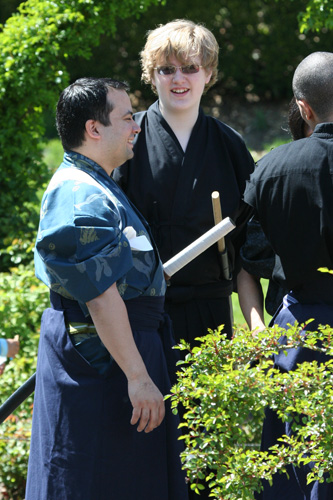
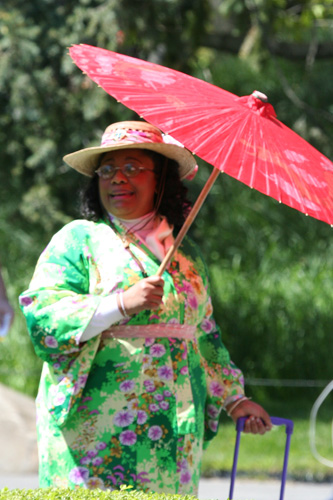
    How awesome is this lady’s kimono? My wife wore a vintage Haori that we bought in a second hand store in Arashiyama.

    Those without cromulent attire can compensate with appropriate coiffure.

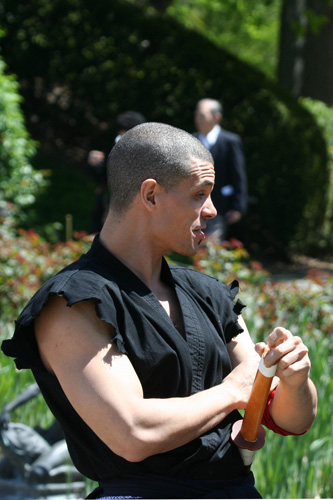
    Brooklyn badass samurai, wearing dark sunglasses

    and cutoff kimonos.

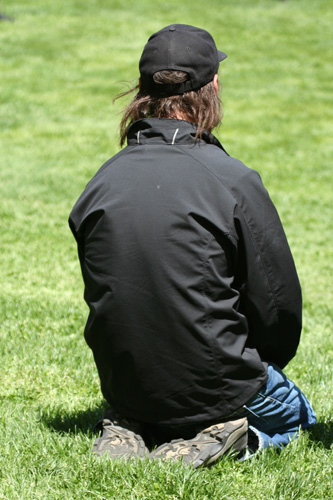
    There’s some meditatin’ going on.

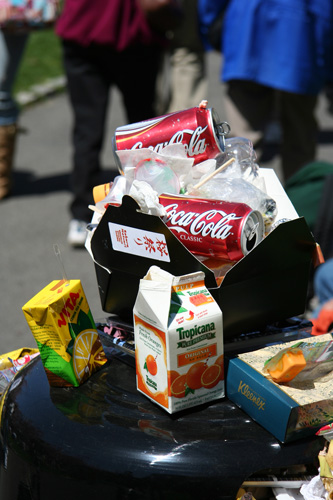
    And mingling of food.

    In the end, you can appreciate the cherry blossoms amongst the throngs of people, just like in Japan. It’s that just that the cops won’t let you get drunk under the cherry trees, like they do in Japan.

  • Bolivian Cup of Excellence

    I am sitting here, reading my blogroll, having a double espresso out of a special cup (“on loan” from a certain European monarch’s palace). The espresso is made from Bolivian Cup of Excellence Juan de Dios Blanco that has the following sad story:

    Juan de Dios Blanco, the grower of this #1 ranked Bolivian Cup of Excellence Coffee, passed away in a car crash less than a week after his coffee was awarded the highest dollar amount ever paid for a Bolivian Coffee.

    Victrola Coffee staff describe the flavor like this:

    This coffee is a mind blower. It is wonderfully sweet with layers of butterscotch, honeysuckle, orange marmalade, dark chocolate and toffee. It is silky on the tongue with a nice, clean finish. Add a drop of cream and there will be no need for dessert.

    You’d think this is a load of bull, but no, not so much. I have no idea what honeysuckle and toffee tastes like, but it definitely tastes a little bit like dark chocolate and orange rind. And it is sweet, even though I could not bring myself to throw out the first shot which never comes out right (that does add a bit more acidity than I’d like).

    And now I want is some grilled cheese.

  • Perfect Workmanship

    Perfect workmanship is expensive. Why? Because it means starting over or laboriously fixing tiny little imperfections. Joel Spolsky describes this very nicely in his article about craftsmanship:

    “The moral of the story is sometimes fixing a 1% defect takes 500% effort. This is not unique to software, no sirree, now that I’m managing all these construction projects I can tell you that. Last week, finally, our contractor finally put the finishing touches on the new Fog Creek offices. This consisted of installing shiny blue acrylic on the front doors, surrounded by aluminium trim with a screw every 20 cm. If you look closely at the picture, the aluminium trim goes all the way around each door. Where the doors meet, there are two pieces of vertical trim right next to each other. You can’t tell this from the picture, but the screws in the middle strips are almost but not exactly lined up. They are, maybe, 2 millimeters off. The carpenter working on this measured carefully, but he was installing the trim while the doors were on the ground, not mounted in place, and when the doors were mounted, “oops,” it became clear that the screws were not exactly lined up.”

    I was recently reading a book by Tracy Kidder called “House”. It’s a great book by the same Tracy Kidder who wrote “The Soul of a New Machine”. “The Soul” is a book about computer architects and builders. “House” is about their counterparts in the business of building houses. In one book Kidder describes the extremely stressful process of designing and building an Eclipse MV/8000 minicomputer. In the other he describes the similarly stressful process of designing and building a Greek Revival house.

    Both books read like a work of fiction, but they are absolutely factual, written about real people and real products. It’s very strange to be able to go and look up characters that became so familiar thanks to those two books. Steve Wallach from “The Soul” went on to form his own company, Convex Computer, sold it to HP in 1995 and is now a venture capitalist. You can even look up what he looks like now.

    Bill Rawn from “The House” heads a big architectural firm of his own. Going there and seeing the buildings that he’s built after the house in the book is somewhat strange: he feels like a literary character, yet there he is, many years later after the events of the book took place. Souweine House, Amherst, MA is listed in the awards section of the website, but unfortunately there is no photo of it.

    Interesting to note that while the Eclipse minicomputers are probably worthless now, the Souvweine House must be worth a tidy sum of money.

    While building the Souweine house, the builders made a mistake concerning the frieze, an important architectural element. They go on to fix it, but in order to do it perfectly, they’d have to rip everything out and start anew, which is just like in Joel’s door trim case is prohibitively expensive.

    “Jonathan feels sorry for the trouble the frieze caused, but not for the little imperfection it represents. No one else will see it, but Bill has said that even when repaired, the frieze won’t quite reproduce his intentions. Orthodox Jews have a tradition that until the Temple in Jerusalem is rebuilt, they will not erect a house or a building without giving it one deliberate imperfection. Though not a member of the Orhodox branch of Judaism, Johnathan believes in the inevitability of imperfection. So why not celebrate it? “There’s a flaw in the house …,” he says, and flashes a smile, a shooting star of a smile, “… which the pernicious part of me sort of likes.””

    By the way, I can’t pass up mentioning my favorite, but apparetly later edited out, quote about Kidder. “For a woman, Tracy really know her stuff and gets into a great amount of hardware detail”. What do you think the source for it is?

  • The Torah Code

    There’s a sequence in Darren Aronofskiy’s “Pi” when the protagonist, mathematician Maximilian Cohen is induced by a Hasidic Jew to on something called Tefillin. Here’s a frame from the movie:
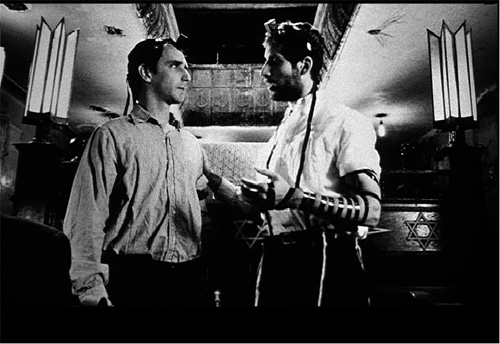
    For an ancient Jewish religious artifact, the two black leather boxes and straps used in prayer, are very strange looking and science-fictiony. I decided to do a bit of research on them, and came upon a lot of very interesting stuff. I’ve made a lot of notes, but for years I did not have the time to sit down and actually write this post.

    Tefillin is a very curious Jewish religious artifact, similar to a few others, such as Sefer Torah and Mezuzah. What they have in common is the exactitude in which they reproduce holy texts in hand-written form.

    Scott Adams nicely summarized the problem of propagating holy writing in his recent post:

    I never knew that there are about a zillion different versions of the Bible because (and I am summarizing Ehrman’s entire book here) it was copied and recopied by hand, by semi-literate, opinionated morons for hundreds of years. Sometimes the copiers left stuff out, sometimes they added their own explanations where things didn’t seem to make sense, and other times they simply made errors.

    This, of course, brings to mind the old joke about a novice monk who asks his superior about the possibility of mistakes in the holy books that the monks in his monastery have been copying by hand for centuries. The head monk goes to check the originals hidden away in a vault. Having not heard from him for days, the novice monk goes to check on the old monk and finds him hunched over the old books crying and saying the same phrase over and over. “The word is ‘celebrate‘ !”

    The Hasidic Jew from “Pi” was a Torah numerologist. See, the Torah is considered to be the literal word of God as given to Moses, exact to a letter. Hebrew letters have numerical values, so Torah can be treated as a string of numbers that might contain hidden patterns, encoded messages, maybe even computer code. Exactitude is very important here – a single letter might change everything, like in a computer program or a cyphered message. Or like removing the letter “r” from the word “celebrate”.

    The practice of using Tefillin comes from a literal understanding of a passage in the Torah, Deuteronomy 6:8.

    “And these words, which I command thee this day, shall be in thine heart:

    And thou shalt bind them for a sign upon thine hand, and they shall be as frontlets between thine eyes.”

    What seems to be a poetic metaphor about the importance of the holy writing, is taken literally here, prompting the creation of an artifact consisting of two black leather boxes containing scrolls with passages from the Torah to be worn bound to a hand and forehead with leather straps.

    If you’ll go shopping for a set of Tefillin, you might be surprised at how much they cost. The cheapest set from a reputable place will set you back at least several hundred dollars, with better made ones costing in the thousands of dollars. Why? Because of the excruciatingly exact way they are supposed to be made.

    The leather cases and straps need to be made from Kosher parchment and to pretty exact specifications. The cheaper ones are made from glued pieces of leather, the more expensive ones are made out of single pieces of leather, either folded using what one website calls “Jewish origami” or pressure-molded by special presses. The latter are considered more kosher.

    But the cases are a small part of the value of the Tefillin. The handwritten scrolls are what’s expensive. Scribes (Sofer) who are qualified to make kosher Tefillin are few and far between, and not only because they are supposed to a God-fearing, religious Jews of high moral fibre. The letters on the scrolls are small, but have to be perfectly formed in a rather complicated font, of which there are several varieties. There can’t be a single mistake, not even in a part of a letter.

    There are certain prayers that have to be said. Letters have to be written in a precise order. They can’t touch each other, holes or edges of the parchment. Parts of the letters can’t be erased and they have to be perfectly formed. The parchment has to be properly prepared, a proper quill pen and specially formulated ink has to be used.

    These are just some basic rules that I gleaned from various websites. Apparently they rules are so complicated that even experienced scribes are sometimes baffled at subtleties of writing these scrolls. When in the middle of a laborious process of writing a scroll, they sometimes come to consult a specialist called a posek rather then throwing away their work and starting anew. Even a specialist is sometimes not sure if a letter is correctly formed. What happens then is rather interesting:

    “Shailos tinok is a query presented to a child. Occasionally a posek will be in doubt how to render a decision, psak. […] He will suggest that a child […] who knows the letters of the Aleph – Bais but has not yet learned to read, be asked. Such a child sees nothing other than the form before him and can judge without any influences.”

    There are literally thousands of ways in which the tiniest imperfection can completely invalidate a Tefillin. And religious Jews take this commandment very seriously, so making of Tefillin is in no danger of being outsourced to China despite the high availability of good calligraphers there.

    There’s even a dispute as to in what order the scrolls need to be put into the cases. Most rabbis agree, but still, there are some who put two pair of Tefillin at once, made in two different ways. Kind of like Ned Flanders who “kept kosher just to be on the safe side”.

    On the cynical side, there’s a phenomenon referred to as “Tefillin date”. Some hypocritical Jews take their Tefillin with them when they go on a date, planning to spend the night, and while breaking the pretty clear “no sleeping around” rule, not breaking “pray with Tefillin in the morning” rule.

    Sefer Torah is a full length Torah (about 300,000 letters) written on a scroll in to specifications that are similar to the making of Tefillin. While writing Tefillin scrolls might take experienced scribe 2-3 days, Sefer Torah is often a lifetime project. Their cost ranges from tens of thousands of dollars to millions of dollars.

    This exacting standard of copying is what made the modern Torah scrolls match almost exactly the texts dating back to before 100 BC found in the Dead Sea scrolls.

    If you ever lived in New York City, you must have seen a mezuzah, the third and simplest of the Torah scroll artifacts. It comes from a literal understanding of Deuteronomy 6:9

    “And thou shalt write them upon the posts of thy house, and on thy gates.”

    Mezuzah takes a form of a decorated case containing a scroll nailed to a doorpost. On almost every floor of almost every apartment building in New York you’ll find at least one door with a mezuzah. In some, like in mine, almost every door has one. The variety of the decorative cases is astounding. There are big ones, small ones, ornate ones, simple ones. They are made of plastic, wood, metal. Most are left by tenants of long ago. Many are painted over. In many cases I see voids in paint where mezuzah used to be.

    The one left to me seems somewhat old, probably left by the original owners of the apartment. On the back it has the original orange paint which is not out of character for my Art Deco building. I bet it dates to the 50s or 60s (can’t be much older than that because it’s “Made in Israel”).
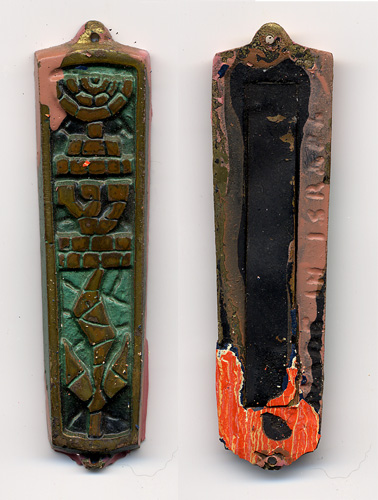
    What makes it absolutely invalid, of course, is the lack of the handwritten scroll inside. In fact, this is the case with most mezuzot you’ll find in New York. The case might be pretty, but the scroll inside takes at least a few hours of scribe’s work and costs from 30 to 100 dollars.

    Even though I am not an observant Jew, one of these days I’ll replace my mezuzah case with a titanium one and buy a real scroll. Also, I want to put on a Tefillin once. All I have to do is find the nearest mitzvah tank, but Hasidim make me feel uneasy.
  • Cats and the Home Office

    My home office is located in the living room these days, across from my wife’s harpsichord and organ. It consists of a sprawling Ikea GALANT desk with office supplies, computer equipment and cats covering most of its surface.

    In particular, I have a Sharp AM-900 Digital Office Laser Copier/Printer/Fax/Scanner that I bought on Amazon for two hundred-something dollars. Basically it’s a decent standalone copier, an ok fax (I am not sure if it can actually print out confirmations). As far as printer and scanner functions go, the drivers are rather crunchy – I have to frequently unplug/reinstall them which is a major bummer. Also, Sharp does not have the drivers available online, so I have to keep the installation cd on my hard drive. But the copier and fax functions alone are worth that money, so I am glad I got it.

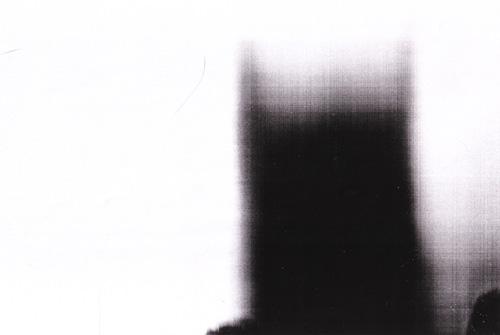
    What I am not glad about is that Tilde the Cat figured out how to press the copy button. She was always fascinated by the printer noise, but now she learned how to produce it. Here’s her self-portrait. She pressed the button and looked at the pretty moving light. Now I’ll have to make an anti-cat button cover, like those on most of my power strips (I make them out of duct tape and steel corners).

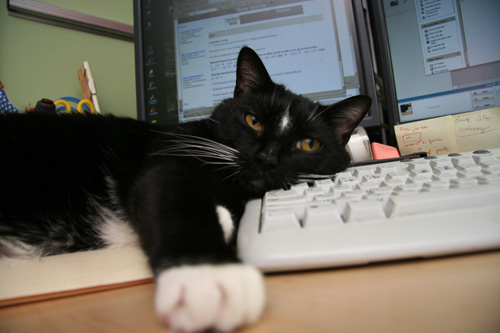
    Gary the Cat, on the other hand likes to use the keyboard as his pillow. He knows that sooner or later he’ll be able to rest his face on my left hand.